Quick summary
SEO is working if more of the right people are finding your website through Google, landing on your important pages, and starting to take action like enquiring or buying. It often feels slow at first because nothing visible happens while Google is still processing your site, but you should start seeing early signs like impressions and small traffic increases within a couple of months, with real results such as leads or sales typically following after three to six months.
SEO can feel vague, especially in the beginning. You make changes, publish content, maybe fix a few technical things, and then nothing seems to happen. Or something happens, but you are not sure if it actually means anything.
The good news is this: you do not need to understand every technical detail to know if your SEO is working. There are a few simple signs that tell you very clearly if things are moving in the right direction.
What “working” actually means in SEO
Before looking at any numbers, it helps to define what success even looks like.
For a small business, SEO is not about rankings or graphs. It is about getting more of the right people to your website and turning some of them into enquiries or sales.
That means SEO is working when more people are finding your site through Google, they are landing on pages that actually matter to your business, and some of them are taking action.
If those things are not improving over time, then something in your SEO needs adjusting.
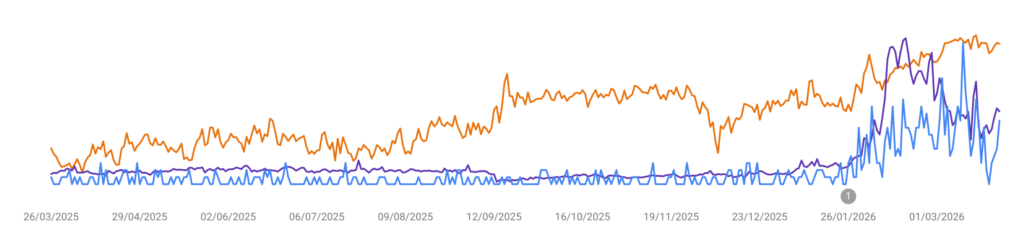
This chart shows a clear turning point after SEO work started in January.
Before January, everything is fairly flat. Impressions (orange) are slowly increasing, but clicks (blue) and average position (purple) are low and stable, which suggests Google was aware of your site but not prioritising it.
From late January onwards, you can see a noticeable shift. Impressions rise more consistently, rankings improve (purple line climbing), and clicks become more frequent and volatile. That spike in clicks is a strong sign that your pages have started ranking for more relevant searches and are being shown to more people.
This is exactly what you want to see: first impressions grow, then rankings improve, and then clicks follow. It shows your SEO work is starting to gain traction and move out of the “nothing is happening” phase into real visibility.
Why does SEO feel slow at the start?
One of the hardest parts when you’ve hired an SEO agency is that early phase where it feels like nothing is happening. You’re investing time and money, but you’re not seeing obvious results yet, which can be frustrating.
Behind the scenes, though, a lot is going on. Your website is being reviewed, improved, and repositioned so Google can properly understand it. At the same time, Google is reassessing your site, crawling updated pages, and comparing it to competitors before making any noticeable changes in rankings.
This is why SEO often feels slow at first and then suddenly picks up. It is not random or inconsistent. It is a gradual build-up of trust and signals, and once that reaches a certain point, you start to see movement all at once.
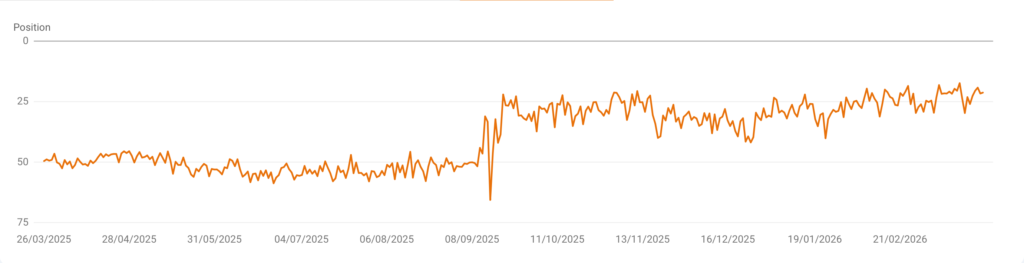
Another example – local service business
These Google Search Console stats are from another client. Here’s what we did to improve their rankings:
- SEO tasks completed in August 2025
- Fix technical issues on their website
- Put technical SEO in place
- Optimised individual pages
How to check if SEO is working?
Instead of trying to make sense of lots of different metrics, focus on a few simple checks each month. Your SEO agency should be able to provide clear reports that answer these for you.
Ask for a monthly report that shows:
- overall website traffic (how many people are visiting)
- how much of that traffic is coming from Google (organic search)
- which pages people are landing on first (landing pages report)
- how many enquiries, calls or form submissions are coming through (this can be recorded either through Google Analytics, or by collecting form submissions on your website)
When you review this, you are looking for steady progress. More people finding your site through Google, landing on the right pages, and starting to get in touch.
This keeps the focus on real business results rather than getting lost in technical data or vanity metrics.
June–August 2024 SEO work: how a 3-month project can deliver results for years to come
This chart shows how traffic to the website has grown over time, broken down by where visitors are coming from.
The dark blue section represents organic search, which is the result of SEO work. You can see that before June 2024, organic traffic is relatively low and steady. During the three months of SEO work (June, July, and August 2024), there is a noticeable lift starting to build.
What is important here is what happens after that. Even though SEO work stopped after August, organic traffic continues to grow month after month. By early 2025 and into 2026, it has increased significantly and becomes the largest and most consistent source of traffic.
This is a good example of how SEO works over time. The initial work lays the foundation, and then Google continues to build trust in the website, which leads to ongoing growth even without constant input.
You can also see that other traffic sources like direct, social, and paid activity fluctuate more. Organic search, however, shows a steady upward trend, which is exactly what you want from SEO.
In simple terms, a short period of focused SEO work has created long-term growth, and the results have continued to compound well beyond those initial three months.
The key website stats that actually matter
There are a handful of metrics that tell you most of what you need to know. You do not need to become an expert in analytics to use them.
Unique visitors
This is simply the number of individual people visiting your website.
It gives you important context. If very few people are visiting your site, then the issue is visibility. Your SEO is not bringing people in yet. If lots of people are visiting but no one is getting in touch, then the problem is not SEO. It is what happens after they arrive.
This is often the first place to look because it helps you understand which problem you are dealing with.
If very few people are visiting your site, then you have an SEO problem. If lots of people are visiting but no one is getting in touch, then you have a website problem.
Traffic sources
This tells you where your visitors are coming from, such as Google search, social media, or people typing your website directly.
If you are putting effort into SEO, you should gradually see more visitors coming from organic search. If that number stays flat, it usually means your SEO work is not yet effective or not focused in the right places.
It is a simple but powerful way to check if your efforts are actually driving people to your site.
Entry pages
An entry page is the first page someone lands on when they visit your website.
This is important because it shows which pages Google is sending people to. Ideally, your main service pages or helpful blog posts should appear here. These are the pages you want potential customers to see first.
If your key pages are not showing up, it may mean they are not ranking well or not attracting clicks. Both can be improved, but it is useful to know where the issue is.
Top visited pages
Once people are on your site, this shows which pages they look at most.
This helps you understand what visitors are interested in. If many people end up on your service or pricing pages, it suggests they are seriously considering working with you. If they never reach those pages, it may be harder for them to find what they need.
This is where SEO and website structure come together. Getting traffic is only the first step. Guiding people to the right places is just as important.
Views per visit
This shows how many pages someone looks at during one visit.
On its own, this number does not tell the full story. Someone might visit one page and contact you straight away, which is a great result. But if most people only view one page and leave without doing anything, it can be a sign that your content is not engaging or not guiding them forward.
It helps you understand how people move through your website and if they are finding what they need.
Bounce rate explained (and why it is less important now)
Bounce rate used to be a common metric in Google Analytics. It showed the percentage of people who landed on a page and then left without clicking to another page or taking any tracked action.
For example, if someone visited your website, read a page, and then left without clicking anything else, that would count as a bounce.
The problem is that this can be misleading. Someone might land on your page, get exactly what they need, and then leave. That is actually a good outcome, not a bad one.
Because of this, Google changed how engagement is measured.
When Google Analytics 4 was introduced in October 2020, bounce rate was removed and replaced with a more useful metric called engagement rate.
Engagement Rate (much more important today)
Instead of focusing on people leaving, it focuses on whether visitors are actually engaging with your site.
Instead of worrying about bounce rate, it is better to look at whether people are spending time on your site and whether they are taking actions such as clicks, enquiries, or downloads.
For a small business, the key question is not “did they bounce?”, but “did they do something that moves them closer to becoming a customer?”
What is engagement rate and what should you aim for?
Engagement rate is a metric in Google Analytics 4 that shows how many people actively interact with your website, rather than just landing on a page and leaving.
A visit is counted as “engaged” if someone does at least one of the following:
- stays on your website for more than 10 seconds
- views more than one page
- completes an action such as clicking a button, submitting a form, or downloading something
This makes it much more useful than bounce rate, because it focuses on whether visitors are actually doing something meaningful on your site.
What is a good engagement rate
For most websites, a good engagement rate is typically between 50% and 70%.
For local service businesses, it is often slightly lower, especially if people land on a page and quickly get in touch. In those cases, a lower engagement rate is not necessarily a problem if enquiries are coming through.
The key is not to aim for a perfect number, but to understand what is normal for your website and look for improvement over time.
When should you take action
If your engagement rate is consistently below 40%, it is usually a sign that something is not working.
This could mean:
- your page does not match what people were searching for
- the content is not clear or engaging
- the page is slow or difficult to use
- there is no clear next step for the visitor
On the other hand, if your engagement rate is healthy but you are not getting enquiries, the issue is more likely to be your offer or conversion process rather than your SEO.
The most important thing is to look at engagement alongside enquiries. High engagement with no action means something is missing. Lower engagement with strong enquiries can still be a success.
How long should you wait before judging SEO
SEO does take time, but not everything takes the same amount of time.
Small technical fixes can show results quite quickly. You might see improvements in days or weeks. Getting your pages indexed and starting to appear in search results can take a few weeks. Traffic growth usually takes a few months.
The part that most people care about, leads and sales, tends to take longer. This is because your pages need to rank well and match what people are actually searching for.
As a rough guide, you should expect to see early signs within the first couple of months. If nothing at all has changed after three months, it is worth reviewing your approach. By six months, you should be seeing clear progress if things are done properly.
Misleading SEO metrics to watch out for
Some SEO reports can look impressive but do not actually tell you if your business is growing. These are the metrics often used to keep clients paying without showing real results.
Keyword rankings (without context)
Agencies may show you that your site ranks for lots of keywords, but these are often low-value or irrelevant searches that bring no real customers.
Impressions
Impressions show how often your site appears in search results, but they do not mean people are clicking or becoming customers.
Traffic without intent
An increase in traffic sounds good, but if visitors are not the right audience, it will not lead to enquiries or sales.
SEO “score” tools
Some tools give your website a score out of 100. These can be useful for basic checks but do not reflect real-world performance or results.
Number of backlinks
Agencies might highlight how many links they have built, but quantity does not matter if the links are low quality or irrelevant.
Domain authority or similar scores
These are third-party metrics and not used by Google. They can move without any impact on your actual rankings or enquiries.
Pages indexed
Having more pages indexed does not mean better SEO if those pages are not useful or not ranking.
Time on site
Longer time on site can look positive, but it does not always mean people are closer to becoming customers.
Bounce rate in isolation
This can be misleading, especially for pages where users get what they need quickly and leave.
Reports full of activity
Some agencies list everything they have done, such as blog posts, audits, or technical fixes, without showing what impact those actions had.
The bottom line
If a report does not clearly show how SEO is contributing to enquiries, leads, or sales, it is focusing on the wrong things.
What should a good SEO report include?
A proper SEO report should be easy to understand and clearly show whether your business is moving in the right direction. It should focus on results, not just activity.
1. Organic traffic
This shows how many people are coming to your website from Google. You should be able to see if this is increasing over time.
2. Traffic sources
A breakdown of where visitors are coming from, with a clear focus on organic search. This helps you see if SEO is actually driving traffic.
3. Landing pages
This shows which pages people land on first from Google. Your key service or product pages should appear here.
4. Conversions
This is one of the most important parts. The report should show how many enquiries, calls, or sales are coming from your website.
5. Conversion rate
This tells you how well your website turns visitors into enquiries. It helps you understand if the traffic is the right quality.
6. Search Console data
This should include impressions and clicks, showing how often your site appears in search and how often people click through.
7. Keyword trends
Not a long list of keywords, but a simple overview showing if your important keywords are improving over time.
8. Top performing pages
A summary of which pages are bringing in the most traffic and enquiries, so you know what is working.
9. Clear insights and next steps
The report should explain what is working, what is not, and what will be done next. It should not just be a list of tasks completed.
If a report does not clearly connect SEO activity to real business results, it is not a useful report.
A simple way to think about SEO
SEO is not about chasing numbers. It is about connecting your business with people who are already looking for what you offer.
When more of those people find you, land on the right pages, and start getting in touch, your SEO is doing its job.
Everything else is just a way of measuring that.