Facebook Pixel

How do I know if my email marketing is working?

Quick summary

Email marketing is working when people open, click, and stay subscribed. Aim for a 30–40% open rate, 2–5% click rate, under 2% bounce rate, and under 0.5% unsubscribe rate. Benchmarks vary a lot by industry, so always compare your results to similar businesses, not generic averages.

Email marketing works best when you measure the right things. Looking only at how many emails you sent does not tell you much. The more useful question is this: are people opening, clicking, staying subscribed, and actually receiving your emails?

The main KPIs to watch are open rate, click rate, click-to-open rate, bounce rate, unsubscribe rate, and deliverability. The exact benchmark depends on your industry, your list quality, and the type of emails you send. That said, there are still useful standards you can compare your performance against.

The main email marketing KPIs to track

Open rate

Open rate is the percentage of delivered emails that people open. Salesforce defines it as unique opens divided by delivered emails, multiplied by 100. ActiveCampaign says a solid baseline open rate falls between 30% and 40%, and its customers averaged 39.26% across campaigns sent between 1 January 2025 and 10 December 2025. MailerLite reported a 2025 average open rate of 43.46% across 3.6 million campaigns. (source) (source) (source)

Click rate

Click rate, often called click-through rate or CTR, is the percentage of delivered emails that generated at least one click. Salesforce defines CTR as clicks divided by delivered emails, multiplied by 100. MailerLite found an average click rate of 2.09% in 2025, while WebFX cites a broader overall average of 2.44%. ActiveCampaign’s 2025 customer data is much higher at 6.21%, but that includes all campaign types and reflects a more engaged customer base. (source) (source) (source) (source)

Click-to-open rate

Click-to-open rate, or CTOR, measures how many of the people who opened your email also clicked. This is useful because it tells you how strong the content inside the email was. MailerLite reported a 2025 average CTOR of 6.81%, with industry benchmarks ranging from 2.96% to 14.82%. (source)

Bounce rate

Bounce rate is the percentage of emails that could not be delivered. ActiveCampaign says a good average email bounce rate is below 2%, and a bounce rate below 1% is ideal. VerifiedEmail also notes that less than 2% is generally healthy, while more than 5% is a danger sign that can damage sender reputation. (source) (source)

Unsubscribe rate

Unsubscribe rate is the percentage of recipients who opt out after receiving your email. MailerLite reported a 2025 average unsubscribe rate of 0.22%. ActiveCampaign says anything below 0.5% is good, and below 0.2% is excellent. (source) (source)

Deliverability rate

Deliverability rate is the percentage of emails that successfully reach inboxes. ActiveCampaign cites EmailTooltester research saying a deliverability rate above 89% is good, and above 95% is excellent. (source)

What is a good benchmark for each KPI?

  • Open rate: 30% to 40% is a solid benchmark, and 40%+ is strong for many permission-based lists. (source)
  • Click rate: 2% to 5% is a useful general benchmark, although some platforms report higher averages. (source) (source)
  • Click-to-open rate: around 6% to 7% is a reasonable general benchmark, with 10%+ showing very strong content engagement. (source)
  • Bounce rate: keep it below 2%, and aim for below 1% where possible. (source) (source)
  • Unsubscribe rate: below 0.5% is good, and below 0.2% is excellent. (source)
  • Deliverability rate: above 89% is good, and above 95% is excellent. (source)

Why benchmarks vary so much

Email marketing benchmarks vary because not all datasets are measuring the same thing. Some reports are based on highly engaged subscribers using modern email platforms, while others include weaker lists, broader industries, or poorer list hygiene.

That is why one report can show an open rate around 43%, while another shows an overall average closer to 19%. WebFX, using a mix of benchmark studies, reports an average open rate of 19.21%, average click-through rate of 2.44%, average unsubscribe rate of 0.89%, and average bounce rate of 2.48%. MailerLite, by contrast, reports a 43.46% open rate, 2.09% click rate, and 0.22% unsubscribe rate in its 2025 dataset. (source) (source)

Email marketing benchmarks by industry

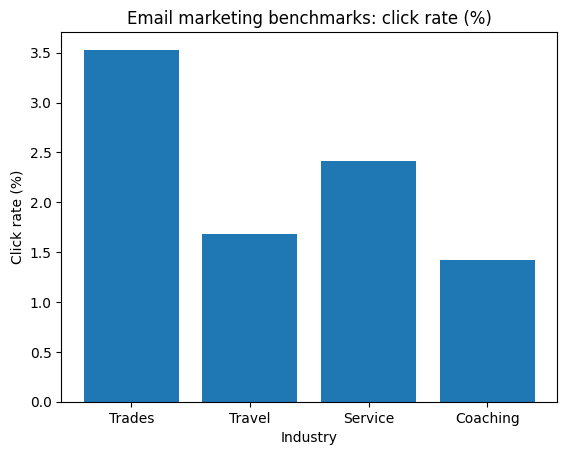
These following figures are based on aggregated industry data from multiple sources including MailerLite, ActiveCampaign and WebFX, and should be used as a general guideline rather than exact targets. Performance varies depending on list quality, segmentation and strategy.
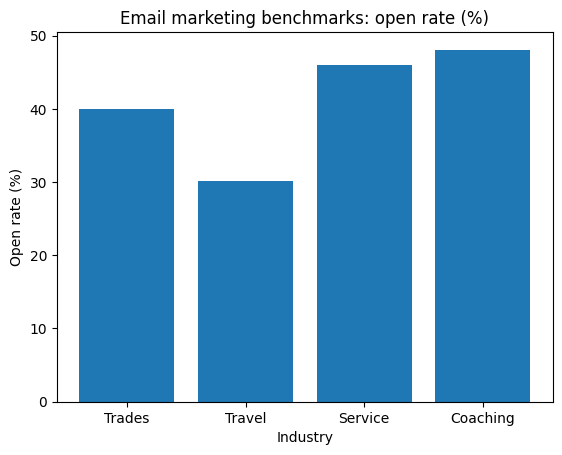
Email marketing benchmarks by industry - Open Rate (2026)

email marketing benchmark by industry - clickrate in 2026

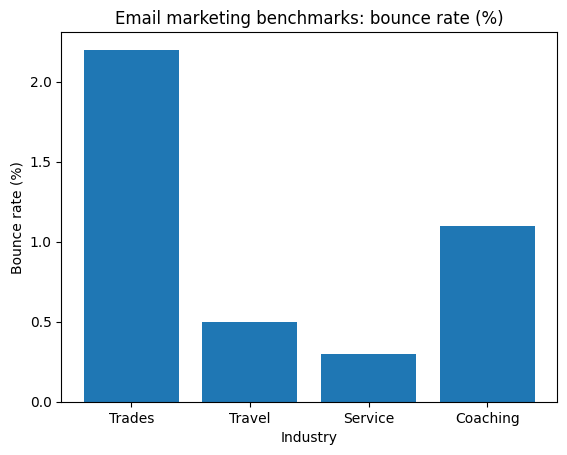
email marketing benchmark by industry - bounce rate in 2026

Trades and construction

If you work with trades, construction, landscaping, home improvement, or related services, construction is one of the most relevant benchmark categories.

  • MailerLite reports a 39.95% open rate and 3.53% click rate for construction. It also reports a very strong 12.38% click-to-open rate and a 0.27% unsubscribe rate. (source)
  • WebFX reports 22.40% open rate, 3.20% click-through rate, 0.30% unsubscribe rate, and 2.20% bounce rate for construction, contracting, and manufacturing. (source)
  • ActiveCampaign’s related real estate category shows a 39.87% open rate and 5.42% click rate. (source)

This tells you something important: open and click rates can be strong in trades and related sectors, but bounce rate becomes a bigger issue if your contact data is old or imported from multiple places.

Travel and hospitality

  • MailerLite reports that travel and transportation had the lowest open rate in its dataset at 30.10%, with a 1.68% click rate, 6.34% CTOR, and 0.13% unsubscribe rate. (source)
  • WebFX reports 15.70% open rate, 1.60% click-through rate, 0.10% unsubscribe rate, and 0.50% bounce rate for travel, hospitality, and leisure. (source)
  • ActiveCampaign reports a much stronger 40.87% open rate and 5.28% click rate for travel and hospitality customers on its platform. (source)
  • VerifiedEmail cites broader industry data showing 7.27% bounce rate for travel and tourism in a messier real-world dataset. (source)

Travel is a good example of why averages can mislead. On a well-managed list, travel brands can perform well. On a neglected list, bounce problems can become severe very quickly.

Service businesses

Service businesses can cover consulting, agencies, health and fitness, healthcare, legal services, and other advice-led or relationship-led sectors.

  • MailerLite reports 45.96% open rate, 2.41% click rate, 7.67% CTOR, and 0.23% unsubscribe rate for consulting. (source)
  • MailerLite reports 47.81% open rate, 1.45% click rate, 4.45% CTOR, and 0.30% unsubscribe rate for health and fitness. (source)
  • WebFX reports 21.48% open rate, 2.69% click-through rate, 0.40% unsubscribe rate, and 0.30% bounce rate for health and fitness. (source)
  • ActiveCampaign reports 39.08% open rate and 7.05% click rate for consulting and agencies. (source)

For service businesses, high open rates often come from trust, authority, and relevance. Click rate can vary more depending on how action-focused the email is. A relationship-building email may get opened and read without driving many clicks.

Coaches, educators, and online training businesses

  • MailerLite reports 48.07% open rate, 1.42% click rate, 4.90% CTOR, and 0.30% unsubscribe rate for coaching. (source)
  • MailerLite reports 43.10% open rate, 1.39% click rate, 5.23% CTOR, and 0.23% unsubscribe rate for online courses. (source)
  • WebFX reports 23.40% open rate, 3.00% click-through rate, 0.20% unsubscribe rate, and 1.10% bounce rate for education. (source)
  • ActiveCampaign reports 39.06% open rate and 6.38% click rate for online training and education. (source)

Coaching and education often produce strong open rates because these businesses are built on trust and ongoing attention. Lower click rates do not always mean the emails are weak. Sometimes the value is delivered directly in the email, so the subscriber reads it without needing to click away.

How to tell if your email marketing is working

A good email strategy is not judged by one number alone. You need to look at the full picture.

1. Check if people are opening your emails

If your open rate is well below your industry benchmark, your subject lines, sender name, timing, or deliverability may need work. Open rate is still useful, but it is less reliable than it used to be because Apple Mail Privacy Protection can inflate opens. Salesforce specifically warns that privacy changes have made open rates less precise, which is why click-based metrics matter more now. (source)

2. Check if people are clicking

Clicks show action. If your emails are being opened but not clicked, your message may be interesting but not persuasive. MailerLite says click rate is now one of the most accurate indicators of newsletter engagement because it does not rely on open tracking. (source)

3. Check your click-to-open rate

If your CTOR is high but your open rate is low, your content is probably fine but not enough people are seeing it. That points to subject lines, targeting, or inbox placement. If CTOR is low, the problem is more likely inside the email itself. (source)

4. Check your bounce rate

If your bounce rate goes above 2%, that is a warning sign. If it climbs above 5%, it can damage deliverability and sender reputation. High bounce rate usually points to list decay, poor-quality imports, fake signups, or weak list hygiene. (source) (source)

5. Check your unsubscribe rate

A low unsubscribe rate does not always mean your emails are great, but a rising unsubscribe rate often means your content, frequency, or targeting is off. Anything above 0.5% deserves a closer look. (source)

What to watch out for

  • Inflated open rates: Apple privacy features can make opens look higher than they really are. (source)
  • Dirty lists: Old contacts and imported databases can push bounce rates up fast. (source)
  • Weak segmentation: Sending the same email to everyone usually hurts click rate. ActiveCampaign points to personalisation and segmentation as key reasons some senders outperform the average. (source)
  • Wrong comparisons: Do not compare a coach’s email results to an ecommerce brand or a travel company. Industry context matters. (source)

Simple benchmarks to use as a starting point

If you want a practical starting point, these are sensible targets for a healthy email marketing programme:

  • Open rate: aim for 30% to 40%+
  • Click rate: aim for 2% to 5%+
  • Click-to-open rate: aim for around 6% to 10%+
  • Bounce rate: keep it below 2%
  • Unsubscribe rate: keep it below 0.5%
  • Deliverability rate: aim for 89%+

These are not fixed rules. They are useful reference points. The real goal is to compare your results against your own industry, then improve steadily over time.

Is email marketing worth it?

Email marketing is working when the right people receive your emails, open them, click them, and stay on your list. That means you should stop looking at one KPI in isolation. Instead, track the full set of numbers together.

If your open rate is strong but clicks are weak, improve the content. If your clicks are solid but bounce rate is high, clean the list. If unsubscribe rate climbs, rethink your relevance and frequency. That is how you turn email marketing stats into useful decisions instead of vanity metrics.

Why email marketing is still one of the most effective marketing channels

Email marketing stands out because it gives you direct access to your audience. Unlike social media or search engines, you are not relying on algorithms to decide who sees your content. If someone is on your list, you can reach them whenever you choose.

It is also one of the most measurable channels available. You can clearly track open rates, click rates, conversions, and engagement, which makes it easier to see what is working and improve over time. Many other channels, especially social media, can be harder to measure accurately due to changing data and visibility limits.

Email marketing is also cost-effective. Once your list is built, the cost of sending emails is relatively low compared to paid advertising. This makes it a strong option for small businesses that want consistent visibility without ongoing ad spend.

Another key advantage is control. Your email list is an asset you own. Social media followers, on the other hand, belong to the platform. Changes in algorithms or platform rules can reduce your reach overnight, while your email list remains stable.

Email also performs well across the full customer journey. It can be used to attract new leads, nurture interest, build trust, encourage enquiries, and drive repeat business. Few other channels can support every stage in such a direct and personal way.

Finally, email marketing works particularly well when combined with other channels. It captures traffic from your website, social media, or ads and turns it into an audience you can continue to engage. This makes it not just another marketing channel, but a central part of a long-term strategy.

In simple terms, email marketing is effective because it is direct, measurable, cost-efficient, and owned by you. That combination is what makes it so powerful compared to most other marketing channels.

What is email marketing?

Email marketing is the use of email to build relationships, promote services or products, and encourage action from subscribers. It can be used to sell, educate, nurture leads, announce updates, and stay visible with your audience over time.

How does email marketing work?

Email marketing works by sending targeted emails to people who have chosen to hear from your business. You collect subscribers, group them by interest or behaviour, send relevant messages, and then measure results such as opens, clicks, conversions, and unsubscribes.

Why is email marketing important?

Email marketing is important because it gives you direct access to your audience without relying on social media algorithms. It helps you stay in touch, build trust, generate leads, increase repeat business, and turn interest into sales.

Is email marketing effective?

Yes, email marketing is effective when it is permission-based, relevant, and consistent. It works best when you send useful content to the right people at the right time instead of sending the same generic message to everyone.

Why use email marketing?

You should use email marketing because it is one of the most reliable ways to nurture leads and keep existing customers engaged. It is useful for building awareness, increasing enquiries, promoting offers, and encouraging repeat purchases.

What is email marketing in digital marketing?

Email marketing in digital marketing is a channel used to communicate directly with subscribers through newsletters, promotions, automated sequences, and sales emails. It sits alongside SEO, social media, paid ads, and content marketing as part of a wider strategy.

How do I start email marketing?

To start email marketing, choose an email platform, create a signup form, build a permission-based list, and decide what type of emails you will send. Then set a schedule, write useful content, and track your results so you can improve over time.

How do I do email marketing step by step?

To do email marketing step by step, first choose your platform and set up your list. Next collect subscribers, decide on your goals, write emails your audience actually wants, send them consistently, and review your KPIs such as open rate, click rate, and unsubscribe rate.

How do I use email marketing for my business?

You use email marketing for your business by sending emails that support your goals. That might mean nurturing leads, booking calls, promoting services, encouraging repeat sales, sharing advice, or keeping past customers engaged.

How can email marketing help my business?

Email marketing can help your business by keeping you visible to people who are already interested in what you do. It can increase enquiries, improve customer retention, strengthen trust, and give you a simple way to promote offers or share valuable advice.

How can email marketing support my overall marketing strategy?

Email marketing supports your overall marketing strategy by helping you turn website visitors and social media followers into subscribers you can contact directly. It also helps move people from awareness to enquiry to sale through regular, relevant communication.

How do I create an email marketing campaign?

To create an email marketing campaign, define the goal, choose the audience, write a clear subject line, create the email content, include a strong call to action, and send it at a suitable time. After sending, review performance to see what worked and what needs improving.

How do I use email marketing for sales?

You use email marketing for sales by guiding subscribers towards a decision with relevant content and clear calls to action. That can include welcome sequences, product or service education, testimonials, limited offers, and follow-up emails based on clicks or behaviour.

When is the best time to send a marketing email?

The best time to send a marketing email depends on your audience, but mid-week often performs well. The real answer is to test different days and times with your own list because your subscribers may behave differently from general benchmarks.

What is a good open rate for email marketing?

A good open rate for email marketing is usually around 30% to 40%, although this varies by industry and list quality. A strong open rate suggests your subject lines, sender name, and audience targeting are working.

What is the average open rate for email marketing?

The average open rate for email marketing varies depending on the data source and industry. As a practical rule, many businesses use around 30% to 40% as a useful benchmark, but the most important comparison is with businesses similar to yours.

What is a good click rate for email marketing?

A good click rate for email marketing is often around 2% to 5%, though some industries perform higher. Click rate matters because it shows whether people are taking action, not just opening the email.

How do I increase my email click rate?

To increase your email click rate, make your emails more relevant, keep the message focused, and use a clear call to action. Better segmentation, stronger copy, and more useful offers usually improve clicks faster than changing button colours or layout.

What is email marketing automation?

Email marketing automation is the use of software to send emails automatically based on timing, behaviour, or subscriber actions. Common examples include welcome emails, abandoned basket emails, follow-ups, and lead nurture sequences.

How do I automate email marketing?

To automate email marketing, set up trigger-based email sequences inside your email platform. Start with simple automations such as a welcome sequence, enquiry follow-up, or lead magnet delivery, then build more advanced flows based on behaviour.

What is triggered email marketing?

Triggered email marketing is email sent automatically when someone takes a specific action or meets a condition. Examples include signing up to a list, downloading a freebie, clicking a link, booking a call, or leaving items in a basket.

What is segmentation in email marketing?

Segmentation in email marketing means dividing your email list into smaller groups based on things like interests, behaviour, location, or stage in the buying journey. It helps you send more relevant emails, which usually improves opens, clicks, and conversions.

What is personalisation in email marketing?

Personalisation in email marketing means tailoring the email to the subscriber. That could include using their name, referring to their interests, sending based on behaviour, or showing content that matches what they are likely to care about.

What is A/B testing in email marketing?

A/B testing in email marketing means comparing two versions of an email to see which performs better. You might test subject lines, calls to action, send times, layouts, or offers to improve results based on real data.

What is split testing in email marketing?

Split testing in email marketing is another term for A/B testing. It means sending different versions of an email to small test groups, then using the winning version more widely.

How do I collect email addresses for marketing?

You collect email addresses for marketing by giving people a clear reason to subscribe and using opt-in forms on your website, landing pages, or booking process. Good incentives include useful guides, discounts, updates, or exclusive tips.

How do I get email addresses for free?

You can get email addresses for free by adding signup forms to your website, social profiles, and content, then offering something valuable in return for subscribing. The best approach is always permission-based rather than buying or scraping lists.

How do I build an email list?

To build an email list, offer something your audience genuinely wants and make it easy to sign up. Then promote your signup form through your website, blog, social media, lead magnets, events, or customer enquiries.

How do I check competitors’ email marketing?

You can check competitors’ email marketing by signing up to their lists, reviewing what they send, how often they send, what offers they promote, and how they structure their emails. This helps you spot patterns, gaps, and opportunities without copying them.

How much does email marketing cost?

Email marketing costs vary depending on the size of your list, the platform you use, and whether you do it yourself or hire someone. Costs usually include software, strategy, copywriting, design, automation setup, and ongoing campaign management.

How much does email marketing cost in the UK?

Email marketing costs in the UK depend on the provider and the level of support you need. A small business doing it in-house may only pay for software, while a business hiring a freelancer or agency will usually pay extra for planning, setup, writing, and reporting.

How much does email marketing cost per month?

Email marketing can cost very little per month for a small list if you manage it yourself, but the monthly cost rises with list size, automation needs, and outside support. Businesses paying for strategy and regular campaign management should expect higher monthly fees than software alone.

How much should a freelancer charge for email marketing?

A freelancer should charge for email marketing based on experience, deliverables, and complexity. A one-off newsletter, a monthly campaign package, and a full automation setup all need different pricing because the workload and value are very different.

How do I do email marketing for free?

You can do email marketing for free by using a platform with a free plan, building a small permission-based list, and sending simple but useful emails yourself. Free tools are enough to get started, but paid plans are usually needed as your list and automation needs grow.

nadin 2026

Hi, I’m Nadin Thomson. I run Business Image Services Ltd, a web desgin & Local SEO agency in Dunfermline, Fife.

We design and support high-converting B2B websites for trades and service-based businesses across the UK.

Our work combines clear, customer-focused design, strong SEO foundations, and ongoing improvements that win trust and help turn visitors into enquiries.

I’ve been building websites since 1999, and for 20+ years I’ve helped organisations of all sizes improve their online presence with clear, strategic sites that generate leads.

I work in both English and German, which is helpful for clients who serve mixed-language audiences or want their messaging to feel natural in both languages.

I hold a university business degree and a postgraduate diploma in digital marketing.

Find out more about Business Image

Explore more

Stop renewing domain names Google doesn't care about
Is WordPress safe for my business website
How long does it take for a blog to get traffic?
How we launched a local business website in record time Thai Massage Stirling
How to fix an outdated website without a full redesign
Name servers, DNS & Hosting for beginners
How I write blog posts that rank actually in Google
WordPress 7.0 released 20 May 26
Does domain authority actually matter, or is it meaningless in 2026?
27 landing page optimisation tips that increase conversions