Quick summary
Marketing a new business does not mean trying to be everywhere or spending thousands on advertising. Start by understanding who your customers are, what problem you solve and where those people are likely to look for you. Make it easy for them to find you, build trust and get in touch, then focus on one or two marketing activities you can realistically maintain. Track where your enquiries come from, learn what works and build from there.
Starting a business is one thing. Finding customers is another.
You may have registered your business, chosen a name, set up a website and created a few social media accounts. Then you reach the point where you realise people aren’t simply going to find you because the business now exists.
So you start researching marketing.
And suddenly everybody has an opinion.
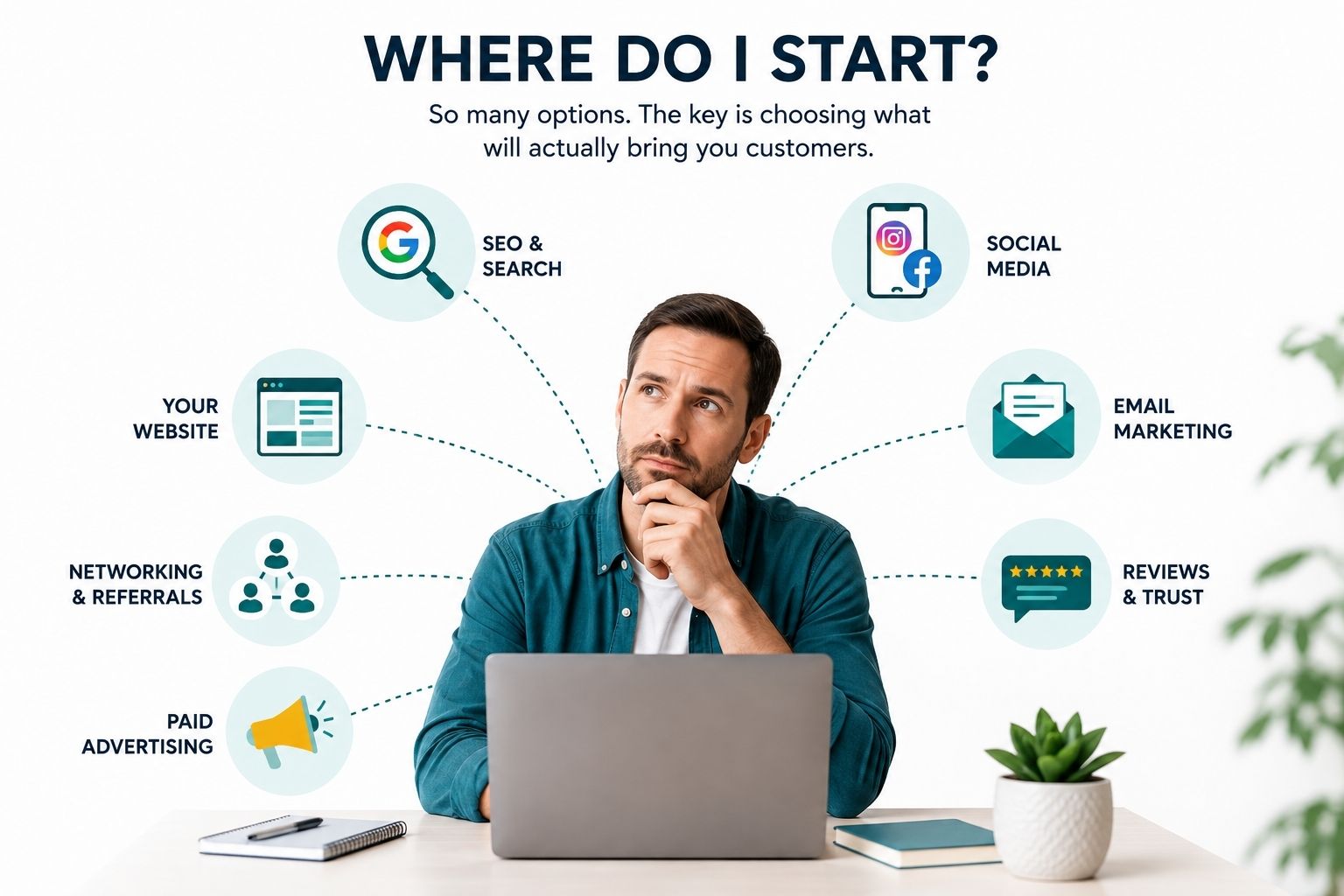
You need to be on Instagram. You need SEO. Start a TikTok account. Run Google Ads. Build an email list. Go networking. Post on LinkedIn. Start blogging. Create videos. Get reviews. Try Facebook Ads.
Before long, marketing starts to look like a full-time job in itself.
It doesn’t need to be.
The important thing when you’re starting out isn’t to do as much marketing as possible. It’s to understand who you’re trying to reach, what you want them to do and which activities are most likely to help you get there.
This guide looks at some of the questions new business owners commonly ask when they start thinking seriously about marketing.
Before you start marketing: get clear about what you are selling
One of the most common pieces of advice from experienced business owners and marketers is surprisingly simple: don’t start with marketing channels.
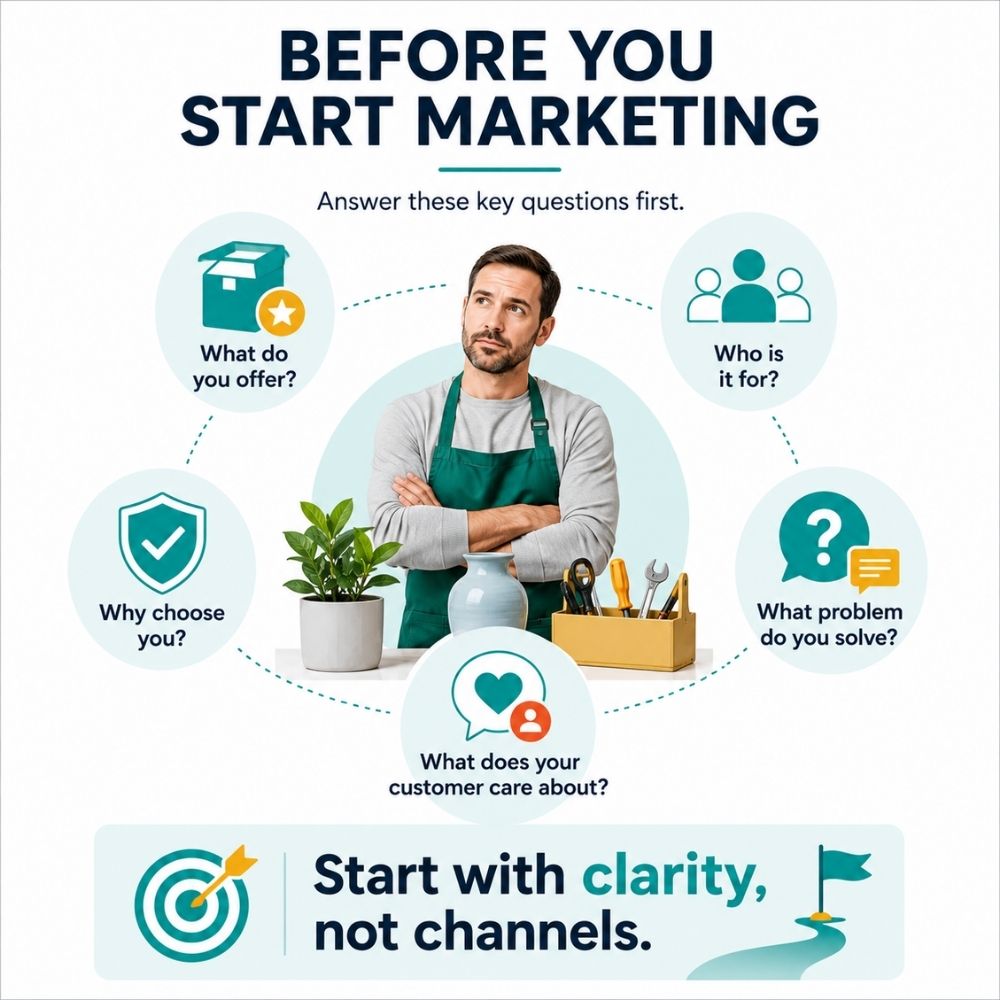
Before you worry about Facebook, Instagram, Google Ads, SEO, networking or email marketing, you need to be able to answer a few basic questions:
- What exactly are you offering?
- Who is it for?
- What problem does it solve?
- Why should someone choose you rather than another business?
- What does your ideal customer actually care about?
This sounds obvious, but it is where many new businesses struggle.
It is very easy to describe your business from your own point of view. You know what you do, how much work goes into it and why you think it is good. Your potential customer is looking at it from a completely different perspective.
They are essentially asking: What’s in it for me?
For example, a self-employed electrician might describe their business as providing domestic and commercial electrical services. That’s accurate, but it isn’t necessarily what the customer is looking for.
The customer might actually be looking for an electrician who answers the phone, turns up when promised, explains the problem clearly and can fix a faulty consumer unit without leaving them waiting for three weeks.
Understanding that difference makes everything that follows easier: your website, your Google Business Profile, your social posts, your advertising and even the way you answer enquiries.
You don’t need a complicated marketing strategy yet
You do need clarity.
Try completing this sentence:
We help [type of customer] who need [problem solved] by providing [service or solution], with [reason they should choose us].
It doesn’t have to become your company slogan. It is simply a useful exercise to make sure you know who you are trying to reach before you start spending time or money trying to reach them.
Who is your ideal customer?
One of the most repeated pieces of advice from business owners and marketers is to work out who you are actually trying to attract.
That doesn’t mean creating an elaborate customer persona with a fictional name, age, favourite coffee and choice of newspaper.
For a small business, it can be much simpler.
Think about the type of person or business most likely to need what you sell:
- What problem are they trying to solve?
- What matters most when they choose someone?
- What might make them hesitate before buying?
- What questions are they likely to ask?
- Where do they look when they need your product or service?
If you are a local tradesperson, for example, your customer may not be particularly interested in how many years you spent learning your trade or which tools you use.
They might care much more about whether you work in their area, whether you have good reviews, whether they can see examples of previous work, how quickly you can help and whether they can trust you in their home.
A freelance designer selling to other businesses will have a very different customer journey. Their potential clients might ask for recommendations, search Google, look at LinkedIn, visit several websites and compare portfolios before contacting anyone.
This is important because your ideal customer should influence where you market your business.
There is little point spending hours creating TikTok videos simply because someone told you that every business needs to be on TikTok if the people most likely to hire you are searching Google instead.
Find out where your customers already are
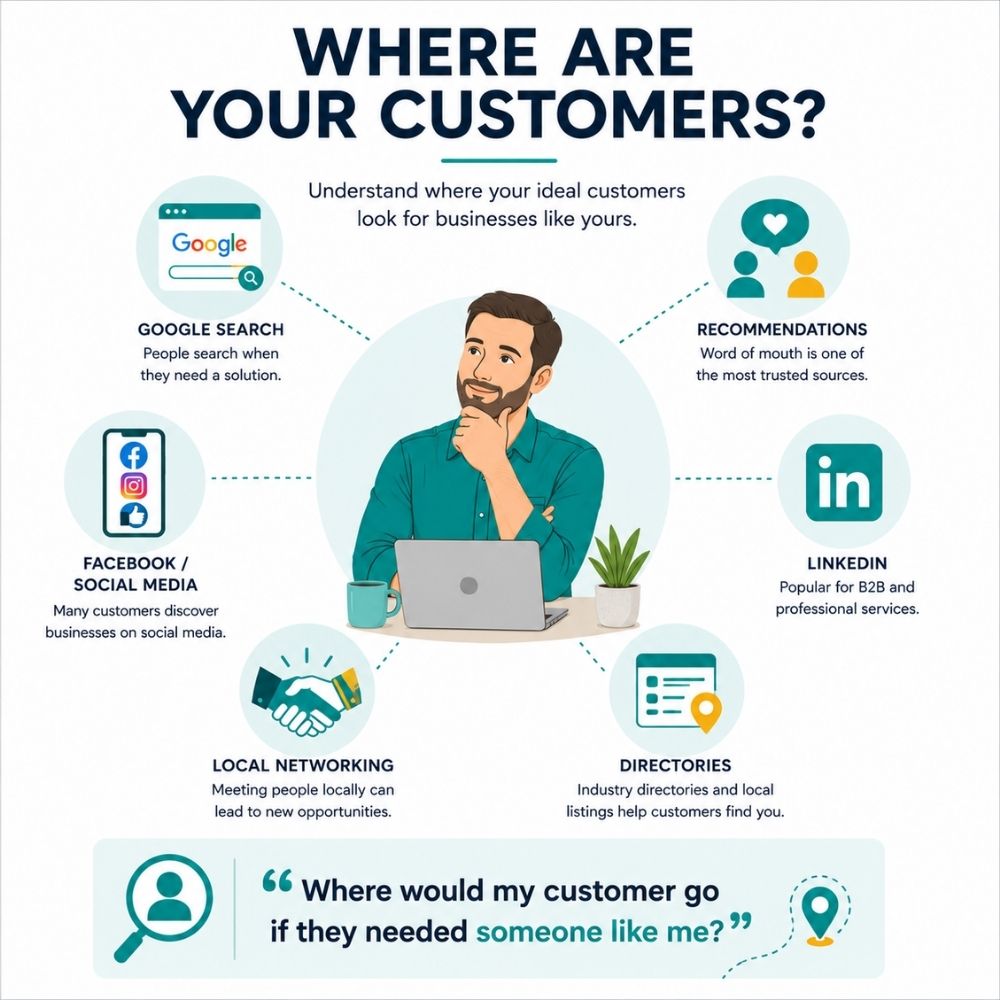
Rather than asking, “Which marketing should I be doing?”, ask:
“Where would my customer go if they needed someone like me?”
The answer might be Google. It might be Facebook groups, LinkedIn, a local networking group, an industry directory or recommendations from friends and colleagues.
Once you understand where your customers are looking, choosing your marketing channels becomes much easier.
What makes your business different?
Once you know who your customers are and what problem you solve for them, the next question is:
Why should they choose you?
This is often described as finding your USP, or Unique Selling Proposition. But don’t get too hung up on trying to invent something completely unique.
Most small businesses aren’t unique.
There are plenty of good electricians, photographers, designers, cleaners, accountants, joiners and consultants. You don’t need to discover something that nobody else in your industry offers.
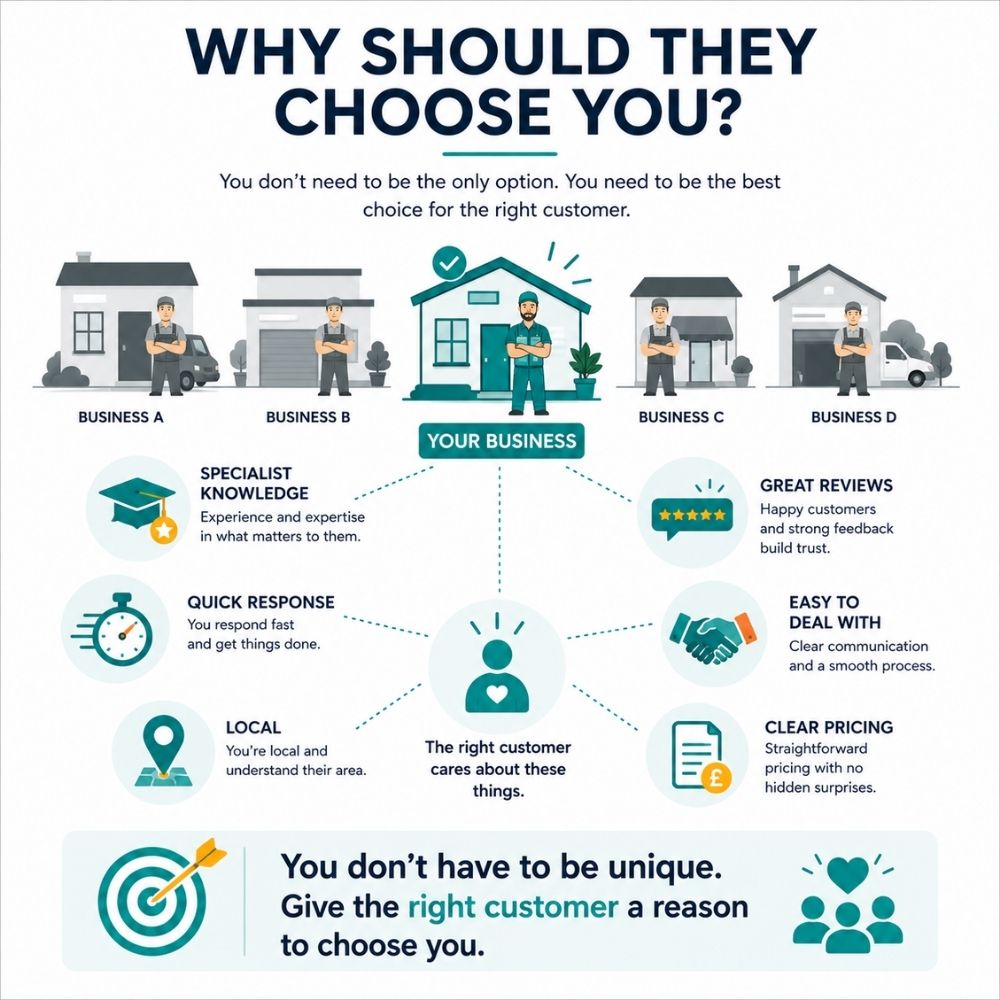
Instead, think about what might make you the better choice for a particular customer.
That could be:
- You specialise in a particular type of customer or project.
- You cover a specific geographical area.
- You respond quickly to enquiries.
- You offer particularly good customer service.
- You have specialist knowledge or experience.
- Your pricing or process is simple and transparent.
- You make something complicated easier for the customer.
- You have excellent reviews or strong examples of previous work.
Sometimes the thing that makes a small business attractive isn’t revolutionary at all.
A tradesperson who answers enquiries, turns up when promised and keeps customers informed can stand out in a market where those things aren’t always guaranteed.
A freelancer who explains everything in plain English and makes the process easy may appeal to customers who feel intimidated by larger agencies.
Look at your competitors
Spend some time looking at businesses offering something similar to you.
Don’t do this so you can copy them. Look for patterns.
- What do they all say?
- What services do they emphasise?
- What do their reviews praise or complain about?
- What questions do customers appear to have?
- Is there something important that nobody explains particularly well?
You may discover that your opportunity isn’t to offer something completely different. It might simply be to communicate it better, make it easier to buy, provide better evidence or focus on a group of customers your competitors largely ignore.
You don’t have to be different from everyone. You need to give the right customer a reason to choose you.
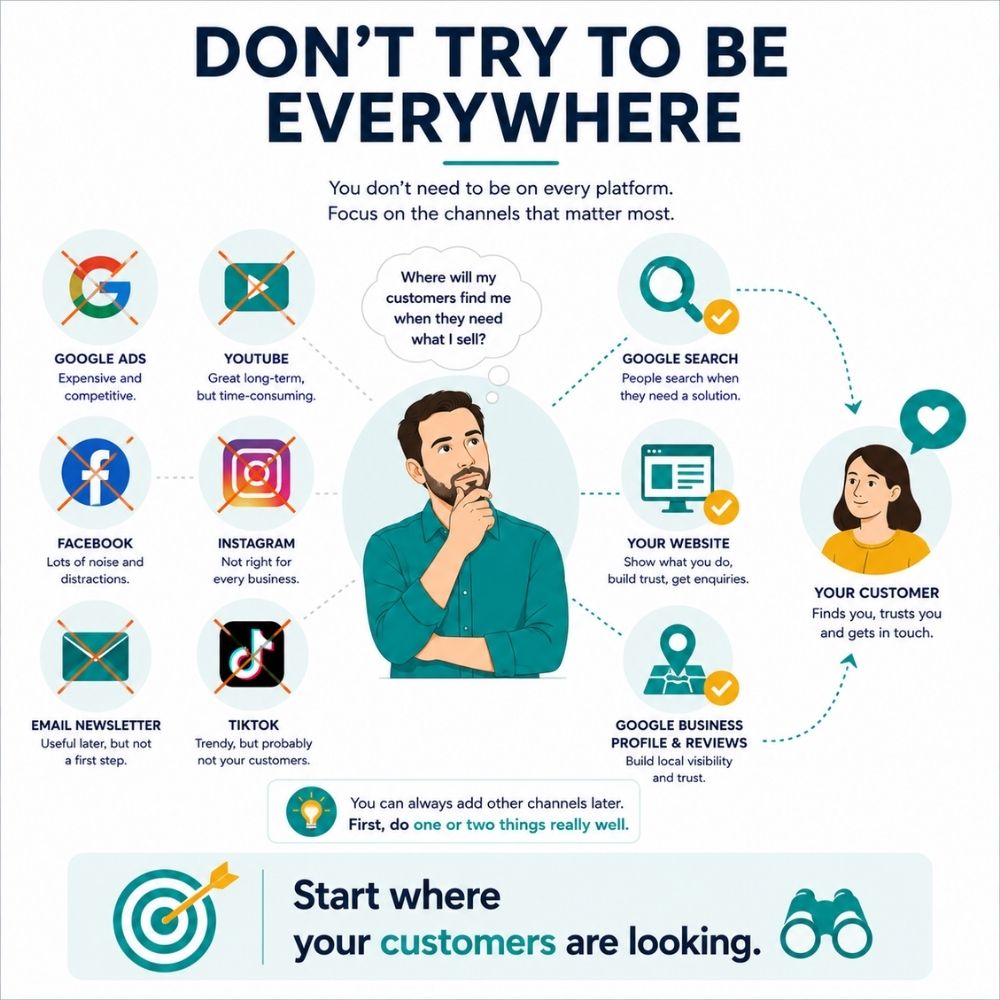
Don’t try to market your business everywhere at once
One of the easiest mistakes to make when you start marketing a new business is trying to do everything.
You set up Facebook, Instagram, LinkedIn and TikTok. You think about Google Ads. Someone tells you that you need SEO. Someone else says you should start an email newsletter. Then you hear that you should be making videos.
Before long, marketing becomes another full-time job.
For a one-person business, freelancer or small trade business, you probably don’t have the time or budget to do all of these things properly. And you don’t need to.
Start where your customers are most likely to find you
The right marketing channel depends on what you sell and how people normally look for it.
- Local trades and services: Google Search, Google Business Profile, your website and customer reviews are likely to be particularly important.
- Professional or B2B services: Your website, LinkedIn, networking and direct outreach may be more useful.
- Visual businesses: Instagram, Facebook or Pinterest may help potential customers discover your work.
- Businesses where customers research before buying: Helpful website content, case studies, FAQs and SEO can build visibility and trust over time.
You can add other channels later. At the beginning, it is better to do one or two things consistently and learn what works than to spread yourself across six platforms and do none of them particularly well.
Ask one simple question
Instead of asking, “Where should I be marketing my business?”, ask:
“Where would someone who needs what I sell actually look for it?”
Start there.
Build trust before you worry about reach
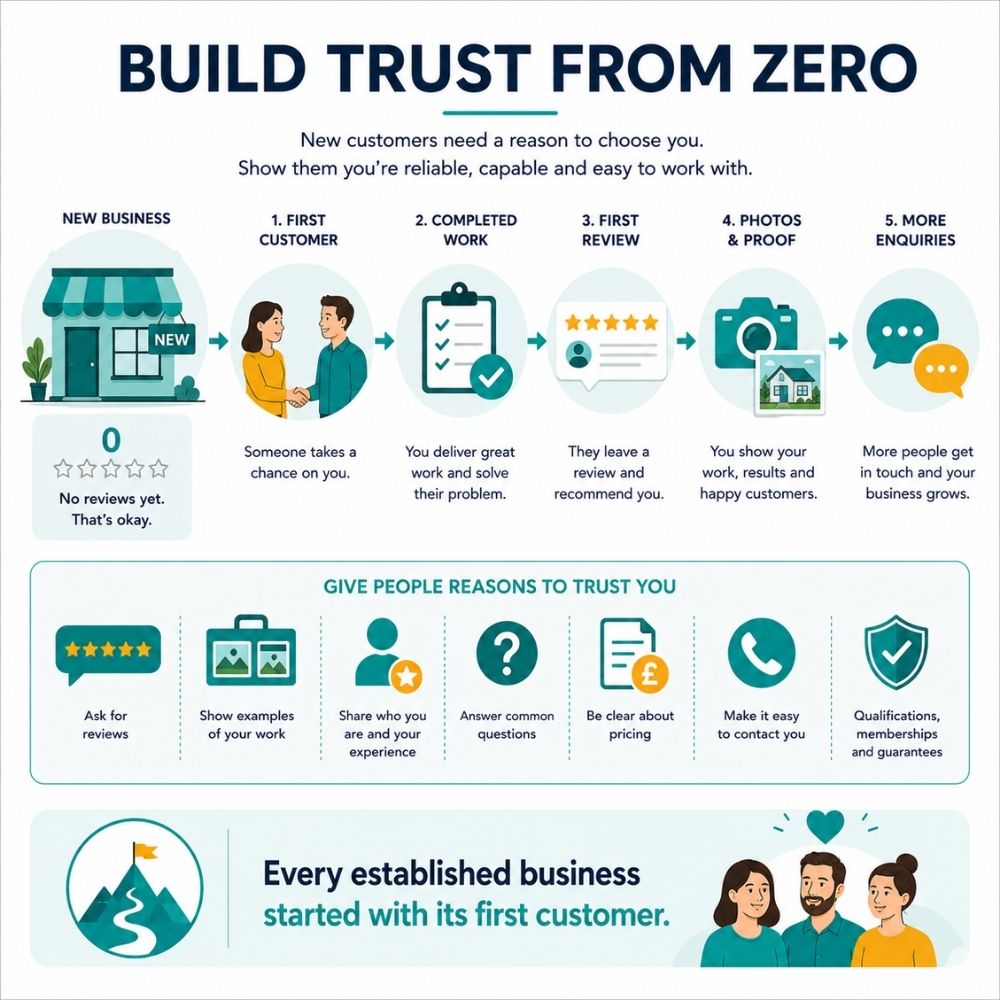
When your business is brand new, one of the biggest marketing problems isn’t necessarily getting people to see you. It’s giving them enough confidence to choose you.
An established competitor may already have years of reviews, photographs, completed projects, case studies and recommendations behind them. You might be every bit as good at what you do, but a potential customer doesn’t know that yet.
This is particularly important for service businesses. Before someone invites a tradesperson into their home, hires a freelancer or hands over money to a business they’ve never used before, they’re likely to do some research.
Give people reasons to trust you
You don’t need hundreds of customers before you can start building credibility. Use whatever genuine evidence you already have.
- Ask your first customers for reviews.
- Show examples of your work.
- Use real photographs rather than relying entirely on stock images.
- Explain who you are and the experience you bring to the business.
- Answer the questions customers commonly ask before buying.
- Be clear about your prices or explain how your pricing works.
- Make it easy to find your contact details.
- Include relevant qualifications, memberships, accreditations or guarantees.
What if you don’t have any customers yet?
Everyone starts with zero reviews.
If you’re genuinely starting from scratch, concentrate on reducing the uncertainty for your first customers. Explain your service clearly, show your experience where relevant and make it easy for someone to speak to you before committing.
You might also offer your service to a small number of initial customers at an introductory price in return for honest feedback and, if they’re happy, a review. That doesn’t mean giving your work away indefinitely. You’re building the first pieces of evidence that future customers can use when deciding whether to trust you.
Your first few reviews, photographs and successful jobs can quickly become some of your most useful marketing material.
Get the basics in place before you spend money on advertising
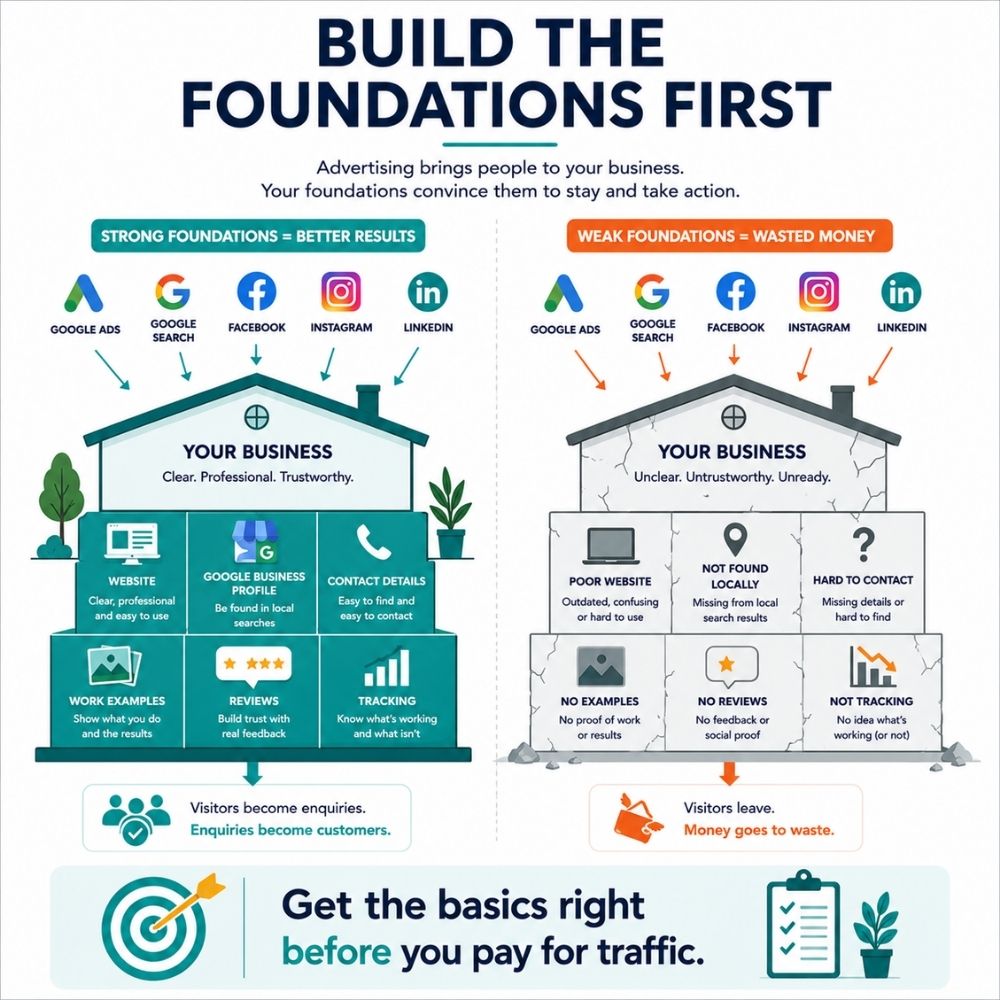
When you’re trying to get your first customers, paying for advertising can feel like the obvious shortcut. Run some Google Ads or boost a few Facebook posts and people will start finding you.
But advertising only gets people to your business. It doesn’t necessarily persuade them to buy from you.
Before you start paying for traffic, make sure you’ve got somewhere useful to send it.
Your basic marketing foundations
For many small businesses, you don’t need an elaborate marketing setup to get started. You do need the basics to be right.
- A professional website: It should clearly explain what you do, who you help and how someone can contact you.
- A Google Business Profile: Particularly important if you provide services within a local area.
- Clear contact information: Don’t make potential customers hunt for a phone number, email address or enquiry form.
- Examples of your work: Show people what you’ve actually done wherever possible.
- Reviews: Start collecting them as soon as you have customers who are happy with your work.
- Basic tracking: Know how people are finding your website and which marketing activities are actually generating enquiries.
Don’t pay to send people to something that isn’t ready
Imagine spending £300 on advertising and getting 500 people to visit your website.
If the website doesn’t explain what you do, looks untrustworthy, is difficult to use on a phone or makes it hard to contact you, you’ve paid for 500 people to discover those problems.
Fixing the foundations won’t guarantee that your marketing works. But it gives the marketing you do afterwards a much better chance.
Get the basics right first. Then start bringing more people to them.
Should you do your own marketing or hire someone?
This is one of the questions new business owners ask most often.
When money is tight, paying an agency hundreds or thousands of pounds every month may simply not be realistic. But trying to learn SEO, social media, advertising, email marketing and everything else while also running your business can quickly become overwhelming.
For most very small businesses, the answer is somewhere in the middle.
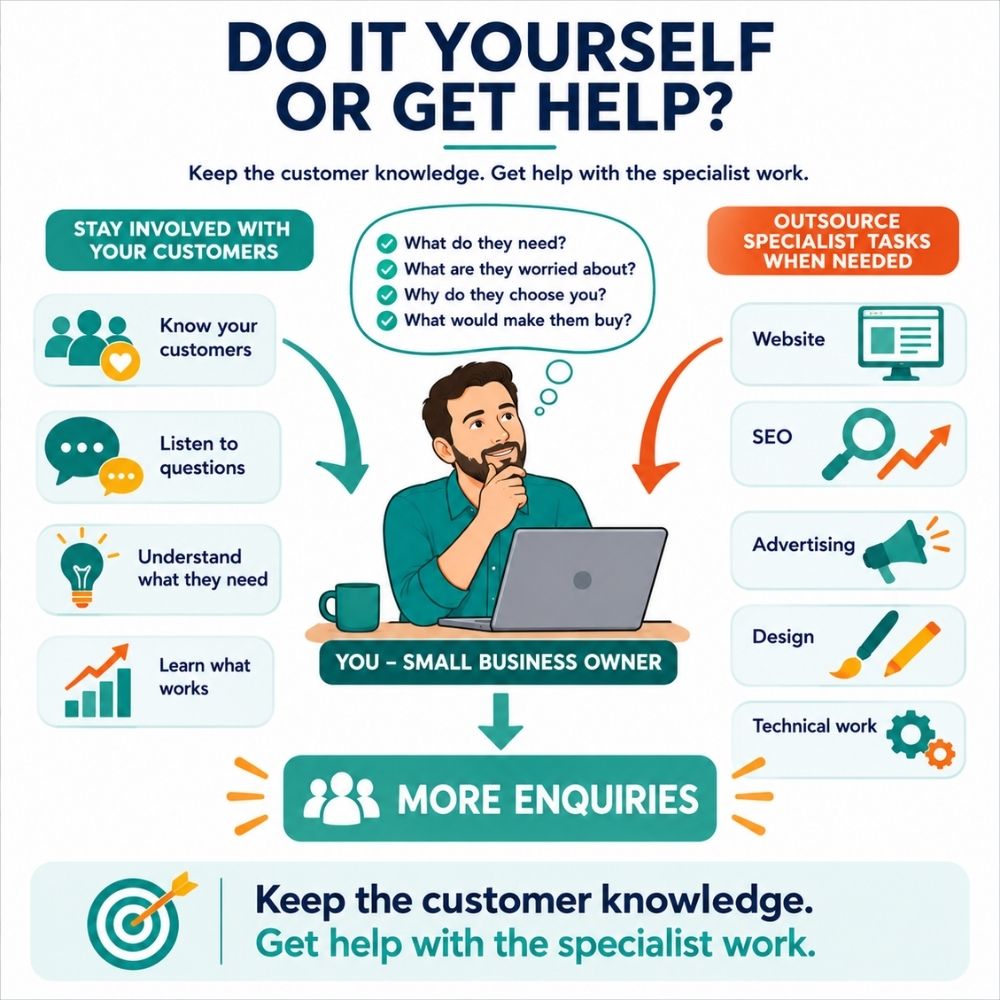
Do enough yourself to understand your customers
There is a real advantage to being involved in your own marketing at the beginning.
You are the person speaking to potential customers. You hear the questions they ask, the things they’re worried about, the words they use to describe their problem and the reasons they eventually decide to buy.
That information is incredibly useful.
It can help you work out:
- Which services people are actually interested in.
- What questions need answering on your website.
- What makes customers choose you rather than somebody else.
- Which parts of your offer people don’t understand.
- Where your customers are finding businesses like yours.
- Which marketing messages get a response.
If you outsource everything immediately, you can miss some of that learning.
But doing your own marketing doesn’t mean doing everything yourself
There is a big difference between understanding your marketing and personally carrying out every marketing task.
You might understand your customers extremely well but have no desire to learn how to build a website, optimise pages for search engines, manage Google Ads or design marketing materials.
Those are skills you can bring in when you need them.
A useful approach for a small business is to keep the knowledge of your customers close to you and get specialist help with the areas where you lack the time, skills or experience.
Be careful about outsourcing random marketing tasks
Hiring different people to “do some SEO”, create a few social posts, run an advert and send some emails doesn’t automatically create a marketing strategy.
Without a clear idea of who you’re trying to reach, what you want them to do and why they should choose you, you can end up paying for lots of disconnected activity.
Before hiring someone, you should at least be able to explain:
- Who your customers are.
- What problem you solve for them.
- What you want your marketing to achieve.
- What you’ve already tried.
- What seems to be working so far.
You don’t need to become a marketing expert. But the more you understand about your own customers and how your business wins work, the easier it becomes to recognise good marketing advice when you receive it.
Learn from your customers yourself. Get help with the specialist work when you need it.
Give your marketing time to work
One of the hardest things about marketing a new business is that you usually don’t know immediately whether something is working.
You publish a website and nothing happens for a week. You write a few social media posts and nobody gets in touch. You start working on SEO and wonder why you’re not suddenly at the top of Google.
It’s tempting to assume you’ve chosen the wrong approach and move on to something else.
But many forms of marketing take time.
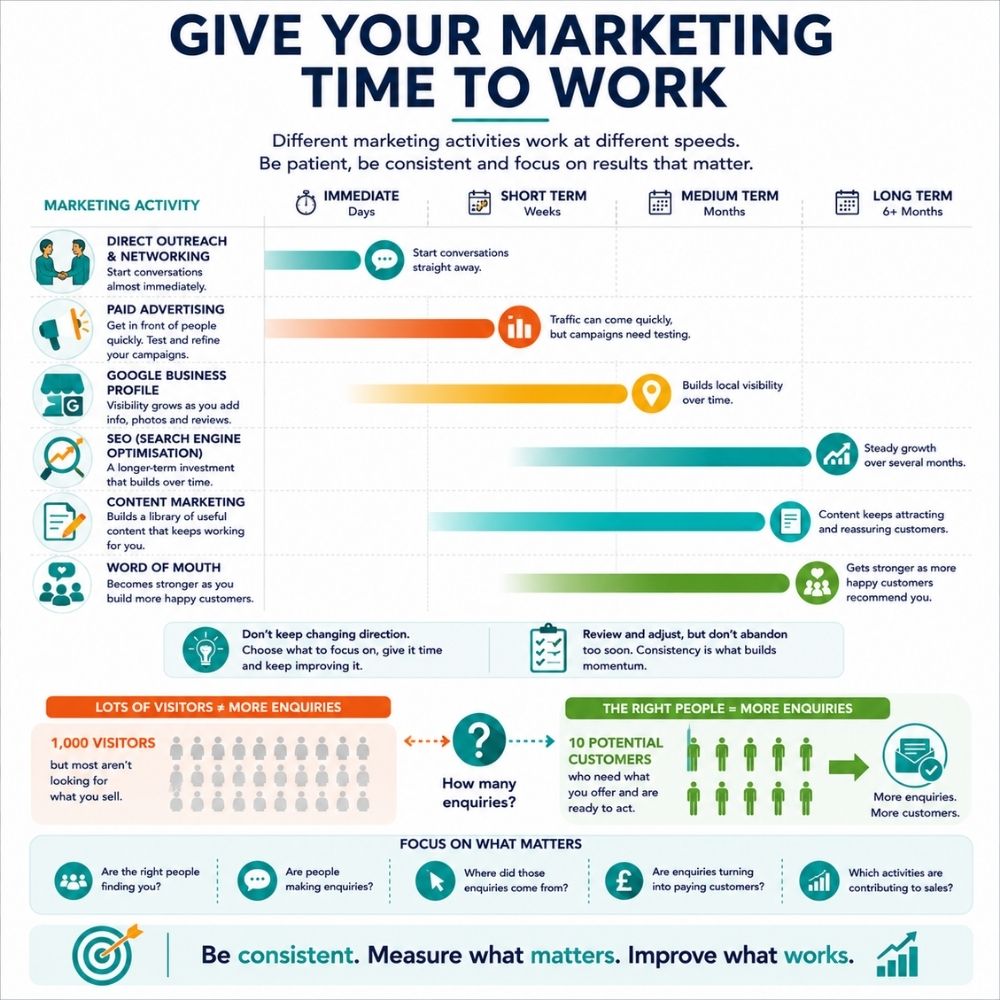
Different types of marketing work at different speeds
Some activities can generate results relatively quickly. Others build visibility and trust gradually.
- Direct outreach and networking can start conversations almost immediately.
- Paid advertising can put your business in front of potential customers quickly, but campaigns often need testing and refinement.
- Google Business Profile can help a local business become more visible, particularly as you add information, photographs and reviews.
- SEO is usually a longer-term investment. It can take months for useful search visibility to develop.
- Content marketing builds a library of useful information that can continue attracting and reassuring customers long after it was published.
- Word of mouth becomes more powerful as you build a larger base of happy customers.
Don’t keep changing direction
A common mistake is what one business owner described as “throwing spaghetti at the wall”: trying lots of different things, giving each one a very short amount of time and then abandoning it when it doesn’t immediately generate customers.
That makes it difficult to learn anything.
Instead, decide what you’re going to try, give it a reasonable amount of time and keep track of what happens.
That doesn’t mean blindly continuing with something that clearly isn’t working. Marketing should be reviewed and adjusted. But there’s a difference between improving a strategy and replacing it every fortnight.
Measure enquiries, not just attention
It’s easy to get distracted by numbers such as followers, likes, website visitors and impressions.
Those numbers can be useful, but they aren’t the ultimate goal for most small businesses.
Ask yourself:
- Are more of the right people finding the business?
- Are people making enquiries?
- Where did those enquiries come from?
- Are enquiries turning into paying customers?
- Which activities appear to be contributing to sales?
Ten website visitors who are actively looking for what you sell can be far more valuable than 1,000 people who have little intention of buying.
Be consistent, measure what matters and improve what you learn rather than constantly starting again.
When should you get professional marketing help?
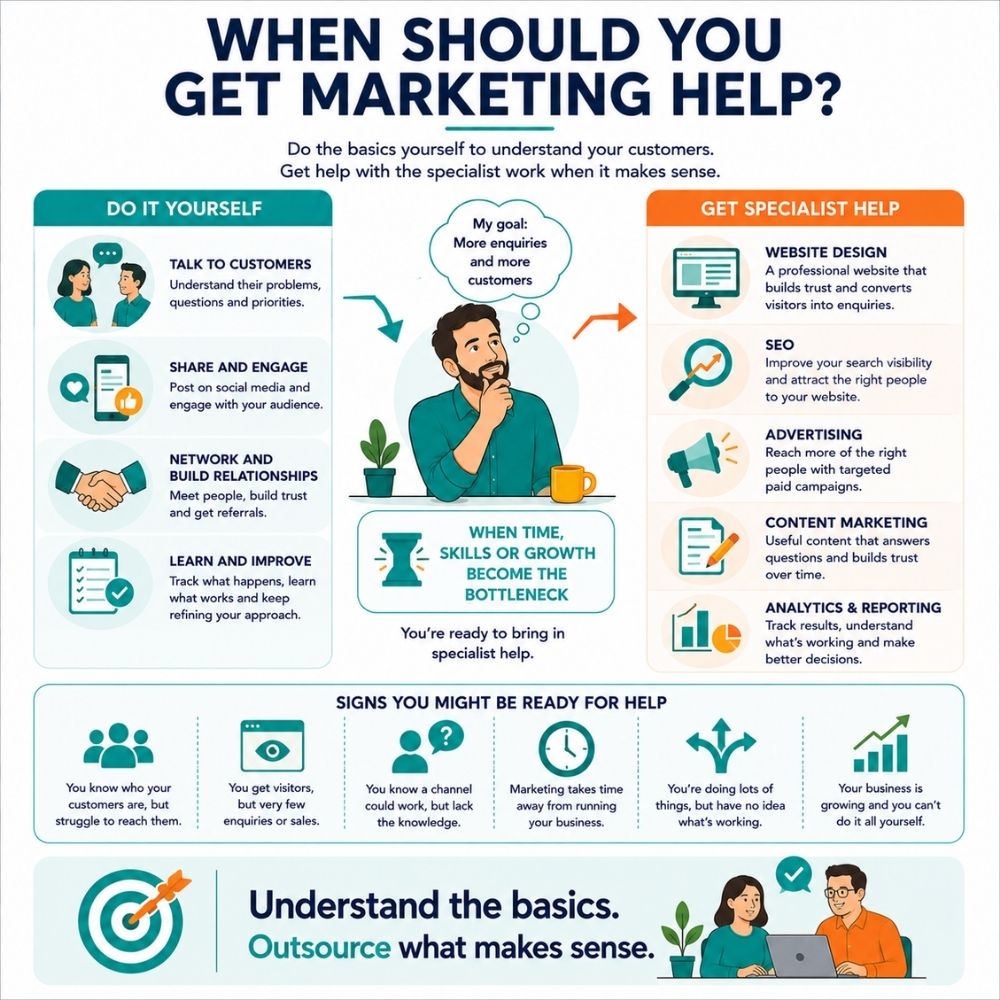
Doing your own marketing does not mean you have to do everything yourself forever.
In fact, there will probably come a point where doing everything yourself starts costing you more in time than you are saving in money.
You might be ready to get some professional help when:
- You know who your customers are, but you are struggling to reach them.
- You are getting website visitors but very few enquiries or sales.
- You know a particular marketing channel could work, but you do not have the knowledge to use it properly.
- Marketing is taking time away from actually running your business.
- You are doing lots of different things but have no idea which ones are working.
- Your business has started growing and you simply cannot keep doing everything yourself.
You don’t necessarily need a marketing agency
Getting help also doesn’t have to mean signing a contract with an agency for thousands of pounds a month.
You might need somebody to help you with one specific part of your marketing: building a website, improving your SEO, setting up Google Ads, creating photographs, writing content or simply helping you work out what you should concentrate on.
One of the recurring themes in the discussions I looked at was the difference between strategy and execution. Hiring somebody to create social media posts, run ads or write articles isn’t particularly useful if you haven’t first worked out who you are trying to reach and what you want those people to do.
That is why it can make sense to learn the basics yourself first. You don’t need to become a marketing expert. You just need to understand your customers and your business well enough to know what you need help with.
Outsource the things that make sense
There is nothing wrong with deciding that your time is better spent fitting kitchens, photographing weddings, advising clients, cutting hair or doing whatever it is that your customers actually pay you to do.
The aim isn’t to prove that you can do all your own marketing.
It is to understand enough about it that you can make sensible decisions about where to spend your time and money.
A simple marketing plan for a new business
If you have made it this far and are wondering what you should actually do next, keep it simple.
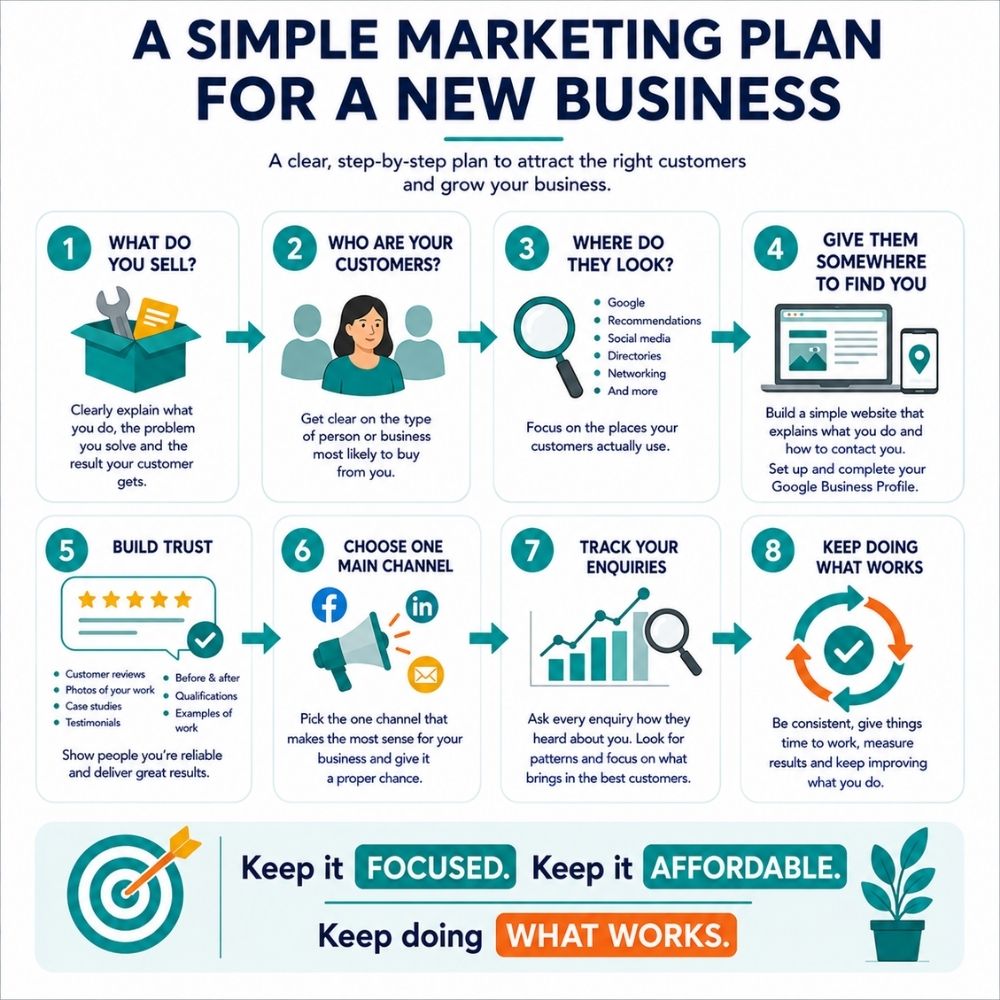
You do not need a complicated marketing strategy, ten social media accounts or an enormous advertising budget. For a one-person business, freelancer or small local business, your first marketing plan could look something like this:
1. Define what you sell
Be able to explain what you do in one or two sentences. Concentrate on the problem you solve or the result your customer gets, rather than simply listing your services.
2. Decide who you want to sell it to
You don’t need an elaborate customer persona, but you should have a reasonably clear idea of the type of person or business most likely to buy from you.
3. Find out where those customers look for businesses like yours
That might be Google, recommendations, LinkedIn, Facebook groups, local networking, trade directories or somewhere completely different.
Don’t assume you need to be everywhere. Concentrate on the places that actually matter to your customers.
4. Give people somewhere to find out more about you
For most businesses, that means having a website. It doesn’t need to be enormous, but it should clearly explain what you do, who you help, where you work and how somebody can contact you.
If you are a local business, set up and complete your Google Business Profile too.
5. Start building trust
A new business has a particular problem: nobody knows whether you are any good yet.
Start collecting evidence as soon as you can. Depending on your business, that could include:
- Customer reviews
- Photographs of completed work
- Case studies
- Testimonials
- Before and after photographs
- Qualifications or professional memberships
- Examples of your work
6. Choose one main way to attract customers
Instead of trying SEO, Facebook, Instagram, LinkedIn, TikTok, email marketing and Google Ads simultaneously, choose one channel that makes sense for your business and give it a proper chance.
You can add more later.
7. Track where your enquiries come from
This doesn’t need to be complicated. When somebody contacts you, find out how they heard about you.
Over time, you will start seeing patterns. You might discover that Google brings your best customers, networking generates valuable referrals or a particular type of content consistently produces enquiries.
That information tells you where to spend more of your time and money.
8. Keep doing what works
This is perhaps the least exciting part of marketing, but one of the most important.
Marketing rarely produces instant results. Give good ideas enough time to work, measure what happens and improve them rather than constantly jumping to the next new tactic.
Your first marketing plan does not need to be clever. It needs to be focused, affordable and something you can realistically keep doing while running your business.
What should you spend on marketing when you are starting out?
This is one of the hardest questions for a new business because, at the beginning, money is usually tight.
You need customers to generate money, but you need money to reach customers. It is very easy to get stuck in the “I need money to grow, but I need to grow to get money” loop.
There isn’t a percentage of turnover or a magic monthly marketing budget that is right for every new business.
A self-employed electrician trying to find customers within 20 miles has very different marketing needs from somebody launching an online product across the UK.
Don’t spend money simply because something is called marketing
When you start a business, there is no shortage of things you can buy.
SEO packages. Advertising. Premium directory listings. Social media management. Email software. Lead generation services. Branding packages. Marketing automation tools.
Individually, many of these might sound affordable. Together, they can quickly become another substantial monthly overhead.
Before paying for anything, ask yourself:
- What am I hoping this will achieve?
- Are my potential customers actually here?
- How will I know whether it is working?
- Can I test it on a smaller scale first?
- Can I realistically afford to keep paying for it long enough to judge the results?
Start with the things that cost more time than money
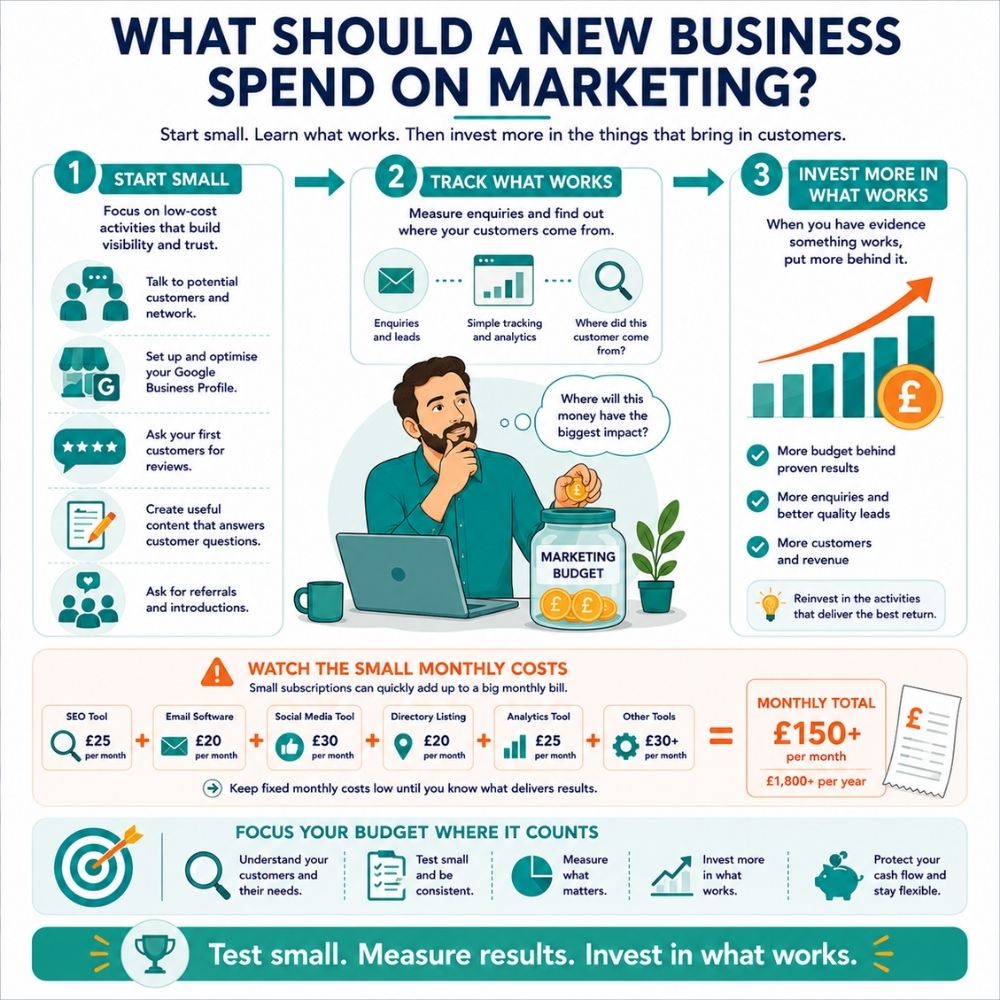
Some of the most useful marketing activities for a new business don’t require a large advertising budget.
- Talk to potential customers.
- Ask existing contacts for introductions and referrals.
- Set up your Google Business Profile if you serve a local area.
- Ask your first customers for reviews.
- Photograph and document your work.
- Attend relevant networking events.
- Create useful information that answers the questions customers regularly ask.
- Make sure your website clearly explains what you do and how to contact you.
These activities help you learn what customers actually care about before you start spending significant amounts of money trying to reach more of them.
Be careful with recurring costs
A £20 or £50 monthly subscription might not sound significant when you sign up for it.
But new businesses can quickly accumulate dozens of small recurring costs. Marketing software, website tools, subscriptions, advertising and professional services all need to be paid whether you have had a good month or a bad one.
Cash flow matters enormously when you are starting a business, so keep your fixed monthly costs as low as reasonably possible until you know what is generating a return.
Spend more when you have evidence something works
Once you start seeing results, the decision becomes easier.
If you spend £200 on something and it consistently generates £2,000 of profitable work, increasing that investment might make perfect sense.
If you have spent £1,000 and cannot tell whether it has produced a single customer, spending another £1,000 simply because you have been told that marketing “takes time” deserves much more scrutiny.
At the beginning, your objective isn’t to have the biggest marketing budget. It is to learn where your customers come from and gradually put more money behind the things that genuinely work.
How long should you give your marketing before deciding it isn’t working?
One of the most frustrating things about marketing a new business is that you often don’t know whether something isn’t working or simply hasn’t had enough time to work yet.
You create a website. Nothing happens.
You publish a few posts on social media. Nothing happens.
You write a couple of articles. Nobody seems to read them.
It is tempting to abandon the idea and move on to something else.
But constantly changing direction can be just as damaging as sticking with something that clearly isn’t working.
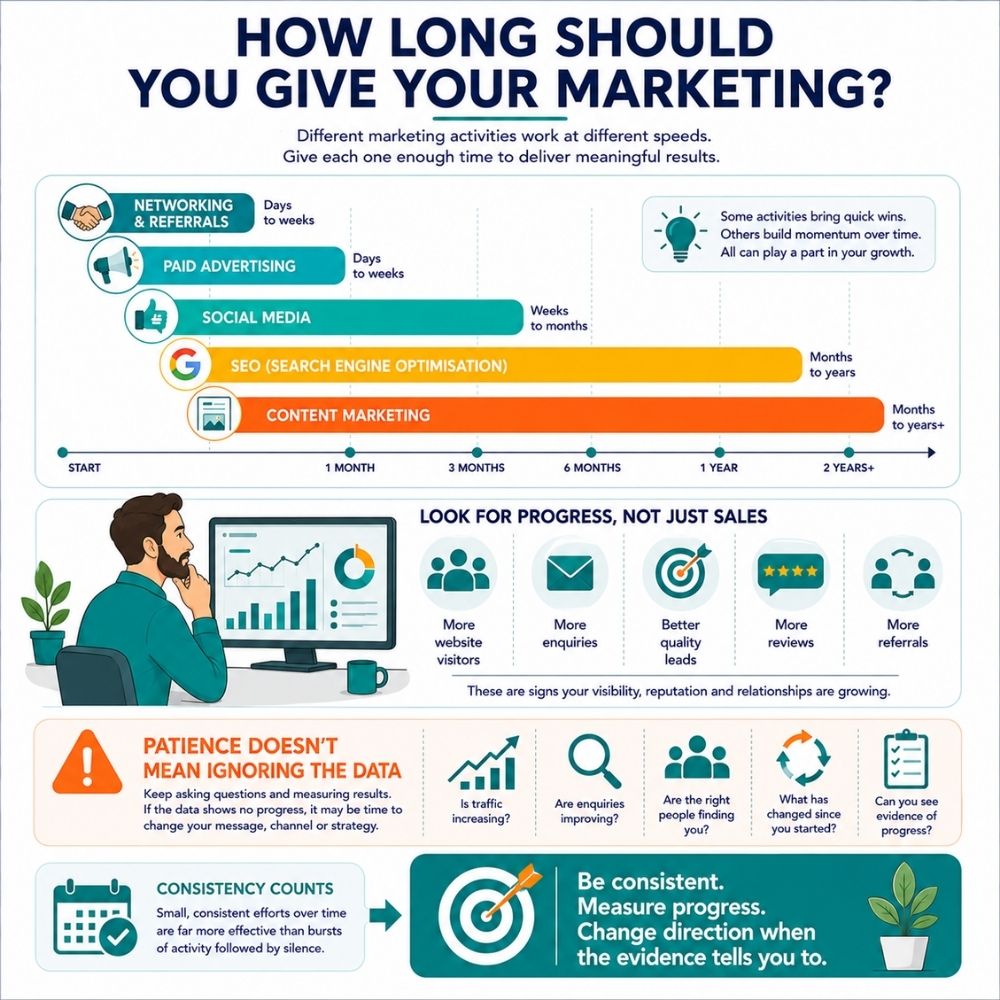
Different types of marketing work at different speeds
There is no universal timeframe for marketing.
Some activities can generate results relatively quickly. Others are investments that build visibility, trust and momentum over months or even years.
For example:
- Networking and referrals can sometimes produce an enquiry almost immediately.
- Paid advertising can start generating traffic quickly, although finding a profitable campaign may take testing and refinement.
- Social media often requires consistent activity before you build a useful audience or generate regular enquiries.
- SEO is usually a longer-term investment. A new website is unlikely to dominate Google a few weeks after launch.
- Content marketing can continue attracting potential customers long after an article, guide or case study was originally published.
This is another reason why copying somebody else’s marketing strategy can be misleading. Their business may have been building an audience, reputation and search visibility for years.
Look for progress, not just sales
Ultimately, marketing needs to contribute to customers and revenue. But when you are starting out, a sale isn’t the only indication that something is moving in the right direction.
You might start seeing:
- More people finding your website through Google
- More visits to important service pages
- More people viewing your Google Business Profile
- More enquiries
- Better quality enquiries
- More recommendations and referrals
- People mentioning articles or posts you have published
- An increasing number of reviews
These are signs that your visibility and reputation are growing.
Don’t confuse patience with blindly carrying on
“Marketing takes time” should not become an excuse for spending indefinitely on something without understanding what it is achieving.
You should still be asking questions.
Is traffic increasing? Are enquiries improving? Are the right people finding you? What has changed since you started? Can you see any evidence that the activity is moving you towards your objective?
If the answer to all of those questions remains no, it may be time to change the message, the channel or the strategy.
Consistency is surprisingly important
One of the recurring themes from business owners discussing marketing was not a clever tactic at all. It was consistency.
It is easy to market your business enthusiastically when work is quiet and then stop completely when you become busy.
A few months later the enquiries dry up, so marketing suddenly becomes urgent again.
Try to build a level of marketing activity that you can maintain even when you are busy. A smaller amount done consistently is often far more useful than occasional bursts of activity followed by months of silence.
Give your marketing enough time to produce meaningful evidence, keep measuring what happens and change direction when the evidence tells you to, not simply because you haven’t had an immediate result.
Common marketing mistakes to avoid when starting a business
When you are starting from scratch, some marketing mistakes simply waste a little time. Others can burn through money you really cannot afford to lose.
A lot of the problems new business owners experience come from trying to do too much, too quickly, without first establishing what actually works for their business.
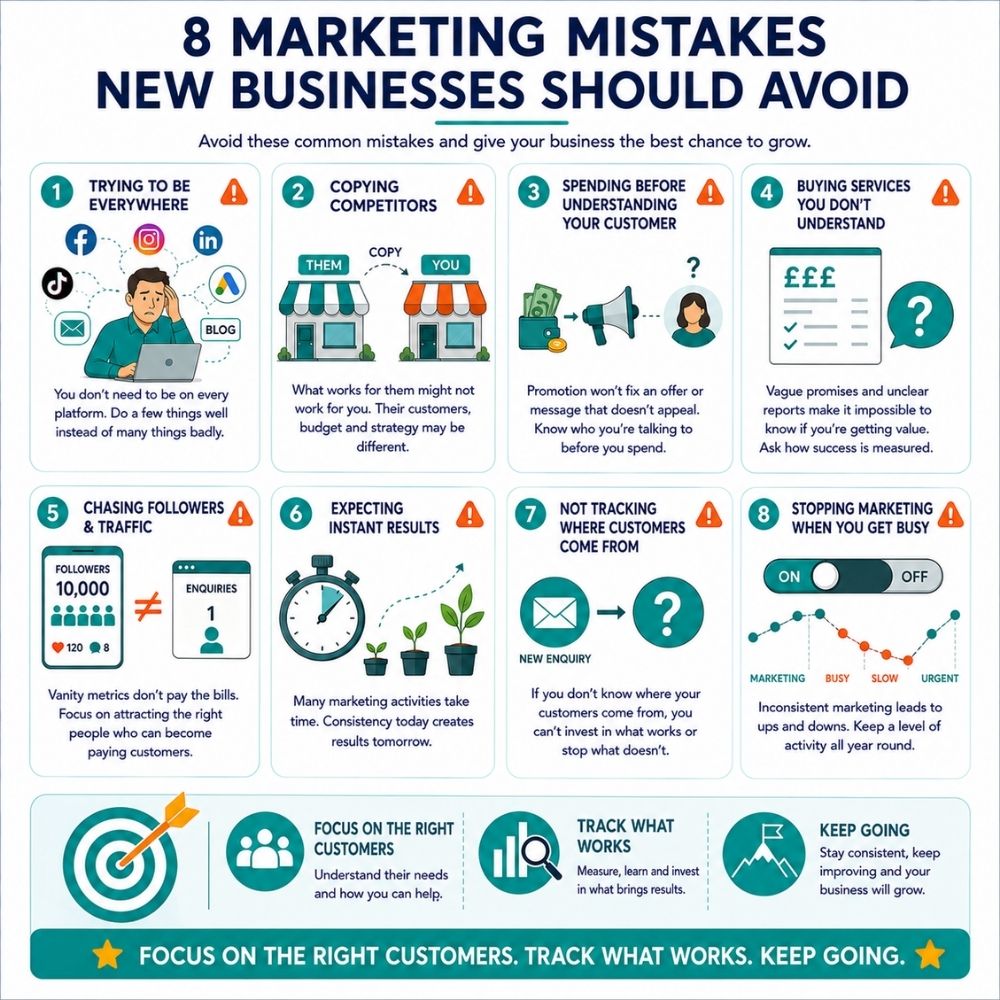
Trying to market everywhere
You don’t need to be on every social network, running Google Ads, writing a blog, sending emails, attending networking events and learning SEO at the same time.
Every additional marketing channel requires time, content, attention and often money.
It is usually better to do one or two things properly than six things badly.
Copying what another business is doing
It is sensible to look at your competitors, but don’t assume their marketing strategy will automatically work for you.
You don’t know what they are spending, which activities actually generate customers or how long they have been building their reputation.
More importantly, their ideal customers might not be the same as yours.
Spending money before understanding your customer
Advertising can get your business in front of more people, but it cannot fix an offer or message that doesn’t appeal to them.
Before spending heavily on promotion, make sure you understand who you want to reach, what they need and why they might choose you.
Buying marketing services you don’t understand
You don’t need to know how to do everything yourself, but you should understand what you are paying somebody to achieve.
Be particularly careful with vague promises such as “improving your online presence”, “boosting engagement” or “getting you to the top of Google” without a clear explanation of what work will actually be carried out.
Ask what success looks like and how it will be measured.
Focusing on followers and traffic instead of customers
More isn’t always better.
Ten thousand social media followers who will never buy from you are less valuable than 100 local people who genuinely need your service.
The same applies to website traffic. The objective isn’t simply to get more visitors. It is to attract the right visitors and help them take the next step.
Expecting immediate results
Some marketing can work quickly, but much of it takes time.
Building a reputation, earning reviews, appearing in search results, developing useful content and generating word-of-mouth recommendations doesn’t happen overnight.
Don’t abandon a sensible strategy simply because it hasn’t produced a flood of customers in the first few weeks.
Failing to ask where customers came from
This is one of the easiest mistakes to fix.
When somebody enquires, ask how they found you.
If you don’t know where your customers are coming from, it becomes very difficult to decide which marketing deserves more investment and which activities you could stop doing.
Stopping marketing when you get busy
This is particularly common in one-person and small service businesses.
Marketing works, the diary fills up and marketing stops because there isn’t enough time. A few months later the work starts drying up and marketing suddenly becomes urgent again.
Try to create a level of activity you can maintain throughout the year rather than repeatedly switching your marketing on and off.
You don’t need to get everything right when you start. Avoid expensive mistakes, pay attention to what your customers tell you and improve your marketing as you learn.
So, where should you actually start?
If all of this still feels like a lot, strip it back.
You do not need a sophisticated marketing system when you launch your business. You need a sensible starting point that helps the right people discover you and gives them enough confidence to get in touch.
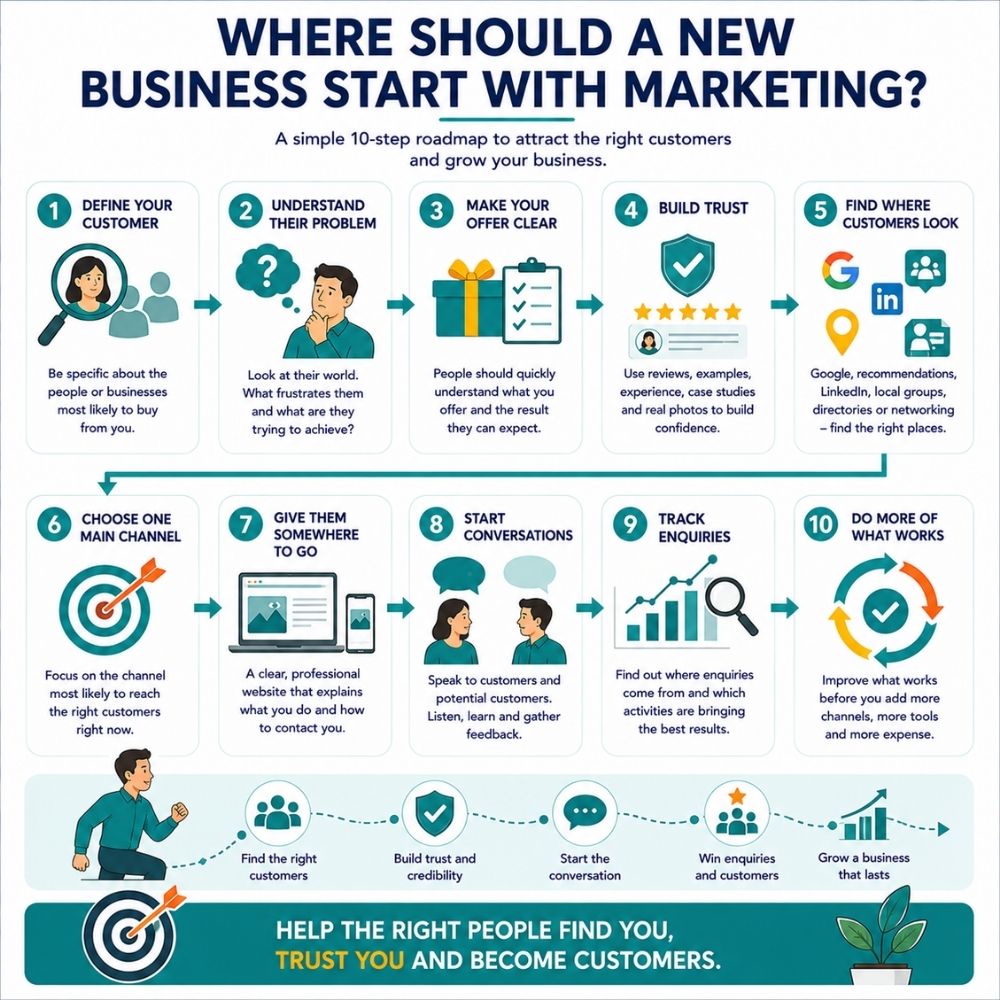
A simple order to follow is:
- Define your customer. Be more specific than “anyone who might need this”. Think about the people or businesses most likely to buy from you.
- Understand the problem you solve. Look at it from the customer’s point of view, not just in terms of the service you provide.
- Make your offer clear. People should quickly understand what they can buy from you and what result they can expect.
- Give people a reason to trust you. Use reviews, examples of your work, experience, qualifications, case studies and real photographs where relevant.
- Find out where your customers look. That might be Google, recommendations, LinkedIn, local groups, directories or networking.
- Choose one main marketing channel. Focus on the place most likely to reach the right customers rather than trying to be everywhere.
- Give people somewhere useful to go next. For most businesses, that will be a clear, professional website.
- Start conversations. Speak to customers and potential customers. Their questions, objections and feedback will help you improve your marketing.
- Track enquiries and customers. Find out where they came from and which activities are producing useful results.
- Do more of what works. Improve proven activities before adding more channels, more software and more expense.
Your marketing will change as your business grows
What works when you are trying to win your first five customers may not be the same strategy you use when you have 100.
At the beginning, you might rely heavily on personal contacts, networking and direct conversations. Later, reviews, referrals, search visibility and useful content can start doing more of the work for you.
You can then introduce other activities when there is a genuine reason to do so.
The important thing is not to build the perfect marketing strategy before you start.
Start with what you know, pay attention to what happens and keep improving.
Marketing is not a list of things every business is supposed to do. It is the process of helping the right people find you, understand what you offer, trust you enough to take the next step and ultimately become customers.
Already have a website but not sure whether it is helping?
If you have already started marketing your business, your website is often one of the first places potential customers will go to check you out.
They might find you through Google, a recommendation, social media, a networking contact or even after seeing your van or business name somewhere locally.
The important question is what happens when they reach your website.
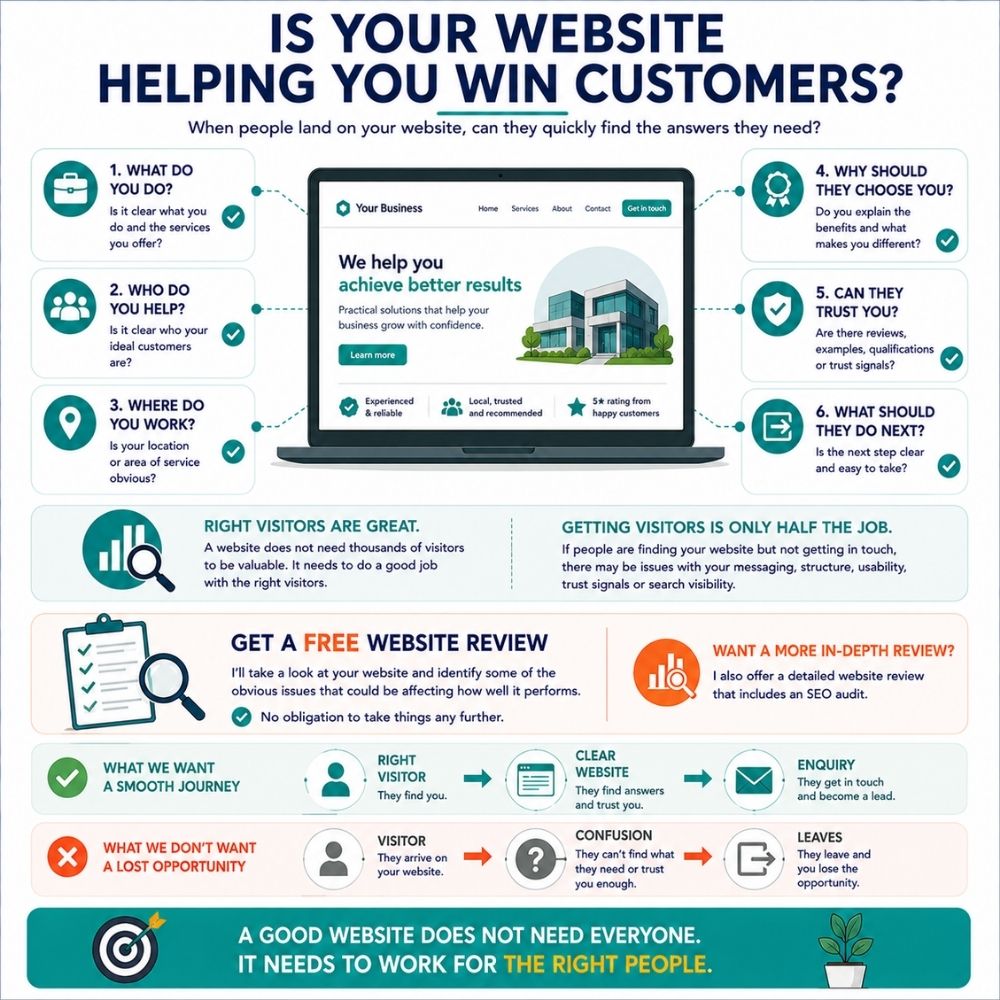
Can they quickly understand:
- What you do?
- Who you help?
- Where you work?
- Why they should choose you?
- Whether they can trust you?
- What they should do next?
A website does not need thousands of visitors to be valuable. It needs to do a good job with the right visitors.
If people are finding your website but not getting in touch, there may be issues with the messaging, structure, usability, trust signals or search visibility that are getting in the way.
Get a free website review
I offer a free initial website review where I will take a look at your website and identify some of the obvious issues that could be affecting how well it performs.
There is no obligation to take things any further.
If you would like a more detailed assessment afterwards, I also offer an in-depth website review that includes an SEO audit.
If your website is already live but you are not sure whether it is helping turn visitors into enquiries, a review is a good place to start.
You do not need to have your entire marketing strategy figured out before you start. Get the basics right, learn where your customers come from and build from there.
If you already have a website and would like an independent opinion on how well it supports your marketing, request a free website review.