Which website builder is best for SEO – Contents
- Which website platform is best for search engine optimisation?
- How we did the research
- Initial search results – which platforms are mostly used in the top 10 Google results?
- Website builders and SEO
- Understanding search intent – what does the searcher want?
- Wix and Squarespace Google results
- Which keyword types were used to find these websites?
- Domain authority and page 1 success
- Combining domain authority with the type of keyphrase used
- Conclusions – which website builder is best for search engine optimisation?
- Why are these 19 pages in the top 10 results?
- Why are there not more Wix and Squarespace websites in the top 10 results?
- What is the best website platform for search engine optimisation?
- Which platform would I recommend?

When you are at the stage to decide which website platform is best for you, one of the points to consider is how well these platforms perform in Google. No doubt Google Sites has an advantage but it lacks many of the powerful tools and advanced ecommerce functionality that other website builders possess.
As a WordPress web developer and SEO expert, it’s always been important to me that my clients’ websites are found in Google. But more importantly – their websites should rank well in Google! It’s easy to rank for your company name, but for a more generic search – that’s an entirely different story when website building.
For years, I have said to my clients that they should only consider a WordPress website if they want to do well in Google.
I have to say that I work mostly with small businesses (from 1 to 50 employees). If the website is to attract new customers, for those businesses, WordPress is the best solution out there.
Most big businesses will have an in-house marketing & web department and they most likely use a custom-built solution.
I see the following question in Facebook Groups all the time.
Which website platform is best for search engine optimisation?
I have had lots of experience with self hosted WordPress websites and I can get them to rank amazingly well in the major search engines.
However, I was curious if my view was somewhat biased towards WordPress because I work with it every single day. When researching “Which website platform is best for SEO”, you will find numerous blog articles claiming this platform is better than another, or that all the platforms have good SEO tools and all perform the same.
I don’t like claims like that unless they are based on actual research.
So I did the research.
I ran 1216 websites through Google. Strange number, I know, but that’s the number I ended up with after cleaning the data.
Here’s how I did the research:
I asked a number of people around the globe to help me with it.
The task was set like this:
Research Methodology – How we researched the best website platforms for SEO
I asked the researchers around the globe to come up with 20 (twenty) random, different and unrelated search phrases for Google. The 20 search phrases should consist of:
- 5 local phrases where you either use a location or a country as part of the search phrase (e.g. What is the best hair straightener UK, best chinese restaurant in Melbourne)
- 5 question phrases without location (e.g. what is the best breed of dog for a first time owner)
- 5 general keyword phrases with location (e.g. Buy astroturf UK, Wedding Photographer London)
- 5 general keyword phrases without location (e.g. deep sea oil drilling, tree cutting)
In total, the 20 search phrases were supposed to be for completely different industries and topics.
The helpers were asked to run each query in Google and take a note of the first 10 actual websites that were found (basically the page 1 results).
- They were asked to ignore any adverts, Wikipedia pages and videos.
- Each website was then opened and – with the help of the Chrome extension Wappalizer – checked which Content Management System is used.
Initial Research Results – which platforms are mostly present in the top 10 Google Results?
The following content management systems were found:
- Adobe Experience Manager (6)
- Atlassian Cloud CMS (1)
- Brightspot (2)
- Chorus (2)
- Contentful (1)
- Custom (687)
- DNN (2)
- Drupal (49)
- Ecommerce (77)
- Expression Engine (3)
- Ghost (1)
- Joomla (3)
- Kentico CMS (1)
- Lithium (1)
- Squarespace (9)
- TownNews (2)
- Umbraco (1)
- Weebly (3)
- Wix (10)
- WordPress (355)
The two biggest numbers are:
Custom (687) and WordPress (355).
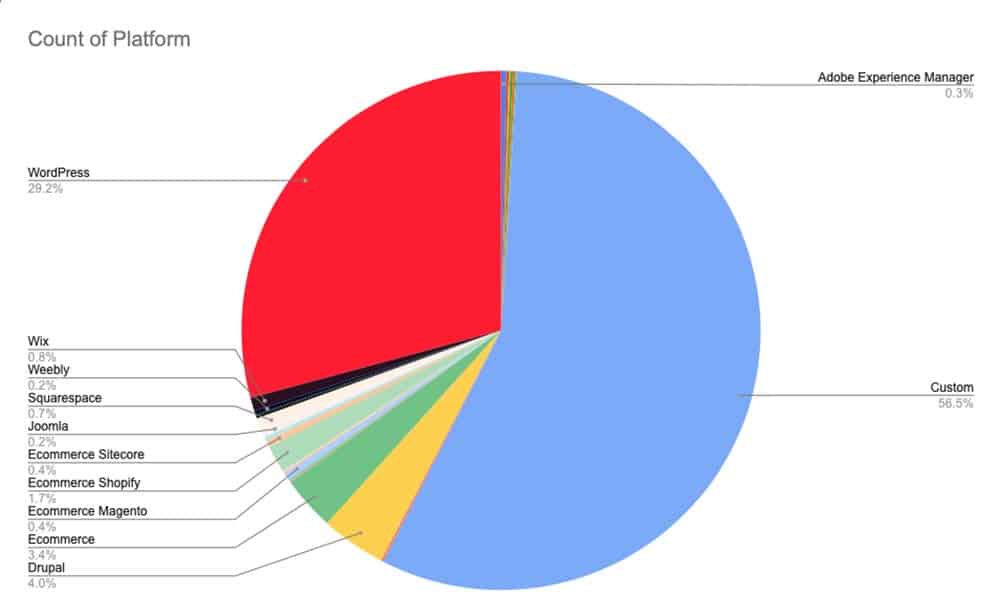
A website was recorded as Custom if no known CMS could be recognised.
I can only assume that many of the big company websites (such as New York Times, The Guardian, Healthline, Tripadvisor, Bupa etc.) are all run on their own developed system.
According to Search Engine Journal, in 2021, the WordPress CMS is used by almost 40% of the world’s websites.
But just because so many people use it doesn’t automatically make it the best CMS.
WordPress is probably aimed at micro (1-person) and small businesses. I found it surprising that – according to Gartner – a small business is considered a business with up to 100 employees, and a medium sized business has between 100 and 999 employees.
A lot of bigger businesses (I’d say 100 employees and above) will likely have a marketing department and an in-house web development team, and several people will work on their website every single day.
When choosing a platform for your business – regardless of the size of your company – you need to consider certain aspects:
- Ease of use
- Monthly and/or annual running costs
- Website security
- How easily can the website be updated (and who will do it)
- Is there any customer support available
- Can I add custom development / functionality
- Website speed
- Server requirements
- SEO tool
… just to name a few!
For these reasons, big companies (such as New York Times, The Guardian, Healthline etc.) will use their own custom built website solution so they can make their website exactly what they need it to be. Their requirements will be substantially different from those of a micro or small business.
Website builders and SEO
Website builders (other than WordPress) can make web design appear an easy thing to do.
These companies have a super easy sign-up and onboarding process (which we can all learn from!!). They allow complete website novices to put a website together with just “a few clicks” using a free website builder in some cases. Few people at this stage harness the power of the inbuilt SEO engines. Such as can be found in WordPresses Yoast SEO plugin and Wix SEO.
“Easy” website builders are very likely aimed at micro businesses. They certainly have their place in the market, as not every business person requires a huge and complicated website.
But the question remains – how are the different website builders performing in terms of search engine optimisation?
Out of 1216 Google page 1 search results, only 10 websites were built using Wix and only 9 websites were built using Squarespace.
I could stop the article here and consider the matter closed and simply say that WordPress is the best CMS for small business owners, but I want to dig deeper.
I want to know WHY these 19 websites are in the top 10 of the Search Results.
Understanding Search Intent – what does the searcher want?
Google wants to show the best results to the person performing a search.
Google is all about search intent.
Most people are logged into Google with their Gmail account. Every search you perform Google will “remember” and likely internally associate with you. So they have built a picture about what you are about (your interests etc.).
This is pretty common these days – if you’ve ever used a store loyalty card – the main reason for them is to collect information about you and then use this information to send targeted marketing your way.
For example our supermarket “knows” we have never bought any baby products but we buy cat food regularly. The personalised marketing we receive from them will never include offers on nappies, but often cat related products such as cat litter, cat toys etc.
Why is this relevant?
If one of the researchers for this project has entered a random search term about something they have never searched for, Google doesn’t quite understand the intention of the search, i.e. what is the searcher exactly looking for? In this context, Google is doing a little bit of guesswork and shows what Google’s algorithm believes is the best result for the query.
The results are most likely less relevant the broader the search term is. A broad search term consists of maybe two or three keywords. Google simply doesn’t understand what exactly you’re looking for.
We can see this in one of the websites shown in the results below, when the searcher was looking for “carpet cleaner”.
One of the websites that was in the top 10 results has an Ahrefs domain rating of Zero and has hardly any backlinks. The domain rating basically gives an indicator of the authority a domain name has. The lower the number the smaller the authority. You can check your own domain authority on Moz.com for free.
If someone is actually looking for these keywords, they will most likely rephrase their keywords and add more keywords to their search query.
This will then give Google a better indication of what they are actually looking for, e.g. a carpet cleaner where they live, or a carpet cleaner product, or if they are looking on how to clean a carpet.
We have all searched for something in Google, clicked on a page and realised within a second or two that the website doesn’t provide the information we’re after.
We then click the Back button or close the browser tab and go back to Google and check out the next result.
In the background, Google has taken a note of your action (closing the browser tab or clicking the Back button) and also how quickly you have done this.
They now know that this website didn’t deliver what you were after. This information will then be recorded for this website and if someone else searches for the same term, the website you just closed is likely not shown to the new person.
I have explained this process in a very simple way here, and usually when one person closes a website quickly it will have no impact on a website’s ability to rank on page 1. But if out of 1000 searches 990 people close the page immediately, Google will probably take note and decide if this website is worth showing in the top 10 results.
This is the SEO purpose.