Updated January 2026
Quick summary
SEO helps your business get found by people who are actively searching for products or services like yours. It improves your visibility in search engines, brings more organic traffic to your website, and builds credibility with potential customers. SEO also supports long-term growth because well-optimised content can continue to attract visitors over time, makes your brand more recognizable, and helps you compete with other businesses online. Unlike ads, organic search can deliver ongoing value without paying for each click.
What is SEO?
SEO stands for Search Engine Optimisation. It helps your website show up when people search online for information, products, or services related to what you offer.
In simple terms, SEO makes it easier for the right people to find your website at the right time.
A super simple explanation of SEO
Think of the internet as a huge library. Every website is a book, and search engines act like librarians. When someone asks a question, the librarian’s job is to recommend the most useful, trustworthy, and relevant book.
SEO is about making sure your website is clear, helpful, and easy to understand, so search engines feel confident recommending it when someone searches for answers.
Search Engine Optimisation (SEO) helps make your website easier to find online.
A more common definition of search engine optimisation
Search engine optimisation is the process of improving your website so search engines can understand it and users find it useful.
An SEO strategy usually includes improving content, structure, performance, and user experience. The goal is not to trick search engines, but to clearly show what your website is about and who it helps.
Good SEO makes your website easier to find, easier to use, and easier to trust.

Why SEO is not easy
SEO is often compared to a game because there are rules, competition, and long-term strategy involved.
Search engines constantly improve how they assess websites so that low-quality or misleading content does not dominate results. If ranking well were easy, search results would quickly become untrustworthy.
This is why SEO focuses on relevance, experience, and usefulness rather than shortcuts. Websites that consistently help users tend to perform better over time.
You need to know the SEO rules to play the SEO game.
In the business context, SEO is really about caring about your customers!
Why you need SEO marketing for your business
SEO is often misunderstood as a purely technical task or a keyword exercise. In reality, SEO is part of your wider marketing strategy and closely linked to how well you understand your customers.
SEO helps your website appear when people are actively searching for solutions, not just scrolling for entertainment. That intent makes SEO traffic especially valuable, even for very small businesses.
SEO is not about hoping people find you. It’s about deliberately putting helpful information in front of people when they are looking for it.
With SEO, you can capture your customers before they are ready to buy.
Understanding the customer journey
People rarely go from “never heard of you” to “ready to buy” in one step.
A typical customer journey includes:
- Awareness: They realise they have a problem
- Research: They look for answers and options
- Compare alternatives: They assess different providers
- Decision: They choose who to contact or buy from
- Purchase: They take action
- After purchase: They may return or recommend you
SEO allows your business to show up during the early stages of this journey by answering questions and providing useful information before someone is ready to buy.
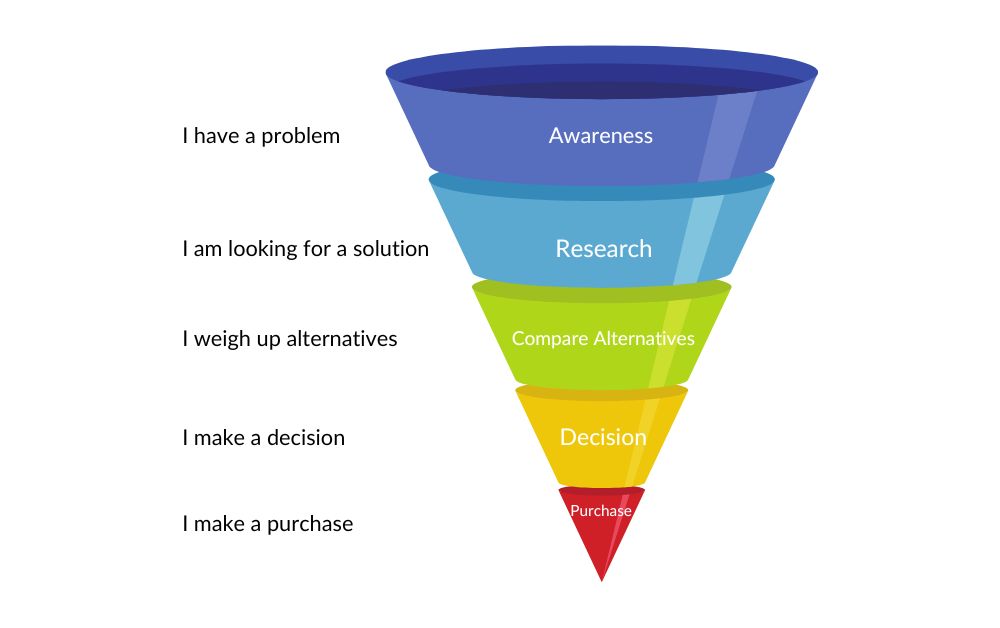
Reach your customers during their solution-finding process with SEO
When someone searches online, they usually have a clear problem or question. SEO allows your website to appear at that moment.
By answering common questions, explaining costs, comparing options, or offering guidance, your website builds trust before a sales conversation even begins. This makes future enquiries warmer and more likely to convert.
SEO and social media: how they work together
SEO and social media are not opposites. They support each other.
SEO helps people find your business when they are searching for answers. Social media helps them check who you are, see your personality, and look for proof that others trust you.
Many people find a business through search and then visit social profiles to confirm credibility. That process works best when both your website and social media are aligned.
Why your website content lasts longer than social media posts
Social media content is short-lived. Most posts are seen briefly and then disappear from feeds. Website content, especially helpful blog posts or guides, can continue to attract visitors for months or even years.
A single well-written page can answer questions, attract traffic, and generate enquiries long after it’s published. That makes SEO a long-term asset rather than a short-term visibility boost.
Social Media comes AFTER SEO - people want to check out your business before they are ready to buy.
How much time do you spend per week creating social media content?
It might seem easy and fun creating reels, social media posts and to be active on your favourite platforms. If your customers hang out there, it’s important to be there and showcase your work.
But your website and particularly your blog posts have a much bigger lifespan than your social media content.
What is the lifespan of a social media post per platform?
- Twitter: 15 minutes
- Tiktok & Snapchat: decays immediately unless it goes viral
- Facebook: 6 hours
- Instagram: 48 hours
- LinkedIn: 24 hours
- YouTube: 20 days or more
- Pinterest: 4 months
- Blog Post: over a year
(Source: The Refinery)
Writing a blog post is time consuming. Thanks to ChatGPT (Artificial Intelligence), you can say good-bye to writer’s block and use the software to brainstorm ideas, generate blog outlines and then you fill in the blanks with your expertise.
Blogging is absolutely worth it and the more you write, the better you will become.
Blogging and SEO in 2026
Blogging is still valuable, but quality matters more than volume. Helpful, experience-led content performs better than generic or rushed posts.
AI tools can help with ideas and structure, but your expertise, examples, and clarity are what make content trustworthy and useful. Search engines and users both respond better to content that shows real understanding.
Final thoughts
SEO is important because it helps the right people find your business when they are actively looking for solutions. It supports trust, visibility, and long-term growth, even for very small businesses.
You do not need to do everything at once. Small, consistent improvements make a real difference over time.
SEO is not about chasing algorithms. It’s about making your website genuinely useful for the people you want to reach.