Quick summary
Product photos can influence sales because customers use them to judge quality, size, fit and whether a product suits their needs. Clean backgrounds work well for clarity, while lifestyle images help people picture a product in use. The best approach is usually a mix of clear hero shots, contextual images, scale, close-ups and alternative angles, with the exact balance depending on what you sell.
Product photography does far more than make a website look attractive. It helps customers understand what they are buying, judge quality, work out size and imagine the product in their own home or life.
In Baymard Institute usability research, 56% of shoppers’ first action on a product page was to explore the product images. Their research also found that 25% of ecommerce sites they assessed provided product images with insufficient resolution or zoom for shoppers to evaluate the product properly. [Source: Baymard Institute]
But another question matters just as much: what should those photographs actually look like?
Should products sit against a clean white background? Should you photograph them in a bright room? Does showing someone using or wearing the product make people more likely to buy?
The research suggests there isn’t one perfect style of product photography for every business. Different photographs answer different questions. A clean product image shows exactly what you are buying. A lifestyle photograph helps you picture owning it—a close-up shows quality and texture. A photograph with a person can show scale, fit and how the product is used.
So the question is not simply whether your product photographs look professional. The better question is: do your photographs give customers the information and confidence they need to buy?
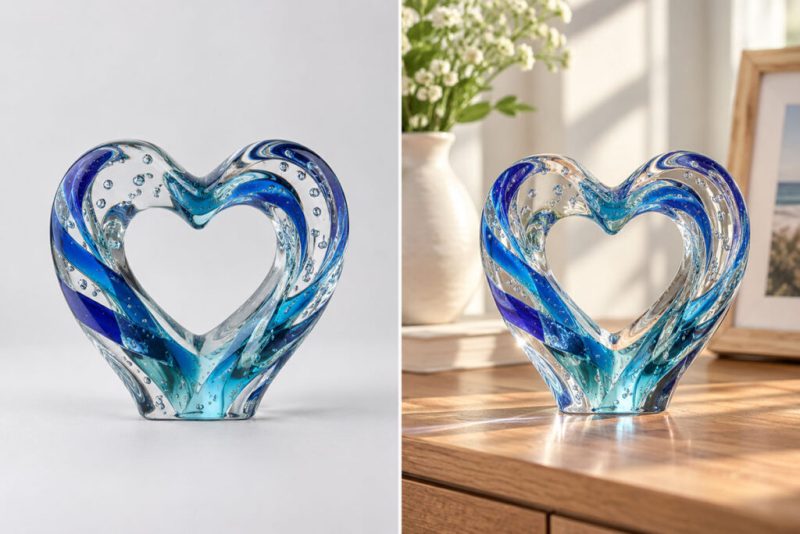
White backgrounds still have an important job.
White and pale neutral backgrounds remain extremely useful in ecommerce because they make products easy to inspect. They remove distractions, create strong contrast and make it easier for shoppers to compare shape, colour, finish and detail.
This is especially important when customers are trying to answer practical questions. What exactly is included? What colour is it? How is it finished? What does the clasp, edge or surface look like?
Baymard Institute’s ecommerce research repeatedly shows that shoppers rely heavily on product images to evaluate details before buying. Their usability testing also found that inadequate image resolution, limited zoom and missing visual information can cause shoppers to abandon otherwise suitable products. [Source: Baymard Institute]
For products where visual comparison matters, a clean background also makes browsing easier. If every product in a category is photographed in a completely different setting, customers have to work harder to compare them.
This is one reason large marketplaces often favour simple primary product images. Amazon, for example, requires the main image for many product categories to show the product clearly against a pure white background. [Source: Amazon Seller Central]
But don’t expect a clean product image to do it all.
A white background can show you what a necklace looks like. It cannot show you where it sits on the neckline. It can show you a lamp, but not how large it feels beside a sofa. It can show you a crystal ornament, but not how it might look displayed on a sideboard in someone’s home.
This is where contextual and lifestyle photography becomes valuable.
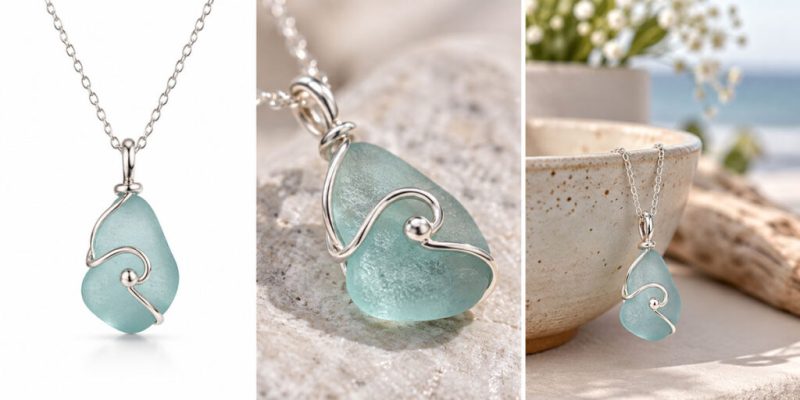
Lifestyle photos help people picture owning the product.
Once a customer understands what the product looks like, the next question is often more emotional: what would this look like on me, in my home or as part of my everyday life?
Research published in the Journal of Business Research compared products shown against plain white backgrounds with products shown in richer, more realistic settings. Across five studies, the researchers found that contextual product displays could increase purchase intention, particularly among female shoppers, because the setting helped customers imagine the product in use. [Source: Journal of Business Research]
The effect is particularly relevant for products that are worn, displayed or experienced rather than selected by specification.
Baymard Institute found during large-scale ecommerce usability testing that simple cut-out images against a white background were not enough for products such as clothing, jewellery, handbags, watches and cosmetics. Shoppers needed to see these products on a person to judge their size, fit and appearance properly. [Source: Baymard Institute]
Take a necklace as an example. A photograph against white can show the colour, shape and clasp clearly. But until you see it around someone’s neck, it can be difficult to tell whether it is tiny and delicate or a large statement piece.
The same applies to handbags. Baymard observed shoppers struggling to judge bag size when they saw a handbag only in isolation. When they saw the same product type worn by a person, customers could immediately understand its proportions. [Source: Baymard Institute]
This doesn’t mean replacing your clean product images. It means adding another type of photograph that answers a different question.
Use the clean image to show the product. Use the lifestyle image to show what owning it could look like.
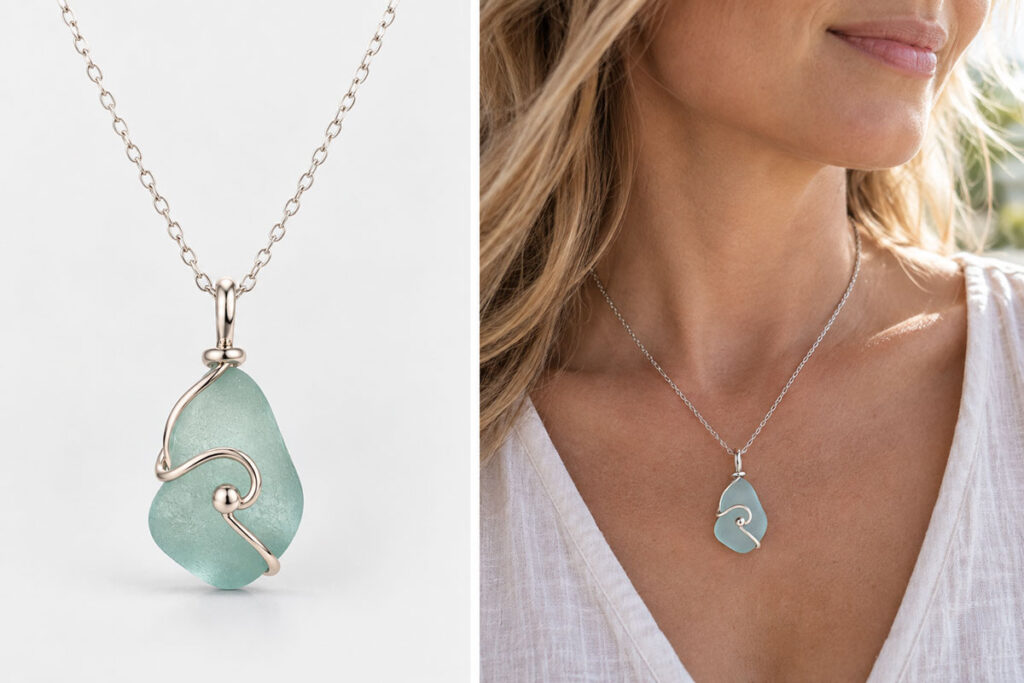
Show the product at the right scale.
One of the biggest weaknesses of product photography is that an isolated image often gives customers no real sense of size.
Baymard Institute found that 42% of shoppers try to judge a product’s size from product images. Without an image showing the product at scale, customers can easily misjudge its size or abandon it because they are unsure. [Source: Baymard Institute]
This matters for far more than furniture. A pendant can look much larger in a close-up than it does when worn. A candle photographed on its own could be 8cm or 30cm tall. A handbag can be difficult to judge until someone is holding or wearing it.
This is particularly important for furniture and home décor. In Baymard’s 2026 research, 49% of shoppers said written dimensions mattered when deciding whether an item would fit in their space, while 42% said they valued images that showed those dimensions. [Source: Baymard Institute, Furniture & Home Decor UX Research 2026]
You can show scale in several simple ways:
- Show jewellery being worn.
- Photograph smaller products in someone’s hand.
- Show furniture inside a realistically proportioned room.
- Place home accessories beside familiar objects such as books or lamps.
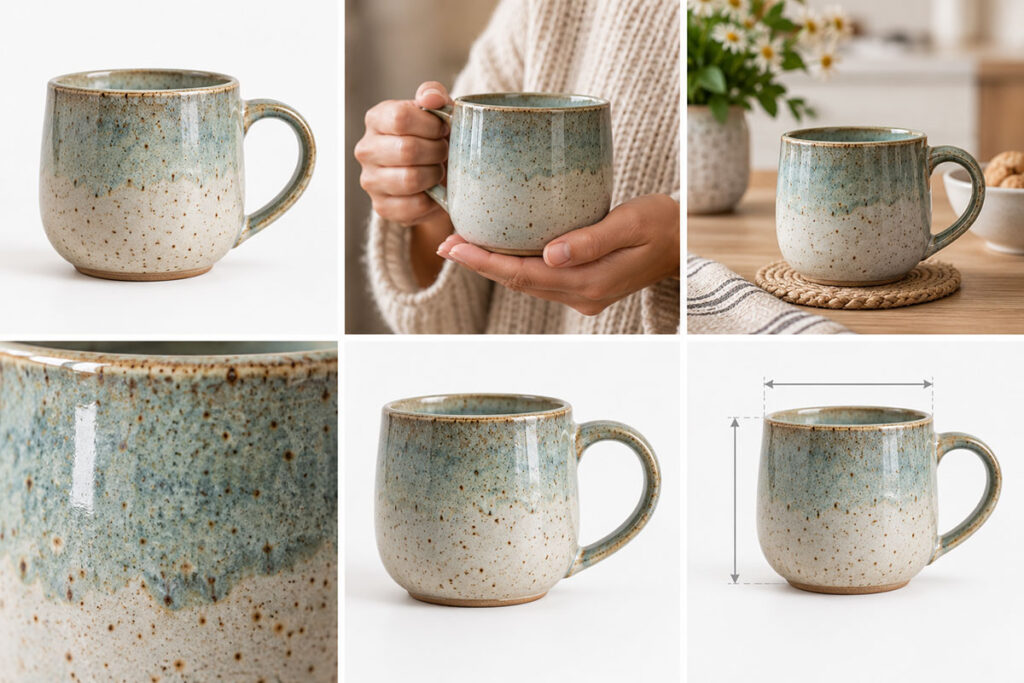
- Add a separate image showing measurements directly on the product.
For products where dimensions matter most, use both approaches. Give customers the exact measurements and show the product in a setting where those measurements make visual sense.
A number such as 32cm tells the customer the technical size. Seeing the same product sitting naturally on a bedside table tells them what 32cm actually looks like.
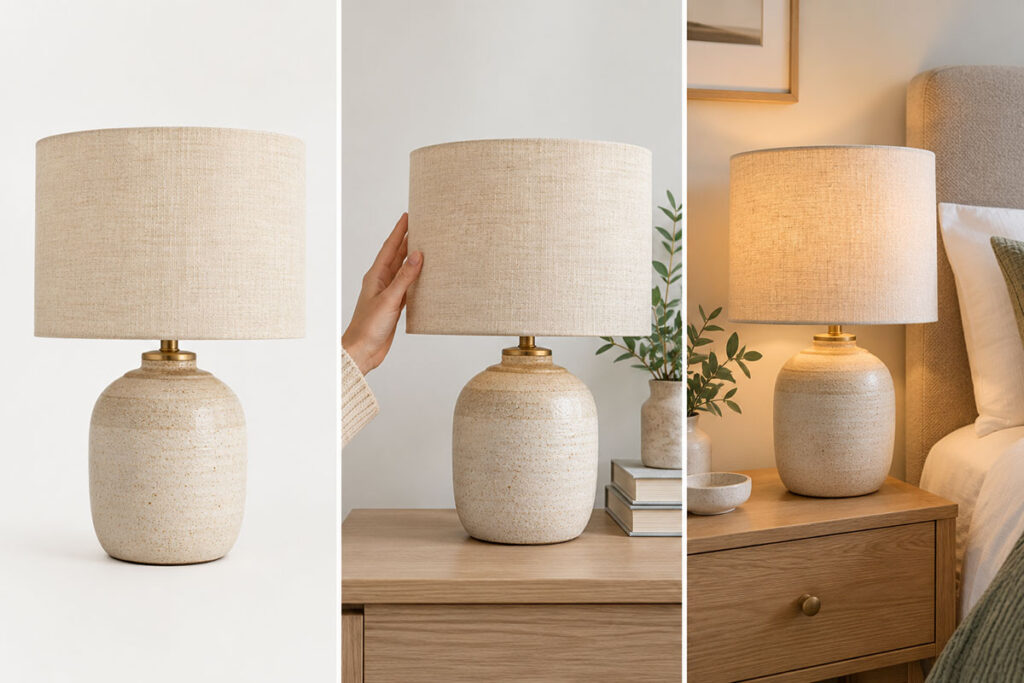
For home décor, context can make a dramatic difference.
Homeware and furniture depend heavily on context because customers aren’t simply buying an object. They are deciding whether that object will work in a room they already have.
This is where some of the most interesting product photography research comes from.
A 2024 study analysed 36,152 online shopping sessions and 1,410 actual sales across three websites selling home décor products. On two of the websites, products shown with contextual backgrounds achieved sales uplifts of 94% and 435% compared with products shown without contextual backgrounds. [Source: Tilburg University, 2024]
Those are striking figures, but they need their own context. The researchers did not find the same effect on Amazon. They concluded that adding a lifestyle background doesn’t automatically increase sales; instead, its effectiveness depends on the website and how customers shop there. [Source: Tilburg University, 2024]
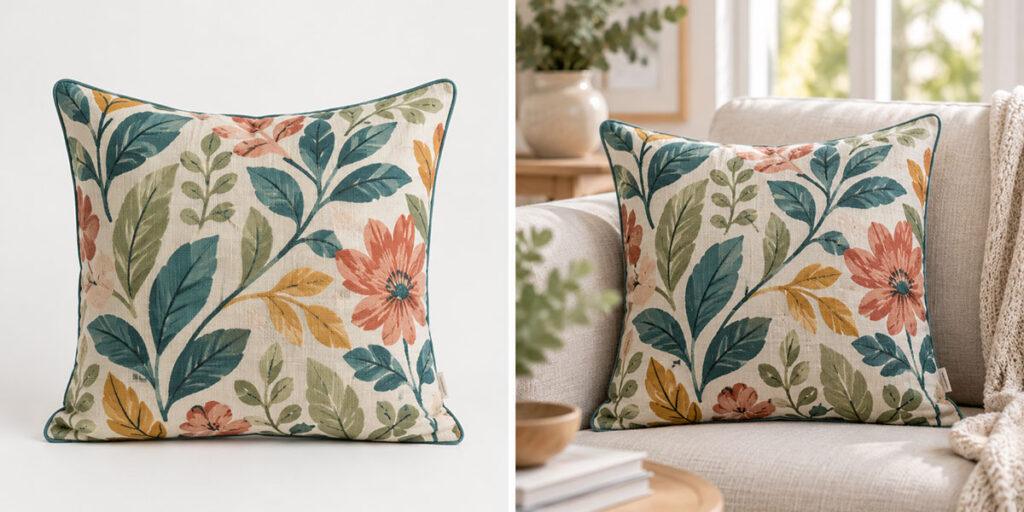
That makes sense for home products. A photograph of a cushion against white shows its colour and pattern. Put the same cushion on a sofa, and you immediately understand its approximate size, how the fabric behaves and the type of interior it might suit.
A lamp photographed on its own shows you the lamp. Put it on a bedside table, and you can judge its proportions, see how much space it takes up and understand the atmosphere it creates when switched on.
Baymard’s 2026 research into furniture and home décor supports this. When shoppers were asked what information they considered important when deciding whether a product would fit their space, 38% selected lifestyle images. [Source: Baymard Institute, Furniture & Home Decor UX Research 2026]
If you sell furniture, lighting, artwork, cushions, ornaments, ceramics or other products designed to be displayed in the home, don’t rely entirely on isolated product shots. Show the product clearly first, then show it where you would expect your customer to use it.
Food photography needs context without distraction.
Food is one of the clearest examples of photography influencing how customers judge the product itself.
A 2024 study looking at food sold through Facebook Marketplace found that the quality of food images significantly influenced both perceived product quality and purchase intention. In other words, people didn’t just judge the photograph. They used the photograph as a cue for judging the food. [Source: DLSU Business & Economics Review, 2024]
For restaurants, bakeries, food producers, and delivery businesses, that makes image quality especially important. Lighting, focus, colour and texture can all affect how appetising the food appears before the customer has any other information to work with.
But adding more props and a more elaborate background does not automatically improve a food photograph.
An eye-tracking study published in Food Quality and Preference found that as backgrounds became more visually prominent, people paid less attention to the food itself. Tableware and decoration could add useful context, but increasingly noticeable backgrounds started competing with the product for attention. [Source: Food Quality and Preference]
Research into product-image backgrounds more generally found something similar. More complex backgrounds attracted more attention, but much of that attention went to the background rather than the product. Moderate background complexity produced the best results for product information processing and purchase intention. [Source: Journal of Business Research]
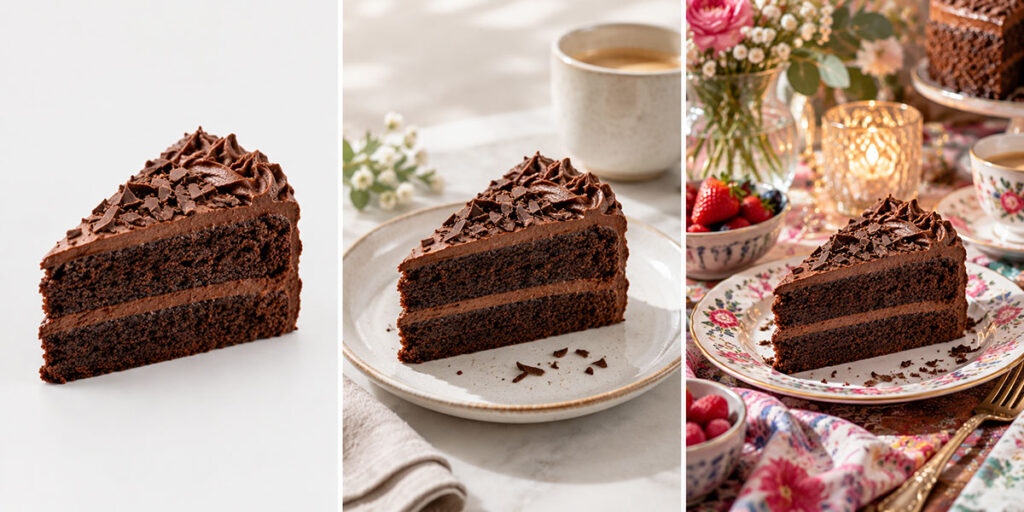
For food photography, the aim is to create enough atmosphere to make the product appealing without building a scene that overwhelms it.
A slice of cake might look more inviting on a ceramic plate with a cup of coffee and soft daylight than against a completely white background. But if you add flowers, cutlery, patterned napkins, ingredients, books and colourful decorations, the customer’s eye may have too many places to go.
The food should still be the obvious hero of the photograph.
Fashion products need to be shown on a person.
Clothing is one of the clearest examples of why a clean product image is not enough on its own.
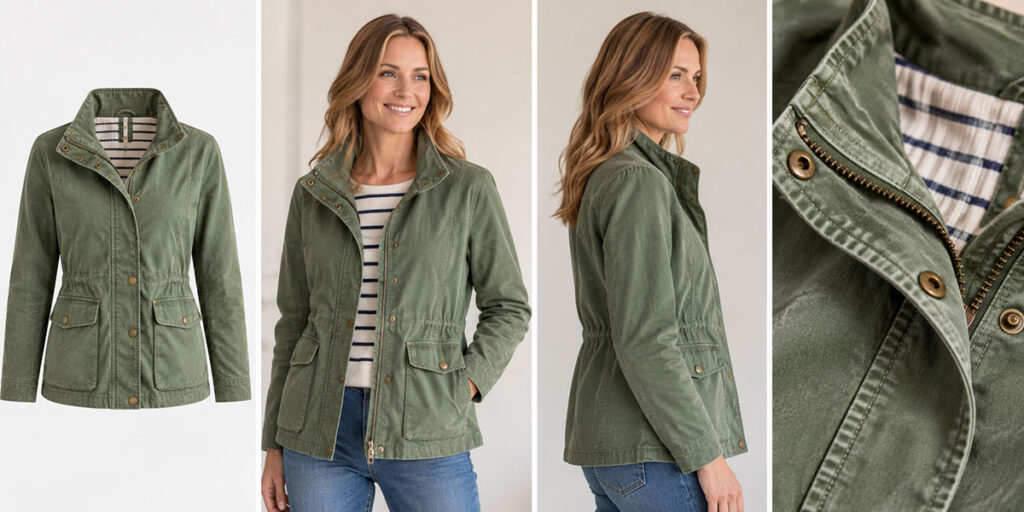
A cut-out photograph against white can clearly show colour, pattern, and construction. But it cannot show how the garment hangs, where it sits on the body, or how long it looks when worn.
Baymard Institute found in e-commerce usability testing that shoppers struggled to judge apparel when products were shown without a human model. Model photography helped customers understand fit, length, proportions and overall appearance far more quickly. [Source: Baymard Institute]
The same principle applies to accessories.
A handbag photographed on its own may look compact or oversized depending on the crop. A watch can appear much larger in a close-up than it does on a wrist. A pair of earrings can be difficult to judge until you see them beside a face.
For fashion products, the most useful image set usually combines several views:
- A clean product image against white or a pale neutral background.
- The product worn by a person.
- A close-up showing texture, stitching, finish or fastening.
- A wider image showing the complete outfit or overall proportions.
- Alternative angles where they help explain fit or shape.
This is particularly important when the product’s value depends on appearance rather than specification. Customers are not only asking, “What does this look like?” They are asking, “What might this look like on me?”
Close-up images help customers judge quality.
When customers cannot pick up a product, turn it over or examine it closely, your photographs have to do that job for them.
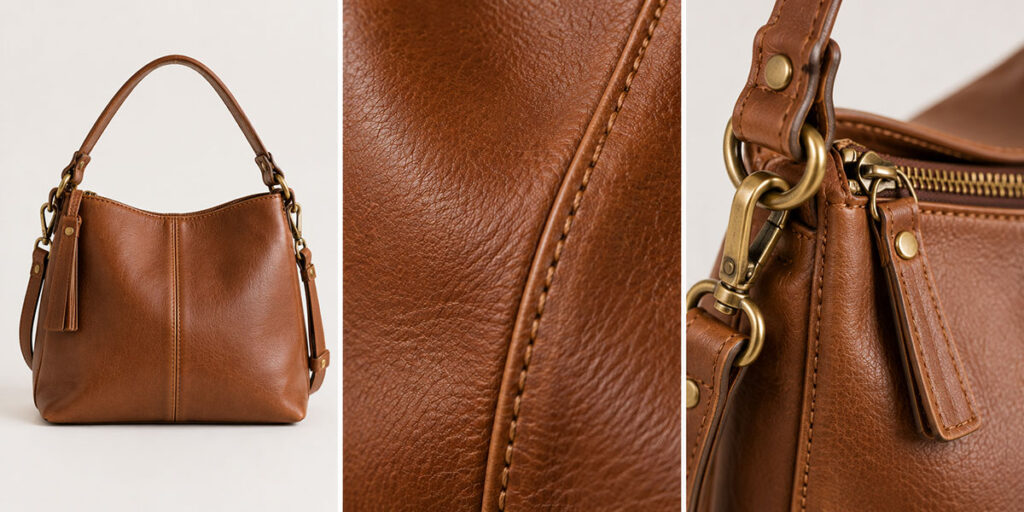
This is why close-up and detail photography is particularly important for products where material, texture and craftsmanship influence the buying decision.
Baymard Institute’s usability research found that customers frequently use zoom and high-resolution images to inspect product details that are difficult to judge from the standard product view. [Source: Baymard Institute]
Think about the details that could reassure someone about the quality of what they are buying. For jewellery, that might be the setting, clasp or surface of a stone. For clothing, it could be stitching, buttons and fabric texture. For furniture, customers may want to inspect the wood grain, upholstery, or finish.
These photographs can also answer questions that would otherwise require a visit to a physical shop.
Is the fabric smooth or heavily textured? Is the pottery perfectly uniform or intentionally handmade? Does the metal have a polished or brushed finish? Can you see the natural variations in the material?
Don’t assume customers will zoom in on your main photo to find these details. Include dedicated close-up images that deliberately draw attention to the features that make the product worth buying.
For handmade and premium products in particular, those small details can be part of why someone is willing to pay more.
Technical products need clarity more than atmosphere.
Not every product benefits equally from lifestyle photography.
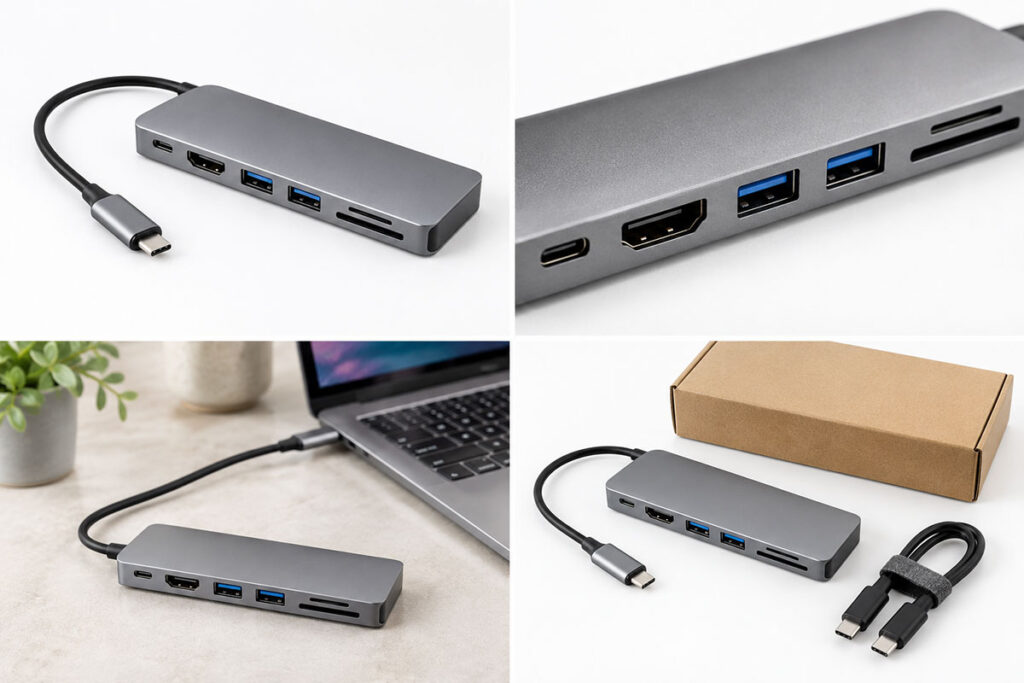
For technical products, like replacement parts and items bought mainly by specification, customers usually want quick answers to practical questions. Is this the right size? Is it compatible? What connections does it have? What exactly is included?
Research into contextual product imagery found that background context is more useful for products where imagination and experience play an important role in the buying decision. For more functional or search-based products, where customers focus on objective features, contextual imagery offers much less benefit. [Source: Journal of Retailing and Consumer Services]
That means a replacement printer cartridge, cable, power adapter, or drill bit doesn’t need an elaborate lifestyle setting to sell effectively.
In these cases, the most useful photographs are usually:
- A clear image of the complete product.
- Alternative angles showing ports, fittings or connectors.
- A photograph showing exactly what is included in the box.
- A scale or measurement image where size matters.
- A close-up of model numbers, labels or important technical details.
You can still use an in-use photograph, particularly if it helps explain what the product does. But the lifestyle image should support the technical information, not replace it.
A USB adapter, for example, might benefit from one photograph showing it connected to a laptop. But customers will likely care far more about seeing the ports clearly and knowing whether it works with their device.
The best product photography is not always the most attractive. It is the photography that removes the most uncertainty before someone buys.
Use more than one type of product image.
The strongest product pages rarely rely on a single photograph.
Different images answer different questions, so a strong product gallery usually combines several types of photography rather than repeating the same view from slightly different angles.
Baymard Institute’s ecommerce research found that shoppers often need several images to understand a product properly. In product listings, just one or two images were frequently not enough to give users the information they needed before deciding whether to click through or buy. [Source: Baymard Institute]
A useful product image set might include:
- A clean hero image that clearly shows the complete product.
- A lifestyle image showing the product in use.
- A scale image showing how large or small it is.
- A close-up showing material, texture or craftsmanship.
- An alternative angle showing the back, side or underside.
- An image showing what is included with the product.
- A measurement image where dimensions matter.
The exact mix will depend on what you sell.
A piece of jewellery may need a clean product shot, an image worn on a person, a close-up and a scale image. A sofa may need a clean front view, several room settings, fabric details and measurements. A technical product may need clear connector shots, compatibility information and an image showing everything included in the box.
The goal is not to add photographs to fill a gallery. Each image should remove a specific doubt or answer a question a customer may have before buying.
Bright backgrounds can attract attention, but they are not always better for selling.
Colour can influence how a product image feels, but it is easy to overstate its effect on sales.
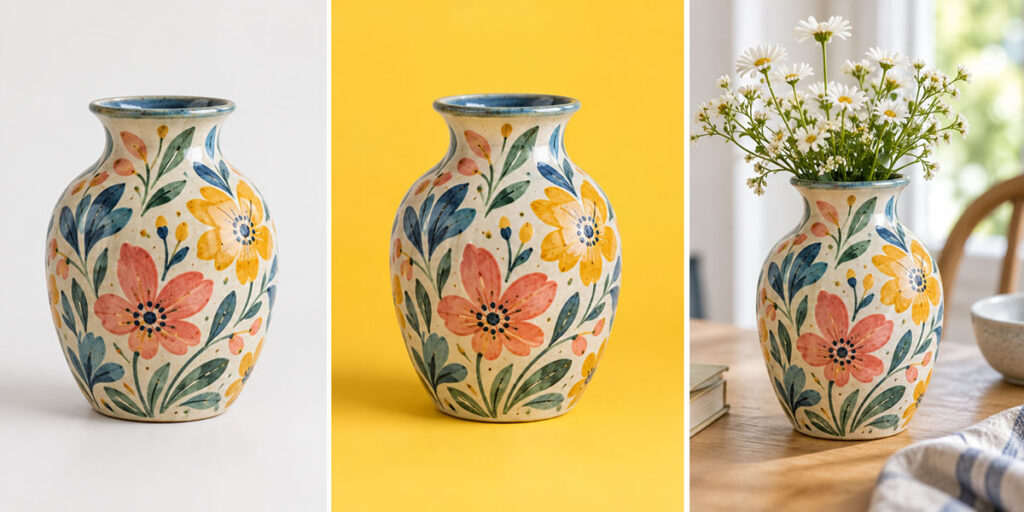
Bright colours such as yellow, orange and pink are often used in advertising because they attract attention quickly and create a more energetic, optimistic feel. This can be useful in social media posts, promotional graphics and campaign imagery where the first job is to stop someone scrolling. [Source: Mailchimp, Colour Psychology]
That does not mean a bright background will automatically improve conversion on a product page.
Research into product-background contrast shows that the relationship between a product and its background can influence how large, clear and visually prominent the product appears. Strong contrast makes an item easier to evaluate, while poor contrast makes edges and details harder to distinguish. [Source: Research on product-background colour contrast]
This is one reason neutral backgrounds remain so useful. They create consistency and let the product provide the colour.
For lifestyle photography, however, brighter settings can work well when they suit the product and the mood you want to create. A children’s product may feel more appealing in a cheerful, colourful room. A summer accessory may suit warm sunlight and bright surroundings. A luxury watch may need something far more restrained.
The background should support the product, not compete with it.
If the first thing you notice is the background colour rather than what you’re selling, the photograph is probably doing too much.
What about personalised and sentimental products?
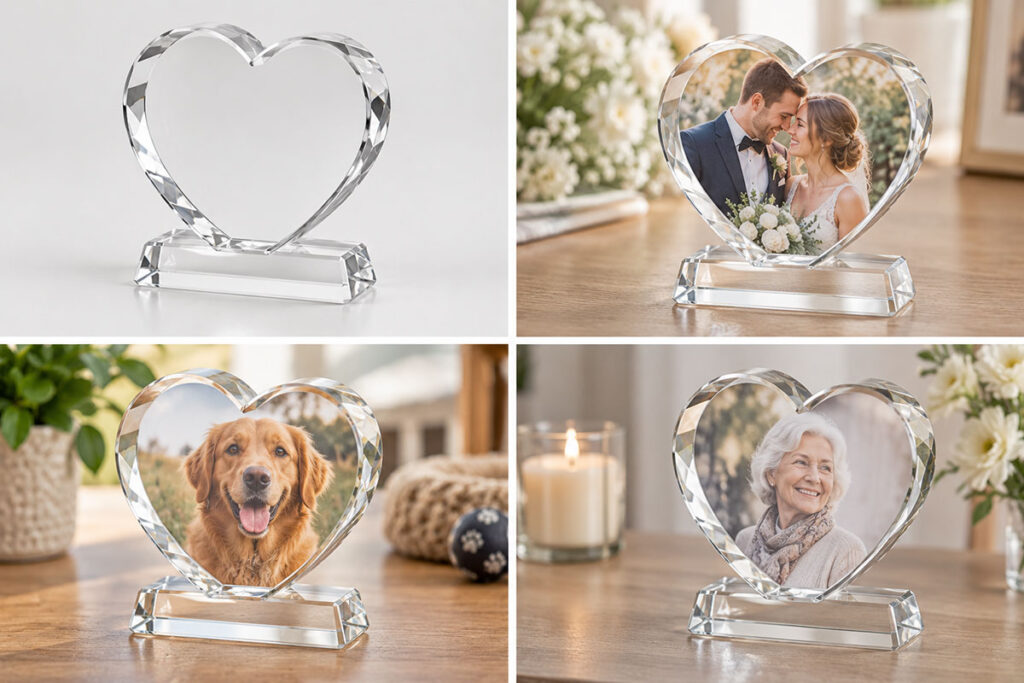
Personalised products have an additional challenge. Customers are not simply evaluating the object itself. They imagine what it will mean when it contains their own photograph, name, message, or memory.
A plain product photograph can show the shape and quality clearly, but it may struggle to communicate that emotional value.
Research into mental imagery in online shopping has found that photographs showing products in relevant usage situations can help people imagine interacting with or owning the product. That mental imagery can, in turn, increase purchase intention. [Source: Frontiers in Psychology]
This makes contextual photography particularly useful for personalised gifts.
For example, a personalised crystal containing a wedding photograph could be shown on a bright sideboard alongside subtle wedding-related details. A pet photo gift could sit naturally in a home. Photograph a personalised keyring with someone’s keys rather than floating it against an empty background.
The occasion matters too. If the same product suits weddings, anniversaries, birthdays, pets, and memorial gifts, don’t rely on one photographic style to represent every reason someone might buy it.
A gallery dominated by black backgrounds and monochrome portraits may communicate remembrance very effectively, but it can make the same product feel less appropriate for a wedding, anniversary or happy family occasion.
Instead, vary the context while keeping the product photography consistent. Show the product clearly, then use additional images to show the different occasions, emotions, and settings it can fit into.
For personalised products, you are selling both the physical object and the meaning the customer can give it.
What is the best product photography approach?
The research points to a simple conclusion: no single background, colour, or photography style works best for every product.
What matters is whether your images answer the questions a customer needs answered before they feel confident buying.
The best product photography is therefore not necessarily the brightest, most colourful, or most artistic.
It is the photography that makes the product easiest to understand and easiest to imagine owning.
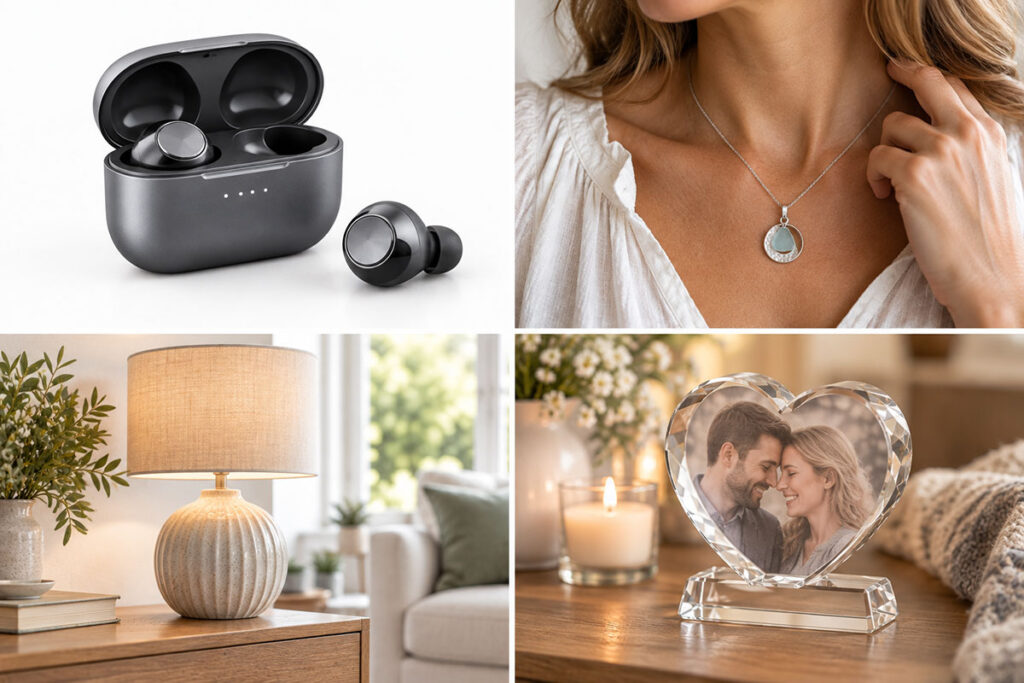
A simple product photography checklist
Before publishing a product, look through its image gallery and ask whether a customer can understand the product without seeing it in person.
- Start with a clear hero image. Show the complete product without unnecessary distractions.
- Show it in context. If the setting helps customers understand how the product is used, worn or displayed, include a lifestyle photograph.
- Make the size obvious. Use a person, hand, familiar object, room setting or measurement image to provide scale.
- Get close. Photograph materials, textures, stitching, finishes, and other details that show quality.
- Show different angles. Include the back, sides, fittings, fastenings or connections where they matter.
- Show what is included. If the customer receives accessories, cables, packaging or additional components, photograph them together.
- Keep backgrounds relevant. Bright and colourful can work brilliantly, but only when the background supports the product rather than overwhelms it.
- Use good lighting and high-resolution images. Customers should be able to zoom in and clearly inspect important details.
- Think about why someone is buying. A wedding gift should feel different from a memorial gift. A luxury product should feel different from a replacement cable.
You don’t necessarily need an expensive studio or dozens of photographs. You need a carefully chosen set of images that answers the questions someone would naturally ask while holding the product.
Start with clarity, then add context. Show customers exactly what they are buying, then help them picture what owning, wearing, using or giving it might feel like.