When you hire someone to work on your SEO, there are two things they need from you before they can do a good job.
First, they need access to your website and the data that shows how it is currently performing.
Second, they need information about your business.
The technical side tells them what is happening. The business information helps them decide what is actually worth improving.
Part 1: The technical information and access your SEO person needs
Before making changes, your SEO person needs to understand what is already happening with your website. That means getting access to the right accounts rather than starting from assumptions.
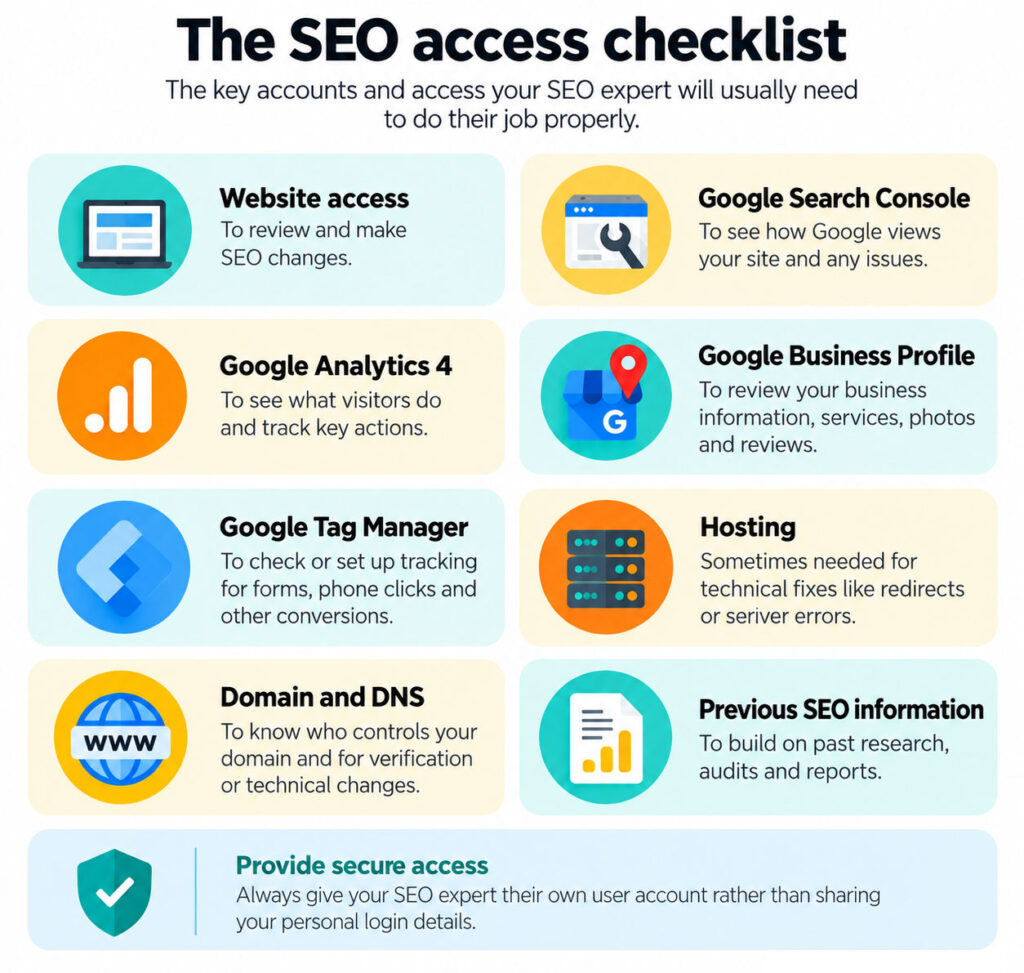
| They need access to | Why | What if you don’t provide it or have it? |
|---|---|---|
| Website, e.g. WordPress | To review the site and make SEO changes. | They can audit the public website, but they can’t properly investigate or make changes. |
| Google Search Console | To see search performance, indexing issues and how Google sees the site. | They will be missing valuable data directly from Google. If you don’t have it, it should be set up. |
| Google Analytics 4 | To see what visitors do and whether they complete useful actions. | It becomes harder to measure whether SEO traffic is actually producing enquiries or other results. If you don’t have it, it can be set up. |
| Google Business Profile | To review and improve local business information and visibility. | For local SEO, they won’t be able to review or make changes to your profile. If you don’t have one, they can check whether your business is eligible for one. |
| Google Tag Manager | To check or set up tracking for forms, calls and other conversions. | This isn’t essential if your website doesn’t use it. Tracking can be set up another way if needed. |
| Hosting | To fix technical issues such as redirects, errors or performance problems. | They may need to ask your web designer or hosting company to make technical changes for them. |
| Domain and DNS | For verification and any technical changes involving the domain. | Usually not a problem until a change or verification is needed. They will need to know who controls it. |
| Previous SEO reports or tools | To see what has already been researched or changed. | They may have to start from scratch and could repeat work that has already been done. |
Website access
Your SEO person will usually need access to your website. For a WordPress website, this normally means their own administrator account.
They need this to inspect how the site is built and, depending on what you’ve agreed, make changes to pages, content, headings, internal links, images, metadata and other parts of the website.
Give them their own user account rather than sharing your username and password. That way, you can remove their access later without changing your own login details.
Google Search Console
Google Search Console is one of the first things I want access to when starting an SEO project.
It provides information directly from Google about how your website performs in its search results.
I can see which searches your website has appeared for, which searches have generated clicks, which pages Google is showing and whether Google is having problems crawling or indexing parts of the site.
It also gives me historical information. That can be particularly useful when someone tells me, “We used to get a lot more enquiries from Google.”
Google Analytics 4
Google Search Console tells me a lot about what happens in Google. Google Analytics helps me understand what happens when someone reaches the website.
Which pages are being visited? Where are visitors coming from? What do they do next? Are people submitting forms or taking other useful actions?
I also want to check whether important actions are actually being tracked. There’s little point producing an SEO report showing increased traffic if we have no idea whether any of those visitors became enquiries.
Google Business Profile
For a local business, I will normally want access to the Google Business Profile too.
This is the business listing that can appear in Google Maps and local search results.
I can check whether the basic information is correct, how the business is categorised, which services are listed and whether the profile and website support each other.
Google Tag Manager
Not every website uses Google Tag Manager, but if yours does, your SEO person may need access.
It is often used to manage tracking for actions such as enquiry form submissions, telephone clicks, downloads and other useful events.
Access also helps avoid adding duplicate tracking or changing something without knowing how the existing setup works.
Hosting
Your SEO person may occasionally need access to your hosting account.
An SEO expert may not be able to fix technical problems from inside WordPress or another website platform. Hosting access may be required to investigate redirects, server errors, performance problems or other technical issues.
They may not use it every week, but they should know who manages the hosting and how to get the right access when needed.
Domain and DNS
Your SEO person shouldn’t need to start changing your DNS records as part of everyday SEO work.
However, they should know where your domain is registered and who controls the DNS.
This can matter for verification, website migrations, domain changes, and certain technical problems.
Previous SEO information
If another company has previously worked on your SEO, don’t throw their reports in a drawer because you’ve changed supplier.
Send them over.
Previous keyword research, SEO audits, reports, backlink lists, and information about changes made to the website can help establish what has already happened.
The same applies to SEO tool accounts such as Ahrefs or Semrush, if your business owns them.
Part 2: The business information your SEO person needs
Once I have access to all the technical information, I can see quite a lot.
What I can’t see in Google Analytics or Search Console is which jobs you enjoy doing, which services make you money or which enquiries make you groan when they arrive.
That’s where I need you.
What do you actually want more enquiries for?
This isn’t necessarily the same as asking what services you offer.
A building company might offer extensions, garage conversions, roofing, repairs and new builds. That doesn’t mean all five should receive equal SEO attention.
Perhaps garage conversions are particularly profitable. You may want more extensions but already have enough small repair work.
Your SEO person needs to know where you want the business to grow.
Which work is most valuable to you?
You don’t need to hand over your accounts, but some indication of the relative value of your services is extremely useful.
If one service typically results in a £5,000 project and another brings in £150 jobs, that can affect where the SEO budget is best spent.
More website traffic isn’t automatically better. Ten visitors looking for a valuable service you want to sell could be worth considerably more than 100 visitors looking for something you don’t particularly want.
Where do you want customers to come from?
Tell your SEO person where you actually work.
That might be within 20 miles of your premises, throughout Fife, across Scotland or anywhere in the UK.
It can also vary by service. You might travel considerably further for a large project than you would for a small job.
Don’t assume your SEO person can work this out from the address in your website footer.
Who are your customers?
Who normally buys from you?
Homeowners? HR managers? Brides? Hotel owners? Facilities managers? Other small businesses?
Different customers search differently and have different questions before they buy.
If you serve several different types of customers, tell your SEO person which ones you particularly want more of.
What do your customers call what you do?
Businesses often use terminology that their customers don’t.
Your SEO person can carry out keyword research, but you can provide something equally useful: the words real customers use when they speak to you.
Look at enquiry forms and emails. Think about what people say when they phone.
Those conversations can reveal completely different ways of describing your services.
What questions do customers ask?
The questions you answer every week can become some of your best website content.
How much does it cost?
How long does it take?
Do I need planning permission?
Do you cover my area?
What’s included?
Can you do this in an older property?
These questions aren’t just FAQs. People search Google and ask AI tools these same questions when they’re researching what to buy.
Who are your competitors?
Give your SEO person a few businesses you consider your main competitors.
They may find some others.
The companies you compete against commercially aren’t necessarily the same websites you’re competing against in Google.
Both are useful to investigate.
What don’t you want more of?
This is surprisingly important.
Perhaps you still provide a service to existing customers but don’t particularly want new enquiries for it.
Maybe you’ve stopped offering something altogether, but it is still mentioned on the website.
Or one service generates plenty of enquiries but rarely produces profitable work.
Tell your SEO person. Otherwise, they may see an obvious search opportunity and start trying to increase something you don’t actually want.
What does a good enquiry look like?
Twenty enquiries sounds better than ten.
But what if 15 of those 20 were outside your service area or wanted something you don’t provide?
Your SEO person needs feedback about the quality of the enquiries being generated.
Which ones became customers? Which were unsuitable? Are you suddenly getting more enquiries for a particular service?
SEO shouldn’t just be measured by how many people reach the website. What those people do afterwards matters.
What have you tried before?
Tell your SEO person about previous SEO companies, Google Ads campaigns, website rebuilds, deleted pages, old domains and major changes you’ve made to the website.
You don’t need to know whether something is relevant.
Just tell them what happened and roughly when. They can decide whether it matters.
A few SEO red flags
I’d be cautious if an SEO expert is ready to start work without asking for much of the above.
They should want access to the data rather than relying entirely on third-party SEO tools. They should also ask about your services, customers, locations, priorities, and what a valuable enquiry looks like.
If most of the initial conversation is about rankings, backlinks and getting more traffic, but nobody has asked what you actually want more business for, something is missing.
An SEO person doesn’t need to know your business as well as you do.
But they do need you to tell them enough about it to make sensible decisions.
Otherwise, they could do a technically excellent job of getting you found for entirely the wrong things.
Can an SEO expert do their job without access to your data?
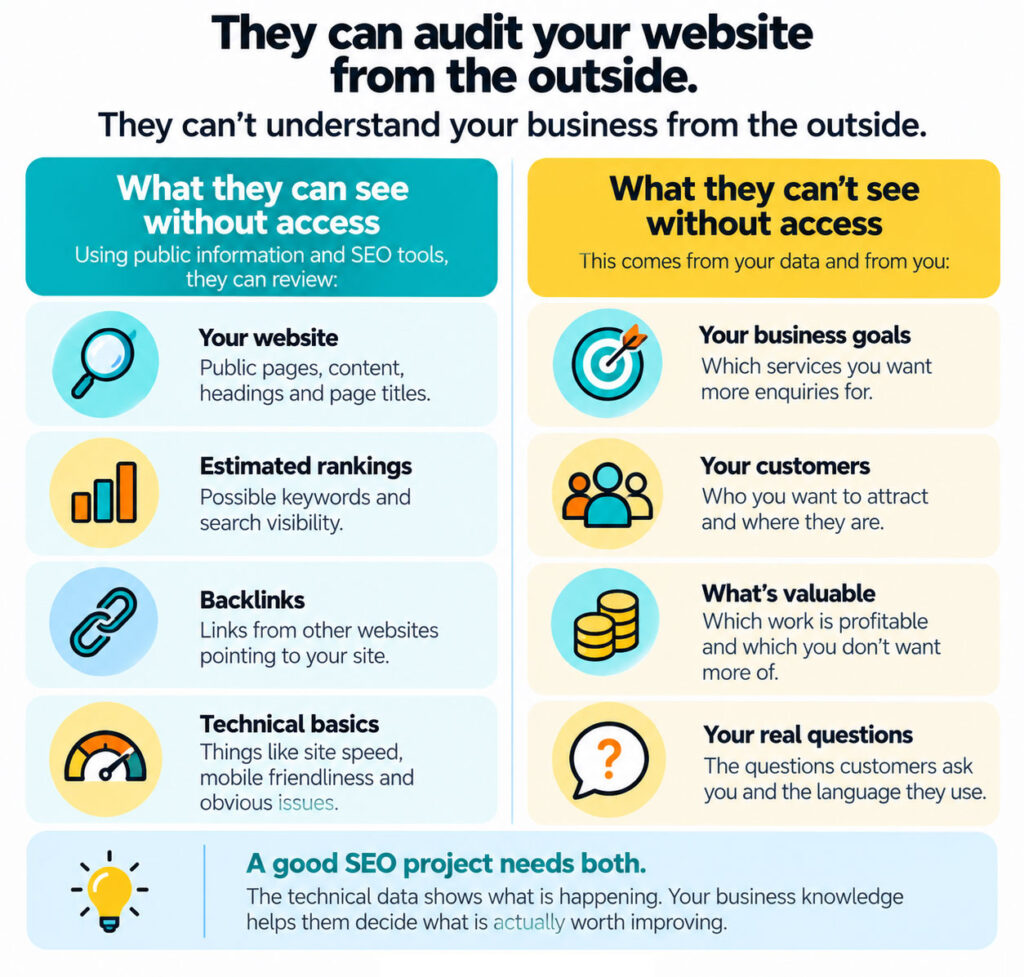
If an SEO company cold calls you and says they have analysed your website, that doesn’t necessarily mean anything suspicious is going on. Quite a lot of SEO information is publicly available.
They can crawl your website and review your pages, headings, page titles, internal links, and technical setup. They can use tools such as Ahrefs or Semrush to estimate which keywords you rank for, review backlinks, compare your website with competitors, and identify potential problems.
That’s enough to carry out an initial review. It isn’t enough to run an SEO campaign properly.
They can’t see some information from the outside.
Google Search Console shows actual data from Google about how your website performs in search, including the queries your site has appeared for, clicks, impressions, positions and indexing issues. GA4 can show what happens after people reach your website and, when tracking is set up correctly, whether they complete important actions.
Then there is information that no SEO tool can provide: what is happening inside your business.
An SEO company looking at your website might spot an opportunity to increase traffic to one of your services. What they don’t know is whether that service is profitable, whether you have capacity for more of that work, whether those enquiries tend to convert into customers or whether it is something you would rather stop promoting altogether.
That’s why I would be wary of anyone proposing an ongoing SEO strategy without asking for access to your data and asking detailed questions about your business.
They can audit your website from the outside. They can’t understand your business from the outside.
A good SEO project needs both. The technical data tells your SEO person what is happening. Your business knowledge tells them which of those things are actually worth improving.