Quick summary
Campsite SEO: Small campsites can still get found on Google, even when booking websites dominate broad searches. Focus on searches that match your location and facilities, provide useful information, keep your Google Business Profile accurate and make direct booking easy.
Main websites people use to find and book campsites
Pitchup and Campsites.co.uk are major specialist booking platforms to consider, alongside Hipcamp. The camping clubs also help people find places to stay, but they work differently from commercial booking platforms.
There is no directly comparable public league table showing each website’s share of UK campsite bookings. The figures below show their scale, but visits, listings and bookings measure different things.
| Website | What it offers | Evidence of its scale |
|---|---|---|
| Pitchup | Online booking for camping, touring, glamping and holiday parks. | Reports 63 million website visits annually and more than 6,000 accommodation options worldwide. These are international figures, not UK-only numbers. [Pitchup] |
| Campsites.co.uk | A specialist UK website for camping, touring and glamping, with online booking. | Says it connects campers with more than 3,000 UK sites, helping thousands of campers book each week. [Campsites.co.uk] |
| Hipcamp | Booking for tent pitches, glamping, caravan sites and private-land camping. | Operates in the UK and internationally. A comparable UK booking or visitor total was not verified for this article. [Hipcamp] |
These figures come from the platforms themselves. They demonstrate their reach, rather than providing an independent ranking of the most-used UK campsite booking websites.
Camping clubs and campsite directories
These websites also help guests discover campsites. They should not all be described as online travel agencies, or OTAs.
| Website | How it differs |
|---|---|
| Caravan and Motorhome Club | A club network with booking and campsite search facilities. Its UK directory includes over 2,100 small, privately owned Certificated Locations. [Caravan and Motorhome Club] |
| The Camping and Caravanning Club | Offers Club Site bookings and access to small member-only campsites. Membership requirements depend on the type of site. [The Camping and Caravanning Club] |
| UKCampsite.co.uk | Primarily a directory and review website, reporting over 250,000 reviews. Visitors can contact campsites through listing forms or follow links to their websites to book. [UKCampsite.co.uk] |
How many campsites are there in the UK?
The UK Caravan and Camping Alliance’s “Pitching the Value” report, published in February 2024 using 2023 data, identified 6,169 holiday parks and campsites across the UK. [UK Caravan and Camping Alliance: Pitching the Value, 2024]
| Country | Holiday parks and campsites |
|---|---|
| England | 4,754 |
| Wales | 922 |
| Scotland | 401 |
| Northern Ireland | 92 |
| UK total | 6,169 |
Source: Table 4.1, UKCCA and Frontline Consultants, 2023 data. [UK Caravan and Camping Alliance: country breakdown]
These figures cover holiday parks and campsites, including caravan and lodge parks and small certificated sites. They are not a count of tent campsites alone. The report also acknowledges that its database does not include every site, so the figures are a documented sector estimate rather than a complete current census. [UK Caravan and Camping Alliance: scope and methodology]
What does this mean for a small campsite?
Booking websites have a clear advantage when someone wants to compare lots of campsites. Campsites.co.uk alone lists more than 3,000 UK sites, while Pitchup reports 63 million website visits a year worldwide. [Campsites.co.uk] [Pitchup]
That helps explain their reach, but it does not mean an individual campsite has to compete with them for every search. Focus on the searches that match your location, facilities and the type of stay you offer.
You search for campsites in your area, and the results are full of booking websites. Pitchup, Tripadvisor and other directories appear before individual campsites. Even finding your own website takes some scrolling.
It is a fair question: if these companies take up so much space, is it realistic to expect a small campsite website to get found?
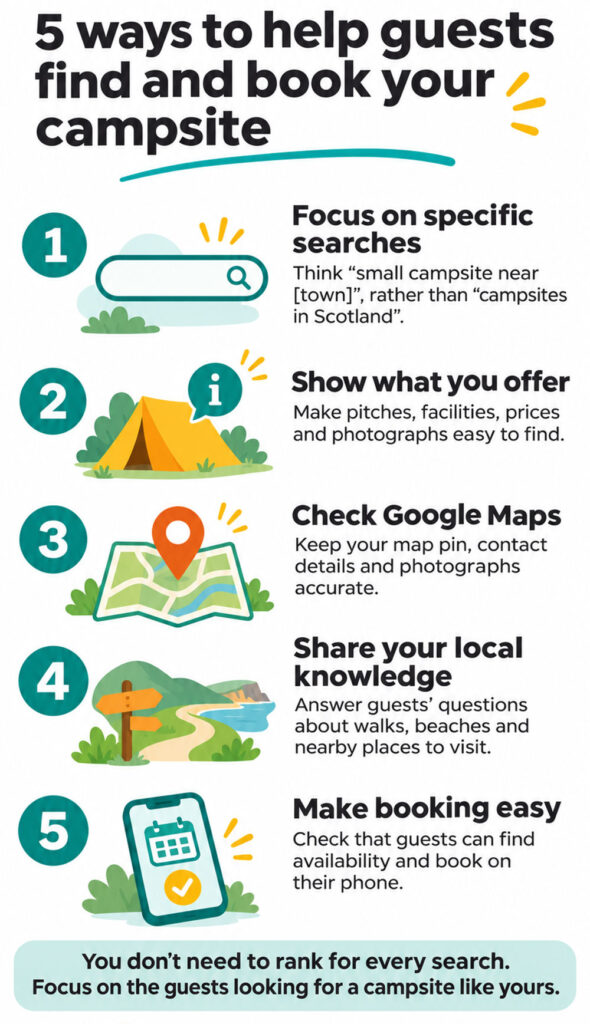
Yes, but you need to be realistic about which searches you target and what you expect your website to achieve. Ranking above the major booking platforms for “campsites in Scotland” is a very different challenge from reaching someone looking for a small touring site near a particular village.
Your website can still earn its place. The work starts with understanding where you can offer a useful answer.
Why do the big booking sites appear so often?
Booking platforms, sometimes called online travel agencies or OTAs, bring together information about many campsites. For someone still comparing destinations, facilities and prices, that is useful.
A person searching for “campsites in Fife” might want a choice of sites rather than information about one particular business. A directory can help them compare.
These platforms also have established brands, extensive websites and resources that a small campsite cannot easily match.
That makes broad searches competitive. That doesn’t mean every search offers the same challenge, or that spending more money automatically buys a higher position in ordinary search results. Google distinguishes paid advertising from its organic rankings.
Start with the searches that suit your campsite.
“Campsites in Scotland” covers an enormous range of holidays. Someone could want a remote tent pitch, a large holiday park or somewhere to stop in a motorhome.
A more specific search tells you much more about what the guest needs:
- Small campsite near Dunfermline.
- Touring pitches with electric hookups in Fife.
- Campsite within walking distance of a village.
- Camping near the Fife Coastal Path.
- Campsite with hardstanding pitches near Edinburgh.
These are examples to investigate, rather than a guaranteed list of easy keywords. Some will still be competitive, and some may attract very few searches.
Choose the ones that accurately describe your campsite. Then make sure your website explains those features clearly.
If guests can walk to the village, give the distance, approximate walking time and details of the route. If you welcome larger motorhomes, explain pitch dimensions and access. Specific information helps people judge whether your site will work for them.
Give each main page a clear purpose.
Before committing to a busy blogging schedule, check your main pages.
Can visitors easily find information about your pitches, facilities, location, prices and booking arrangements? Does the website explain where you are, beyond showing a postcode in the footer?
A page called “Touring pitches” should answer the questions someone has before booking a touring pitch. Include photographs, available surfaces, electric hookups, size restrictions and relevant facilities.
Your location page can explain nearby places, driving distances and public transport. Keep it honest: being an hour’s drive from an attraction is different from being on its doorstep.
You do not need a separate page for every nearby town. A collection of almost identical pages with different place names offers little help to a guest.
Make your website worth visiting.
A booking listing follows the platform’s format. Your own website has room to explain the details that make staying with you different.
Useful information might include:
- Photographs showing the pitches, views and facilities.
- Whether the ground slopes and where vehicles can park.
- How quiet the site is, including nearby roads or working farm activity.
- Walks that start at the gate.
- Where guests can buy food or get an evening meal.
- What happens if they arrive late.
You don’t need to describe every campsite as a “hidden gem”. Tell people what they will actually find.
A small site with basic facilities can be exactly what someone wants. Clear descriptions help attract suitable guests and avoid disappointed expectations.
Google Maps deserves attention too.
The standard website listings are only part of Google Search. Your Google Business Profile can also help people discover your campsite through local results and Maps.
Google says local results mainly depend on relevance, distance, and how well known a business is. Complete and accurate business information with genuine reviews can support local visibility, although they do not guarantee a particular position.
Check that your map pin, website link, telephone number, business category and opening information are accurate. Add photographs that reflect the current site.
Ask guests for honest reviews and respond helpfully. Reviews also give prospective visitors something useful to read while deciding whether to book.
Use local knowledge to support your website.
Blog posts can help when they answer questions your guests actually ask.
For a campsite in Fife, suitable topics might include walks from the site, visiting nearby villages without a car, or planning a few days along the coast.
Make the connection to staying with you clear. Include practical details and link to relevant accommodation or booking pages where they help the reader.
Prioritise a few useful articles you can maintain. A long list of generic posts creates more work without necessarily making the website more helpful.
Booking platforms and direct bookings can work together.
You do not have to choose between appearing on booking platforms and investing in your website.
A platform may introduce your campsite to someone who has never heard of it. Your website can support guests who find you through recommendations, local tourism websites, Maps or a search for your business name.
Make sure those visitors can quickly confirm they have found the official website and understand how to book.
Explain any genuine benefits of booking directly, such as access to your full range of pitches or advice about choosing a suitable spot. Only promise the best price if you can consistently honour that claim.
Measure bookings, not just rankings
A first-page position matters only if it brings suitable guests to your business.
Look at whether your website generates enquiries and completed bookings. Ask guests how they heard about you. Use Google Search Console to understand which searches bring visitors, and check whether people can complete your booking process easily on a phone.
A small campsite has no universal visitor target. Your capacity, season, occupancy and booking value all affect what worthwhile progress looks like.
Google itself makes clear that no technique automatically guarantees first place. Be wary of anyone selling that promise.
Is campsite SEO worth the effort?
It can be, provided the work reflects your campsite, budget and available capacity.
Expecting a small website to dominate every broad camping search is unlikely to be a sensible goal. Building visibility for relevant searches, helping guests find your official website and making direct booking easier are more practical aims.
Start by checking your main pages, Google Business Profile and booking process. Those improvements give future visitors a better chance of finding what they need and choosing to stay.
Want to understand where your campsite website can improve? Contact Business Image Services to discuss a website and SEO review.
A practical checklist for your campsite website
Start with these checks. You do not need to do everything at once.
Check how people find you
- ☐ Search Google for your campsite’s name. Can you easily find your official website?
- ☐ Search for a campsite like yours using your location and a feature, such as “small campsite with electric hookups near [town]”. Note which websites appear.
- ☐ If you have Google Search Console, check which searches already bring people to your website.
- ☐ Ask guests how they found you. Keep a simple record of their answers.
Check your main website pages
- ☐ Clearly state where your campsite is and which towns or attractions are nearby.
- ☐ Explain which tents, caravans and motorhomes you accept, including any size restrictions.
- ☐ List your facilities, pitch options, prices and opening dates.
- ☐ Answer common questions about dogs, children, arrival times and site rules.
- ☐ Replace vague descriptions with useful details. Change “near the beach” to an accurate walking time or driving distance.
- ☐ Add current photographs of your pitches, facilities and entrance.
Check your Google Business Profile
- ☐ Make sure your map pin shows the correct entrance.
- ☐ Check your telephone number, website link and business details.
- ☐ Check that your opening information reflects your season.
- ☐ Add recent photographs.
- ☐ Ask guests for honest reviews and respond to the reviews you receive.
Try booking on your phone
- ☐ Open your website on your phone and find the booking button.
- ☐ Check how easily you can find prices and availability.
- ☐ Follow the booking steps up to the payment stage. Look for anything confusing or difficult to use.
- ☐ If you take enquiries instead, check that the form works and the enquiry reaches you.
- ☐ Explain what happens after someone sends an enquiry, including when they can expect a reply.
Choose what to improve next
- ☐ Write down the five questions guests ask most often. Answer these on the relevant website pages.
- ☐ Choose one useful local topic for a blog post, such as walks from your campsite.
- ☐ Check your listing on your local tourism website. Correct outdated information and check the link to your website.
- ☐ Review enquiries and direct bookings each month to see whether your changes are helping.
Start with anything that could stop someone booking: missing prices, unclear pitch information, a broken enquiry form or a booking button that is difficult to find.
Unsure which keywords to target?
Get a focused list of keyword and blog ideas for your campsite for £39 (incl. VAT).
You’ll receive:
A shortlist of relevant keywords your website could realistically compete for, based on your location and facilities.
Suggested blog topics to answer potential guests’ questions and help them find your campsite.