Quick summary
Low-competition keywords are search terms that are easier to rank for because fewer websites are targeting them; you can find these for free by using tools like Google Search suggestions, keyword planners, and forums or by analysing “people also ask” and related searches, then prioritise those that match your audience’s intent so you can attract relevant traffic without competing for the most competitive terms.
If you’re just starting out improving your website, the term “keyword research” might make you want to run for the hills…
But please read on… 🙂
Finding low competition keywords in 2026
Looking for low competition keywords is still a useful approach in 2026, especially for smaller websites and newer businesses. However, the focus has shifted away from chasing exact phrases and towards understanding topics and search intent.
Search engines now do a much better job of understanding meaning, context, and related terms. This means you don’t need to repeat the same keyword over and over to rank. Instead, it’s more effective to clearly cover a topic and answer the questions people are actually searching for.
Longer, more specific searches often still have less competition and clearer intent. These phrases usually come from real problems or questions and are a good opportunity to attract the right visitors rather than large volumes of unfocused traffic.
Free tools such as Google Search Console, Google autocomplete, and “People also ask” can still help you uncover keyword ideas. The key is to look at how people phrase their questions and what information they expect to find, not just search volume numbers.
Rather than aiming for keywords with zero competition, focus on creating useful, well-structured content that covers a subject in depth. This approach naturally allows your pages to appear for multiple related searches and performs better long term.
As soon as you read SEO anywhere, you will quickly read about Keyword Research.
Keyword research is like looking for the best words or phrases that people use when they search for something on the internet. An SEO expert does this by:
- Understanding what people search for: They think about what words or questions people might type in when looking for the business’s products or services.
- Using SEO tools: They use special online tools that show how often people search for these words and how much competition there is for them.
- Analysing competitors: They look at what keywords competitors are using and how they rank in search results. They might look at the websites, but also will use SEO tools for this task.
- Selecting the best keywords: They pick the keywords that are most likely to bring the right kind of visitors to the website.
- Planning content: They plan website content and articles using these keywords to help the site show up higher in search results when people use those keywords.
This helps your website attract more visitors who are interested in your expertise and what you’re offering.
But if you’re just starting out improving your website, the term “keyword research” might make you want to run for the hills…
It’s such a strange thing to start thinking about, so I will explain a few concepts that make this whole thing more straightforward for you – without spending a penny on expensive SEO software!
The #1 thing to understand about keywords: You cannot just pick random keywords, sprinkle them on your website and - voila, you’re ranking in Google!
What is the point of keyword research?
You want to find key phrases that:
- people search for in Google and
- you have a chance to be found in Google.
What does “ranking in Google” mean?
“Ranking in Google” means how high up your website appears in Google’s search results.
Imagine Google as a vast library, and each website is a book. When you search for something, Google shows you a list of websites, like a librarian suggesting books.
The higher your website is on this list, the more likely people will visit it. So, “ranking” is like being one of the first books the librarian recommends.
Where should my website rank in Google?
Your website should be ranked as high as possible in Google search results, preferably in the top ten results.
Most people don’t go beyond the first 10 search results, so being in the top 10 means more people are likely to find and visit your website.
Will my website get clicks if it appears below position 10 in Google?
Here’s the thing: The higher your website shows up in the Google search results, the more website clicks you will get!
You can still pick up clicks if you rank in position 20 or 30, but the vast majority of visitors will click on the results in the top 10.
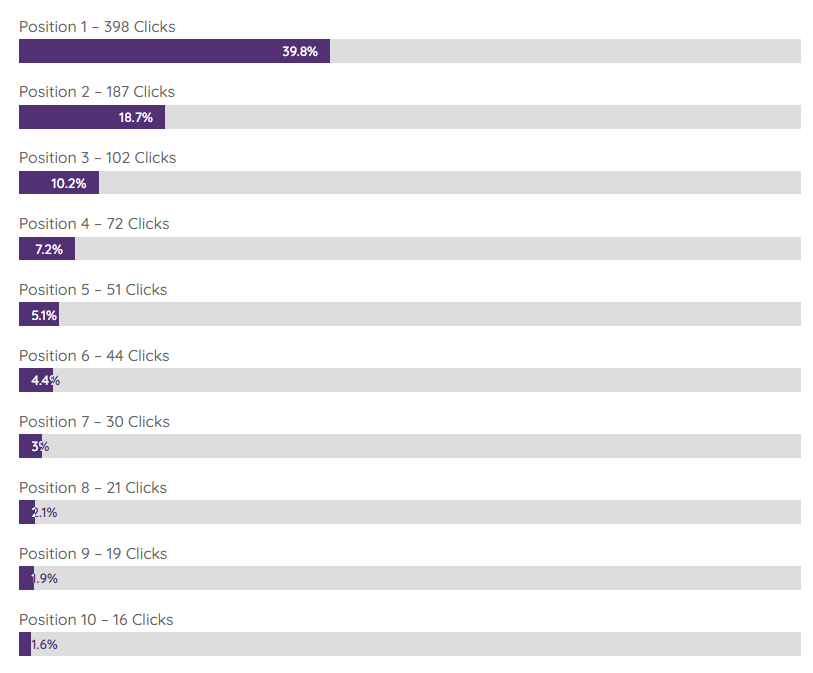
Let’s look at the data:
Backlinko looked at lots of Google data and their information was updated in May 2023.
| Google Position | Click-Through Rate in % | Monthly website clicks you’d get if 1,000 people search for a keyphrase per month |
| 1 | 39.8% | 398 |
| 2 | 18.7% | 187 |
| 3 | 10.2% | 102 |
| 4 | 7.2% | 72 |
| 5 | 5.1% | 51 |
| 6 | 4.4% | 44 |
| 7 | 3% | 30 |
| 8 | 2.1% | 21 |
| 9 | 1.9% | 19 |
| 10 | 1.6% | 16 |
You can clearly see who gets the most clicks ⬇️⬇️⬇️.
Here’s the good news: You don’t need thousands of website visitors every month to build your business!
If your website works well, you have informative, helpful, and relevant website content and clear calls to action, you can start getting enquiries from very few monthly website visitors!
For example, the proposal photography pages on my photography website pull in approximately 120 monthly visitors, generating 10-15 enquiries every month!
Also, the above numbers are just for one key phrase. If your website had 200 hundred key phrases ranking in position 5, you’d be getting over 10,000 free visitors a month from Google!
The above numbers are just for 1 key phrase. If your website had 200 hundred key phrases ranking in position 5, you'd be getting over 10,000 free visitors a month from Google,
Every page on your website and every blog post needs to be optimised around ONE key phrase!
This might sound strange when you first hear it.
If you use the same keyphrase on different pages and blog post on your website with the hope for higher rankings – this will be completely counterproductive!
Google does not rank websites! Google ranks web PAGES!
Therefore, every page needs to cover one subject REALLY well.
Furthermore, you need to indicate to Google what this particular page is all about.
You “indicate” this by using your main keyword in Headline 1 and also in the URL of your page or blog post.
First, you decide which keyphrase you want to rank for in Google, and then you add more keywords and keyphrases on your particular page or blog post that support the main keyphrase you want to rank for.
Therefore, optimising for one keyphrase does not mean adding this keyphrase hundreds of times on the same page. It means adding the exact keyphrase a few times and then adding more keyphrases that are similar in meaning and also others that support the subject.
So for this blog post, keyphrases with a similar meaning are:
- How do you know if a keyword is too competitive to rank for
- How do I know what keywords to rank for
- How do you know if a keyword is competitive
As you can see, all three things mean a similar thing.
When I started writing this blog post, my “working title” was this:
How to find out if you can rank for a keyword without using expensive SEO software
I then entered this in Google, and it told me that people actually search for “How do you know if a keyword is too competitive to rank for”.
What is search intent (don’t skip this bit)
People use Google for 4 reasons:
- Informational: they want to learn something, usually questions (e.g. “What is…”, “How to….”)
- Commercial: they want to research before deciding to buy (e.g. “best washing machine”, “gas central heating vs. infrared central heating”)
- Navigational: They are looking for a specific thing, which might be an actual physical location or an online location (e.g. “Reddit Login”, “Nearest petrol station”)
- Transactional: they want to buy something (e.g. “buy AEG washing machine”)
Google KNOWS what the person’s intention is by simply checking the keyword. You can easily piggyback on Google’s wisdom!
Google usually provides enough information (for free) to find out what you can rank for
So here’s what to do.
- Decide on your keyphrase
- Enter the keyphrase in Google
- Look at the search results
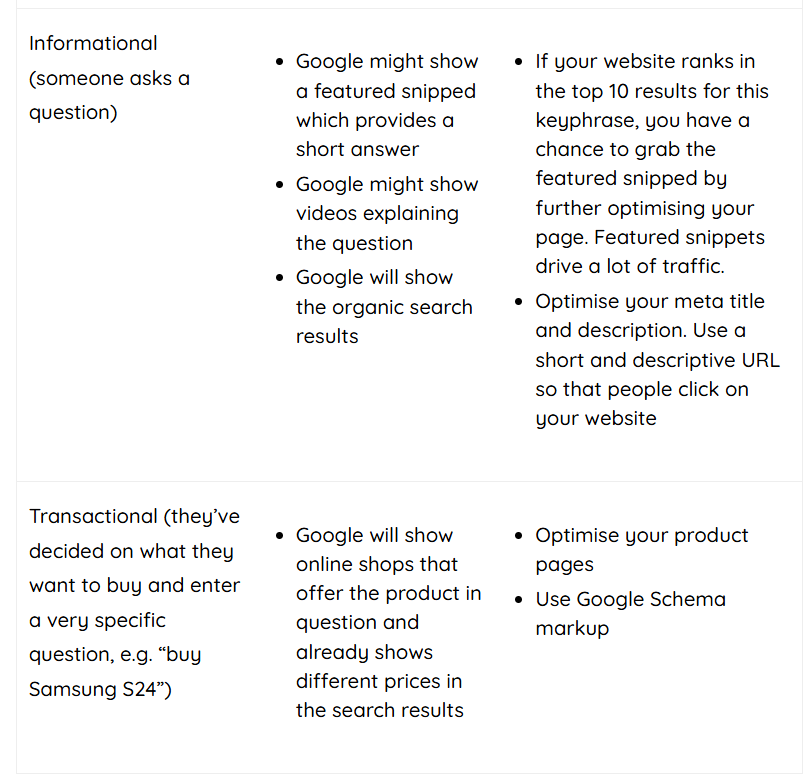
| Your key phrase is | Google will show | What you need to do |
| Commercial |
|
|
| Navigational (physical location) |
|
|
| Navigational (online location) |
|
|
| Informational (someone asks a question) |
|
|
| Transactional (they’ve decided on what they want to buy and enter a very specific question, e.g. “buy Samsung S24”) |
|
|
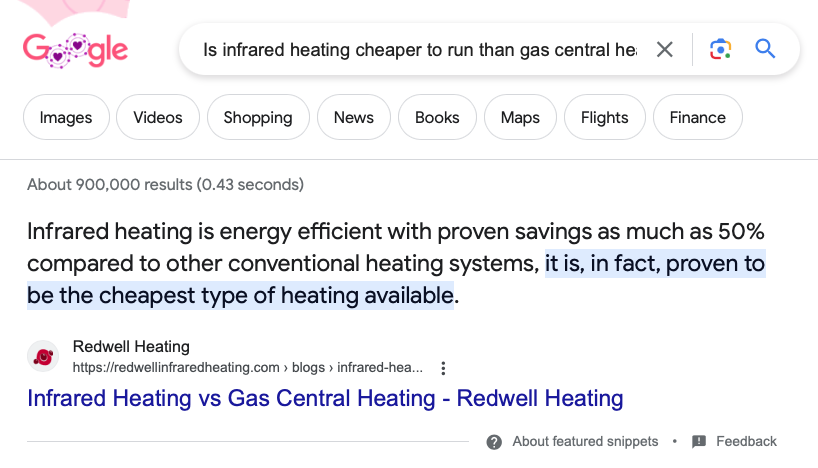
Here’s an example of a Google Featured Snippet
How do I know if a key phrase is too competitive for me?
Let’s say you want to rank for “best outdoor shoes”.
Your search intent is informational (but Google might already show shoe product pages).
Check the top 10 results. Which companies are ranking for this keyphrase?
If the top 10 results are “owned” by your industry’s giants, and Amazon, and your website is still in its infancy, you may want to amend the key phrase to include more words.
Generally speaking, the fewer words your key phrase contains, the harder it will be to rank for. There might be instances where you’ve found a key phrase with only 2 words, and you have a chance to rank, but this is unlikely in most cases.
Another thing to understand is that the more words someone enters in Google, the closer they are to making a buying decision (for commercial intent!)
Let’s stick with the “best outdoor shoes” example. You’ve realised it’s too difficult to rank for, and the industry giants own the top spots in Google. You can amend this keyword to the following:
- Best leather walking shoes for women
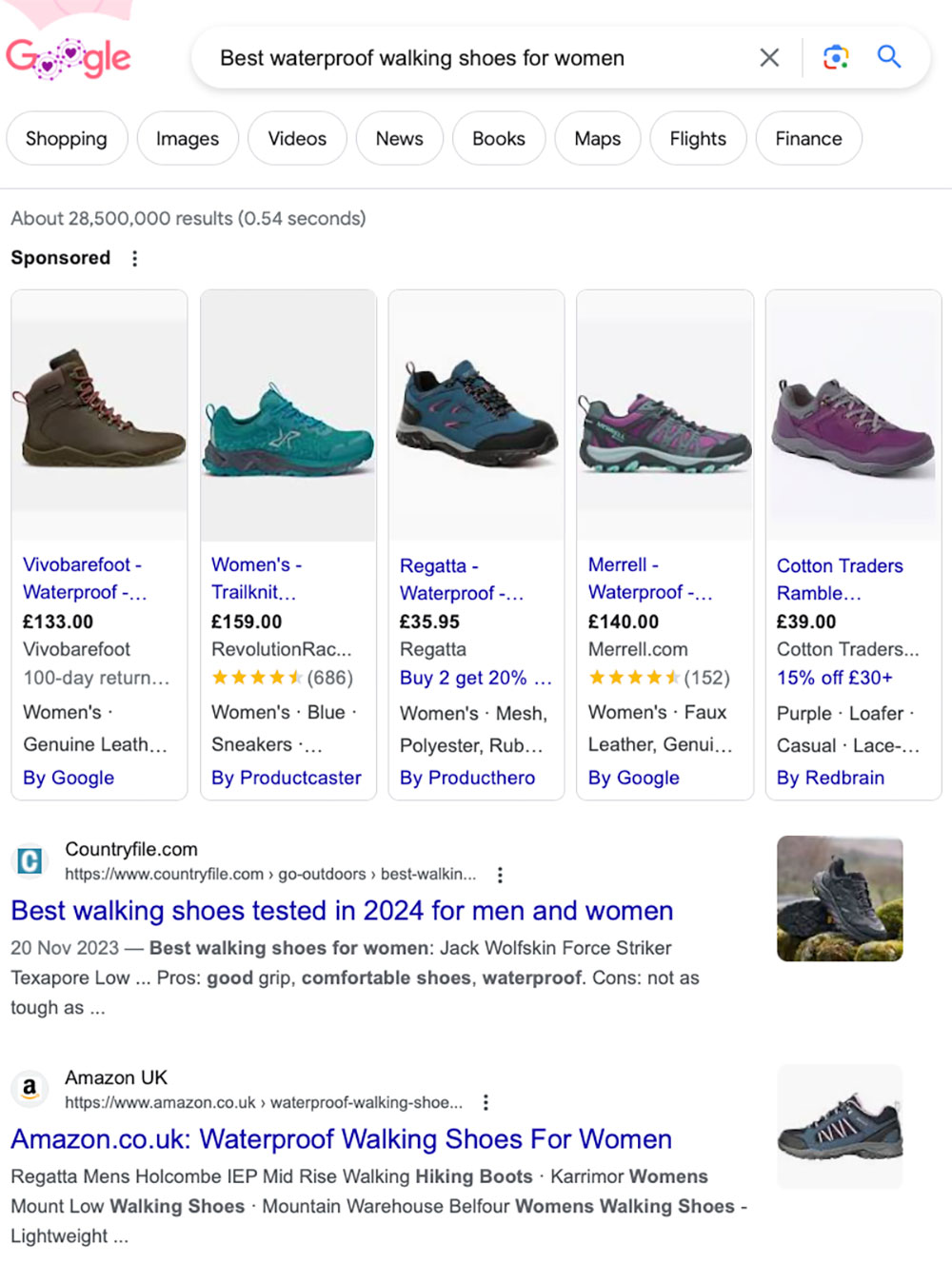
- Best waterproof walking shoes for women
- Best lightweight waterproof walking shoes for women
As you can see, more keywords give you a much better opportunity to rank in Google and drive traffic to your website. Check the top 10 results for each key phrase and see who owns these 10 spots.
Can you squeeze your way into the top 10?
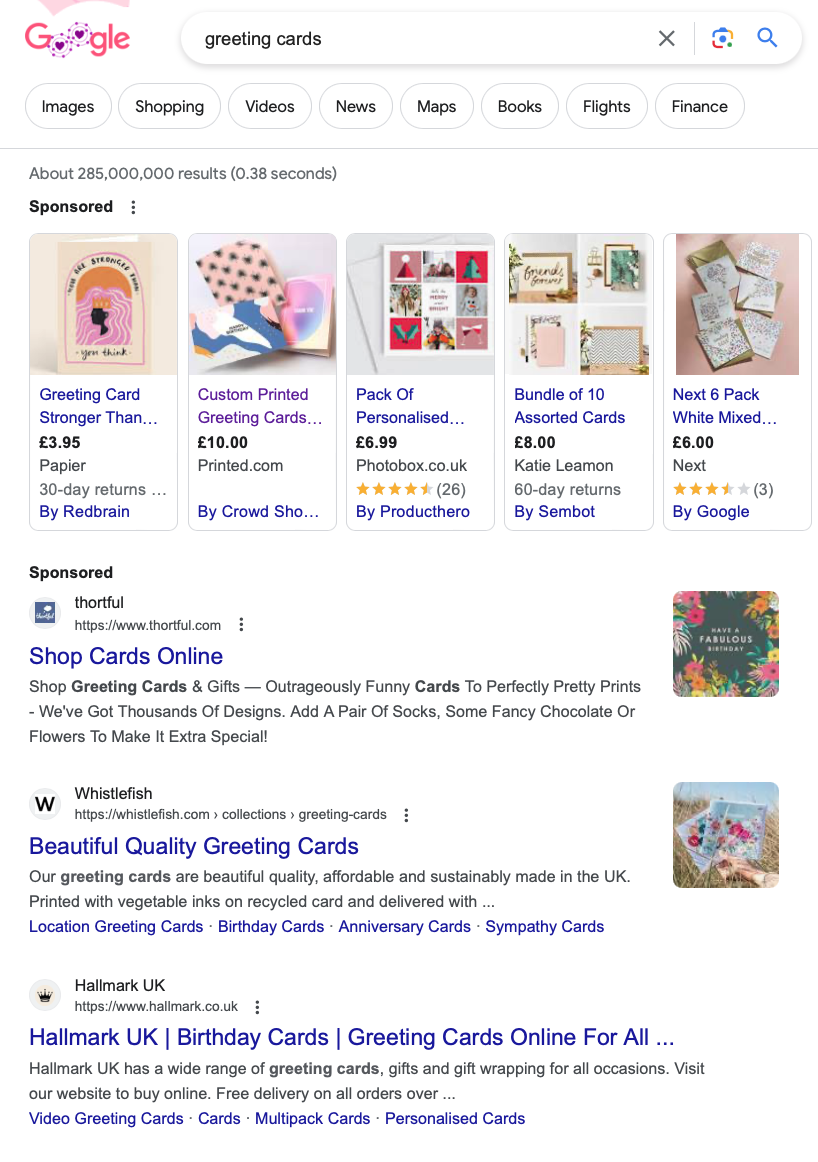
If you enter a keyword in Google, and you see a list of several ads - this is another indicator for a highly competitive keyword!
Check this Google screenshot. There are many ads before the organic search results
How to find a “pot of gold” in Google
Let’s say you’re blogging about an informational key phrase. Like this blog post, the key phrase is “How do you know if a keyword is too competitive to rank for?”
If you find the website “Reddit” in the top 10 search results, you’ve struck Gold!
If Reddit is displayed high in the results, no one has answered this question correctly on their website. This is a good chance to quickly rank in Google by providing a great and helpful answer to your website visitors.
You can then jump into Reddit and reply to the question with a part of your blog post and then post a link to your blog post for people to find out more.
Be careful randomly posting a link to your website on Reddit – this is frowned upon and seen as self-promotion. So always lead with helpful advice first before posting a link!
You’ve done your keyword research. What now?
- Do your keyword research for every blog post you publish on your website.
- Plan a keyword research time block every six months.
- With your findings, build a content plan around the keywords you’ve found.
- Publish Blog posts regularly.
- Monitor your keyword rankings in the Google Search Console
- Improve “low hanging fruit” – i.e. the keywords which are already ranking in the top 10 or are close to the top 10. Optimise the pages and you will push them further up the ranks – attracting more visitors to your website.
- Monitor the development of keywords over time. With seasonal changes and cultural changes, keywords can change over time too.
- Use the words to describe your products and services that your customers use. Use Google Trends to compare your chosen word with common alternatives and make a decision based on data.
Learn how to write a blog article that ranks in Google and is found in AI
What is a low competition keyword?
A low competition keyword is like a hidden treasure in a big game.
It’s a word or phrase that not many websites are using, but still, some people are searching for it on the internet.
Because fewer websites use this word, it’s easier for your website to be one of the top ones listed when someone searches for that keyword on Google.
What does keyword difficulty mean?
Keyword difficulty is like a game level. It tells you how hard it will be to rank high on Google for a specific word or phrase.
If the keyword difficulty is high, it’s like a hard level in a game, because many other websites are also trying to be the top result for that keyword. A low keyword difficulty means fewer websites are trying for that keyword, making it easier for your website to rank higher, like an easier level in the game.
What does a keyword research tool do?
It can provide keyword suggestions, look at a specific competitor keyword and find the right keyword for a particular type of content – as part of your SEO strategy and content marketing strategy.
Even a free keyword tool can help you find a specific keyword, related keyword or keyword opportunity which might give you a better search engine result.
More advanced tools can highlight what’s called a keyword gap. This report will show you the competitor keywords your competitors rank for in the search result, but your website does not cover a specific topic.
A keyword tool designed to identify what people type into search engines, offering insights like search volume and keyword difficulty score.
Additionally, an SEO tool, often available as a free keyword tool, suggests related keywords and long tail keywords and helping you expand your keyword idea pool.
It’s a key asset for any SEO expert for evaluating keyword difficulty, using a keyword difficulty checker to assess ranking challenges.
With its help, you can pinpoint keyword opportunities, target keywords, competitor keywords, and specific organic keywords, making your website more discoverable on search engines like Google.
What does keyword competition mean?
Keyword competition means how many websites are trying to rank for the same word or phrase in search engines like Google.
Imagine a popular toy at Christmas; lots of people want to buy it, so many stores compete to sell it.
Similarly, if many websites use the same keyword, they are all competing to appear at the top of Google’s search results when someone searches for that keyword. High competition keywords are like popular toys, with many websites trying to get noticed for them.
What does search volume mean?
Search volume means how many times people are searching for a specific word or phrase on search engines like Google within a certain period, usually a month.
Search volume is the number of people who ask the same question.
A high search volume means a lot of people are looking for that word or phrase, while a low search volume means fewer people are searching for it. This information helps in understanding how popular or in demand certain search terms are.