Quick summary
A subdomain appears before your main domain, such as shop.example.com. Use one for a separate shop, booking system, customer portal or software platform. Keep ordinary pages and blog posts on your main website.
You have probably used a subdomain without giving it much thought.
You may have visited support.example.com to find help, shop.example.com to buy something, or login.example.com to access an online account. These addresses clearly belong to the same company, but they may lead to completely different websites or systems.
Say your business website is example.com. You have just added an online shop, but it runs on different software from the rest of the website. You could give the shop the address shop.example.com.
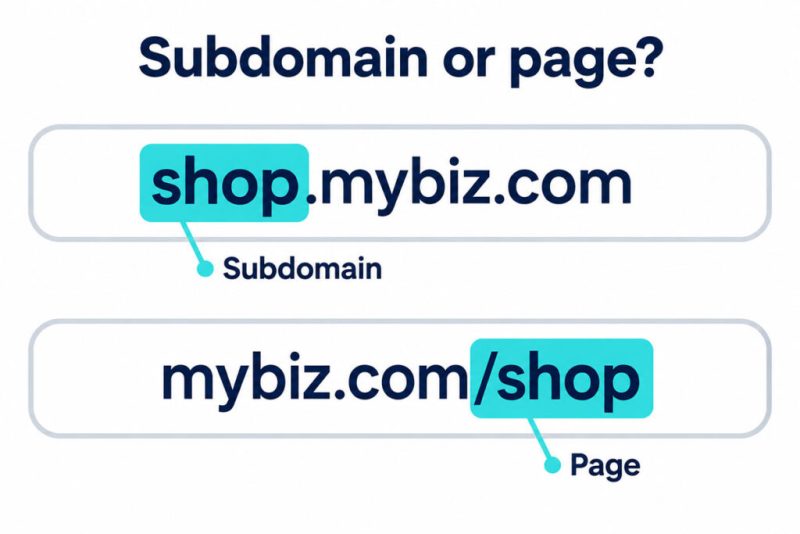
Take the address shop.mybiz.com. The main domain is mybiz.com, and shop is the subdomain.
Here is the key point: where does shop appear?
At the front, as in shop.mybiz.com, it is a subdomain. After the slash, as in mybiz.com/shop, it is a page on your website.
What is a subdomain?
Look at shop.mybiz.com. See the word shop at the front? That is the subdomain.
Swap shop for support and you get support.mybiz.com. Now the address can take customers to your help centre instead.
The words shop and support appear before the main domain. They tell your browser you want to visit a particular area or service within that organisation.
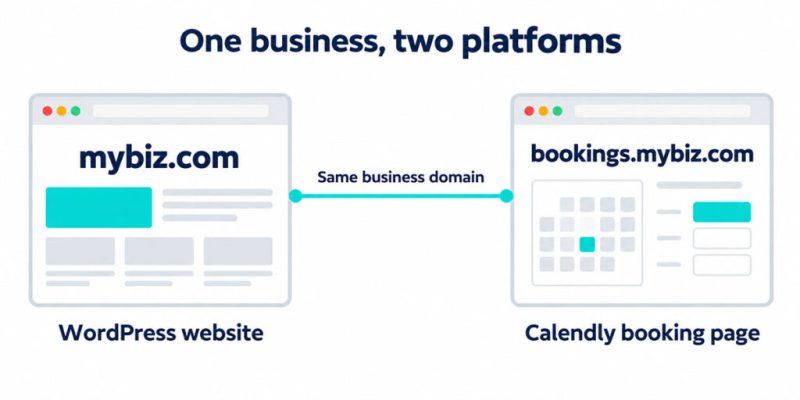
A subdomain is part of your main domain name, but you can point it to a location that’s different to your website. For example, your website might run on WordPress while a subdomain opens your shop, booking system or customer portal.
You do not normally need to buy a subdomain. Once you own the main domain, you can create addresses beneath it, such as shop.example.com or members.example.com.
You still need somewhere for the subdomain to point to. That could be an existing hosting account, a separate website or a paid service such as an e-commerce, booking or membership platform.
What is the difference between a domain, subdomain and slug?
The easiest way to understand the difference is to compare two web addresses:
- example.com/shop
- shop.example.com
They look similar, but they are structured very differently.
In example.com/shop, the word shop comes after the domain. It is part of the page address. This final identifying part of a page address is commonly called the slug.
In shop.example.com, the word shop comes before the main domain. It is a subdomain.
| example.com | Main domain | The main website |
| example.com/about | Page using the slug about | An ordinary page on the main website |
| example.com/services/web-design | Page using the slug web-design | A page within the Services section |
| shop.example.com | Subdomain | A separate shop, website or system |
| login.example.com | Subdomain | A separate login area or online application |
A slug helps organise pages within a website. A subdomain can separate one website, platform or function from another.
The most useful rule is this:
If it is another page on the same website, use a normal page address. If it is a distinct website, platform or system, a subdomain may make sense.
Is a subdomain a separate website?
It can be, but it does not have to be.
A business might use shop.example.com for a completely separate ecommerce website. It might have its own design, pages, products, hosting and administration area.
Bookings are a good example. Keep your website on WordPress, put your appointment calendar on Calendly and use bookings.mybiz.com as the link you give to customers.
What are subdomains used for?
There are dozens of possible uses. These are some of the most common ones that businesses and website owners encounter.
1. Software login areas
If you run a software company, you can keep your sales information on example.com and direct existing customers to login.example.com when they need to access their accounts.
2. SaaS applications
HubSpot’s public website sits at hubspot.com. The software itself opens at app.hubspot.com. You will see the second address in your browser whenever you work inside your HubSpot account.
3. Customer portals
Most client portals solve a very ordinary problem: customers lose files and ask for another copy. At portal.mybiz.com, they can sign in and retrieve their own invoices, documents and project information. In many cases, client-management software provides this area.
4. Online shops
Already have a WordPress website but want to use Shopify for the shop? Put Shopify on shop.mybiz.com. Your original website does not have to move.
5. Course and membership areas
Addresses such as academy.example.com, learn.example.com and members.example.com are often used for courses, training videos and members-only material.
The public website can concentrate on attracting new members, while the subdomain provides the content available after someone joins or pays.
6. Help centres and knowledge bases
A growing help library can quickly become much larger than an ordinary FAQ page. Placing it at help.example.com or support.example.com gives customers an obvious place to find instructions, search support articles and raise a request.
Your customers can access support.mybiz.com and land in Zendesk, where you have published the setup guide they need. Your main WordPress website is not involved.
7. Booking and scheduling systems
A subdomain such as book.example.com can connect visitors to an appointment or reservation system.
This works well for consultants, hotels, attractions, therapists and service businesses that use external booking software.
8. Campaign and sign-up pages
A business might create offer.example.com, join.example.com or events.example.com for a focused campaign.
Email and marketing platforms such as Kit can also use a branded subdomain for sign-up forms, creator profiles, link pages and newsletter landing pages. The business retains a recognisable address even though another platform provides the page.
A subdomain is useful here when the campaign is built or managed separately. If it is another page on the existing website, a normal address such as example.com/offer will likely be easier.
9. Staging and development websites
Web designers commonly use addresses such as:
- staging.example.com
- dev.example.com
- test.example.com
These provide somewhere to build a new website or test changes without altering the live site.
The address itself does not make the site private. A staging website should be properly protected so that customers, search engines and unwanted visitors cannot wander into it.
10. Demonstration websites
If you’re selling software or an app and want to show potential customers how it works, you can send them to demo.mybiz.com. The demo can use sample users, such as Jane Bloggs, who do not exist. Potential clients can click around, make mistakes and start again without causing a problem.
Larger organisations sometimes use addresses such as:
- uk.example.com
- de.example.com
- fr.example.com
Each subdomain can have its own language, products and regional information.
This is not always the best choice for a smaller website. Language sections such as example.com/de/ can be simpler to maintain and may make it easier to consolidate the website’s search visibility.
11. Staff systems and company intranets
An address such as staff.example.com might lead to internal documents, training, rotas or company systems.
Again, an unadvertised address does not secure something. If the content is private, it needs a proper login and access controls.
12. Individual client areas
Some software platforms create a separate subdomain for every customer, such as clientone.example.com and clienttwo.example.com.
When someone visits their organisation’s address, the platform knows which company they belong to and can display the correct branding, users, settings and information.
13. Blogs and online publications
I wouldn’t recommend using blog.mybiz.com for a small business. Simply put your blog at mybiz.com/blog. All your blog posts are then within your main website and support the services you want to rank for.
A subdomain makes more sense when the blog is a very large, separate publication or cannot run on your existing website.
14. Developer documentation
Bigger software companies often publish technical guides, PDFs, and help files at developers.example.com or docs.example.com. These areas may contain setup instructions, code examples and product references intended for developers rather than ordinary customers.
15. File downloads and transfers
An address such as downloads.example.com or files.example.com can be used for reports, software, large files or customer downloads.
The files may be stored on an entirely different service while the address still carries the company’s name.
16. Images and other website media
Large websites sometimes deliver images, videos and downloadable assets through media.example.com or cdn.example.com.
Most small business owners will never need to create this themselves. It is usually part of the way a web developer or hosting provider improves the delivery of a busy website.
17. Service status pages – a subdomain is often better
Large companies often have a separate status page that lets customers find information during an outage; for example, BT, Virgin Media, and mobile phone companies have such pages. It tells customers when a service is experiencing a fault or undergoing maintenance.
If your booking system goes down at 9 am, customers often search Google to see if their service is down. Google might then refer them to the service status page, for example status.mybiz.com, so they don’t have to phone the service provider.
18. Marketing emails
You can use a subdomain for newsletter sign-up pages. Platforms such as Mailchimp and Kit let you connect an address such as newsletter.mybiz.com to a page hosted on their system. Search the platform’s help section for “subdomain” to find its setup instructions.
Can you host a subdomain somewhere else?
Yes, and this is one of the main reasons subdomains are so useful.
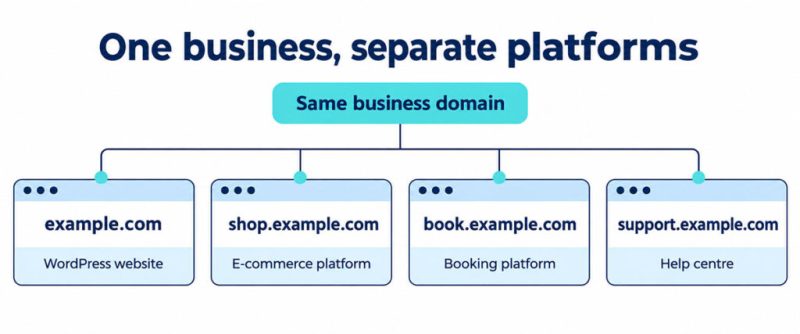
Imagine a business with the following setup:
- example.com contains its WordPress website.
- shop.example.com opens a shop hosted by an e-commerce provider.
- book.example.com opens an external booking system.
- support.example.com opens a help centre hosted elsewhere.
To the user, everything still looks like it’s connected to the same business. Behind the scenes, however, each service can be supplied and managed separately.
The business does not need to squeeze every function into one website or move its main site whenever it adopts a new platform.
Can people find a subdomain if it is not linked from the website?
Possibly. Never treat an unlinked subdomain as secret.
Automated services scan the internet continuously. Subdomains may also appear in public records created when you secure a website. Common names such as admin, test, staging and login are easy to guess.
I regularly come across staging websites left open because nobody expected them to be found. Add a password as soon as you create yours. Removing it from the menu will not keep bots out.
Are subdomains bad for SEO?
Subdomains are not automatically bad for SEO. Search engines can crawl and rank them.
The issue is that a subdomain can be treated more like a separate website than an ordinary section of the main site. It may need to establish its own relevance, links and reputation rather than benefiting as directly from the main website’s existing strength.
That is why a company blog will often be better at example.com/blog than blog.example.com, particularly when the purpose of the articles is to improve the main website’s search visibility.
The same applies to service pages. example.com/services/web-design makes far more sense than web-design.example.com when web design is simply one of the services offered on the main website.
A subdomain is easier to justify when search rankings are not its main purpose. A customer login, staff portal, support platform or software application has a different job.
Exceptions exist, especially for very large websites. The important point is not to create a subdomain simply because the address looks tidy.
When should you not use a subdomain?
A subdomain is probably unnecessary when:
- You are creating a standard About, Contact or Services page.
- The new content belongs naturally within the main website.
- You want the content to strengthen the main website’s SEO.
- You like how your subdomain looks.
- Adding a different design or changing the navigation can confuse visitors.
- You are using it in place of proper security.
- The activity is a completely separate business with its own name and audience.
I have never seen a good reason to put ordinary pages on separate subdomains. Keep your Contact page at mybiz.com/contact, your About page at mybiz.com/about and your services at mybiz.com/services. They are all part of the same website.
When you should buy a separate domain
If your main business is plumbing and electrical, but you’re a Wedding DJ at the weekend, you really want a separate domain name for your wedding DJ services.
Do I need to pay for separate hosting for my subdomain?
In most cases, you can use your subdomain in your existing web hosting package. However, you can also connect it to an entirely different provider. Good web hosting providers will let you set up subdomains easily in their control panel. It’s a simple process: you enter a word in a field, such as hello, and the rest of your domain is already displayed.
You can deal with the technical setup once you know what you’ll use it for.
I don’t know if I need a subdomain
Ask yourself: Am I creating a page for my existing website? If yes, just add another page or post to your existing website. Such as: mybusiness.com/new-service.
Am I creating a separate tool or system? Then a subdomain may be better.
Frequently asked questions about subdomains
Is www a subdomain?
Yes. In www.example.com, www is technically a subdomain. It became so familiar that most people no longer think of it as one.
Can I have more than one subdomain?
Yes. A business can create several subdomains for different purposes, such as shop.example.com, support.example.com and login.example.com. That does not mean it should create one for every page. Each additional area brings more to manage.
Do I have to pay for every subdomain?
You do not normally pay to register each subdomain. You may have to pay for the hosting, software or external service connected to it.
Can a subdomain have a different design?
Yes. It can look completely different from the main website. Keeping recognisable colours, logos and navigation can reassure visitors that they are still dealing with the same organisation.
Can a subdomain have its own email addresses?
Yes. An organisation can use an address such as bookings@notifications.example.com, although most everyday business email will be easier to recognise at bookings@example.com. Email-sending subdomains are more commonly used behind the scenes by newsletter and notification services.
Is a subdomain private?
No. If it is available on the public internet, assume that people and automated tools can discover it. Protect private areas with appropriate access controls.
Can I point my subdomain to a different website or platform?
Yes. You can easily connect book.mybiz.com to Calendly or shop.mybiz.com to Shopify. These are different hosting environments, but your web address still contains your business name.
Can I move a subdomain later?
Yes. You can do this easily by updating the DNS records. DNS settings for your subdomain.
The short version
A subdomain is an address placed before your main domain, such as shop.example.com. It gives a separate website, platform or service a recognisable address connected to your business.
A slug comes after the domain and identifies a page, such as the contact part of example.com/contact.
Use ordinary page addresses for the content that forms part of your main website. Consider a subdomain for a shop, login area, customer portal, booking system, help centre, software application or other independently managed service.
The fact that you can create a subdomain does not mean you need one. Its purpose is to separate something meaningful, not merely to make a web address look different.