Quick summary
Comments were once a hallmark of blogging. A blog comment promised a two-way conversation where readers could ask questions, share experiences or push back against a blog owner’s ideas. But moderating comment sections takes time and resources, and many large publishers switched off their blog comment section in the mid-2010s because of spam, toxicity, inappropriate content and legal risks (Nieman Lab). Today comment debates extend beyond media sites: small businesses must decide whether feedback should live on their own pages, in the comments section of a blog post, or on social media platforms.
What the data shows
Comments do not drive traffic or backlinks on their own:
- A HubSpot analysis of more than 100,000 blog posts found no correlation between the number of comments a blog article received and the number of page views or incoming links (HubSpot).
- OptinMonster summarised that comments are “nice to have, not a necessity” for traffic, which means blog commenting alone should not be the centre of your SEO efforts (OptinMonster).
User-generated text can contribute to search visibility:
- Neil Patel examined 560 posts on his site and noted that comments added about 3,978 extra words per blog post. Around 26.7% of ranking keywords came from the comment section and those keywords accounted for roughly 16% of search traffic, suggesting a possible SEO benefit when comments are useful and relevant (OptinMonster).
Most comments are spam:
- SEO consultant Brendan Egan observed that 99% of blog comments submitted to small business sites are spam, spammers or attempts to gain backlinks (Simple SEO Group). He also noted receiving hundreds of junk comments per day before removing URL fields from his comment forms.
Consumers read comments:
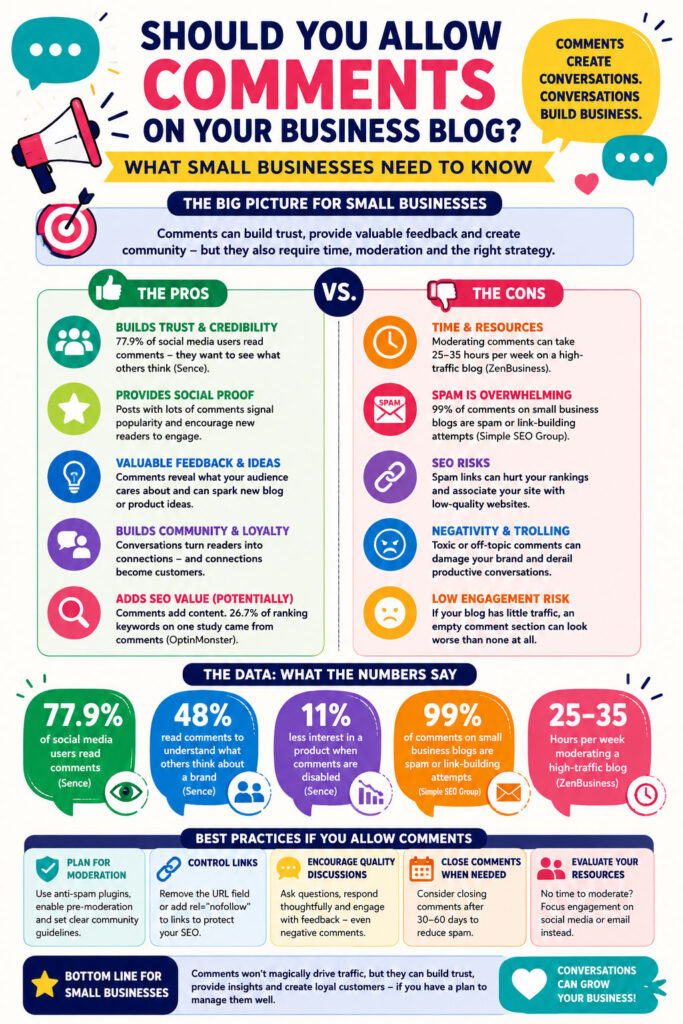
- A 2025 survey cited by Sence found that 77.9% of social media users read comments (Sence). Nearly half of respondents said they read comments to understand what others think about a brand, and disabling comments on marketing posts reduced interest in learning more about a product by 11%.
Moderation workload is real:
- Everett Bogue, who turned off comments on his high-traffic blog, estimated that comment moderation and moderating comments would consume 25–35 hours per week (ZenBusiness).
- For news outlets, moderation often requires dedicated staff; The Times of London ran its comments with a team of six moderators covering 24/7 (Nieman Lab).
Pros of allowing comments
Builds credibility and humanises your brand:
- Allowing comments shows that you welcome feedback. Trevellyan notes that comments help small businesses build rapport and trust with readers, especially when a business owner replies to a genuine comment from a real blog reader (Trevellyan).
- Responding publicly can make a business seem more personable and can show that there is a real person behind the website or WordPress website (ZenBusiness).
Provides social proof:
- Posts with many thoughtful comments signal popularity and spark curiosity (ZenBusiness). Trevellyan also lists social proof as a key benefit because readers notice when many others engage, especially if a good comment adds more value than the usual “great post” reply (Trevellyan).
Offers feedback and content ideas:
- Comments can reveal what topics resonate with your audience and suggest new post ideas, related posts or recent posts (Trevellyan).
- Pat Flynn argues that comments help bloggers understand what readers want and even shape future services, products or a future guest post topic (ZenBusiness).
Fosters community and loyalty:
- Comment sections allow readers to converse with each other, creating a sense of community around a blog post or WordPress blog (Trevellyan).
- Engaging with comments can also encourage users to subscribe, enquire, purchase later or return to the blog comment section for future discussions (ZenBusiness).
Adds user-generated content:
- Quality comments contribute additional text and keywords, which may provide small SEO benefits when the commenter has added something useful and relevant (OptinMonster).
Cons of allowing comments
Moderation is resource-intensive:
- For high-traffic blogs, moderating comments can consume dozens of hours per week, especially when every blog commenter needs to be checked before publishing (ZenBusiness).
- Trevellyan warns that unmoderated comments can damage credibility if you cannot respond promptly or enforce a clear comment policy (Trevellyan).
Spam and low-quality comments:
- Most comments on small business blogs are spam or link-building attempts (Simple SEO Group). Filtering out spam requires plugins, manual review and the discipline to moderate comments before they go live.
Risk of linking to bad sites:
- If spam comments include links, search engines may associate your site with low-quality or malicious websites, potentially harming SEO and your wider SEO efforts (Simple SEO Group).
Potential for negativity and off-topic discussions:
- Comment sections can become toxic or derail into debates unrelated to your content, especially when a negative comment or inappropriate content is left unchecked (Nieman Lab).
- Everett Bogue found that some commenters spent hours starting fights and criticising trivial details, distracting him from his core work (ZenBusiness).
Low engagement on small sites:
- If your website has little traffic, an empty comment section may look worse than none at all. Trevellyan cautions that enabling commenting will not bring in new traffic (Trevellyan).
Trends and industry practice
Major publishers reconsider comments:
- In the mid-2010s, outlets such as Popular Science, the Chicago Sun-Times and NPR disabled comments because of toxicity and cost (Nieman Lab).
- By 2026, some newsrooms are reopening comments for subscribers because of community and revenue benefits. The Washington Post relaunched a moderated comment platform in late 2024 and the Financial Times now uses AI moderation tools to encourage quality discussion.
Transparency builds trust:
- Sence’s analysis shows that consumers react negatively when comments are disabled and that trust and engagement suffer (Sence).
- Brands that actively manage comments often maintain a stronger sales funnel.
Small business blogs often disable comments:
- Many small businesses use WordPress or similar blogging platforms where comments are enabled by default. However, due to spam and limited staff, it is now common to disable comments entirely or require strict moderation on a WordPress website (Simple SEO Group).
Best practices if you choose to allow comments
- Plan for moderation: Set aside time or appoint a team member to review and respond to comments. Use anti-spam plugins such as Akismet and enable pre-moderation so comments are approved before going live.
- Control links: Remove the website URL field or automatically add
rel="nofollow"to links to avoid passing SEO value to questionable sites (Simple SEO Group). - Encourage quality discussions: Ask open-ended questions, respond to genuine feedback and highlight insightful comments. Responding professionally to criticism can improve trust (Sence).
- Close comments after a time window: Closing comments after 30–60 days can reduce spam on older posts while still allowing discussion on new content.
- Evaluate your audience and resources: If your blog receives little traffic or you lack time to moderate, it may be better to disable comments and focus engagement on social media or email instead.
What do blog owners and business owners think?
A quick look at Reddit comments on the subject shows a very clear trend:
- most bloggers, SEO professionals and small business owners now believe blog commenting has little to no direct SEO value in 2026.
- The majority of comments describe blog commenting as outdated, time-consuming and heavily spammed.
- Many users said comment links are usually “nofollow”, meaning they pass little SEO authority, while others warned that low-quality comment spam can even damage your reputation.
- That said, there were a few consistent exceptions. Some users still felt blog comments can be worthwhile when they are genuinely useful, highly relevant and part of a wider marketing strategy.
- Several Redditors said thoughtful comments can still help with networking, niche visibility, referral traffic and relationship building, especially on active blogs with real audiences.
- A common theme was that comments should be treated more like community engagement than link building.
- Another strong trend was that many small business owners have disabled comments entirely because of spam, moderation workload and lack of engagement.
- Others said discussions now happen more naturally on social media platforms, Reddit, Facebook groups or newsletters instead of directly on blog posts.
Overall, Reddit discussions strongly suggest that blog commenting is no longer considered an effective standalone SEO tactic, but can still have value for branding, visibility and audience engagement when done properly.
Should you allow comments on your business blog?
For small businesses, allowing comments on blog posts is a strategic decision rather than a simple yes or no. Research indicates that comments do not directly drive traffic or search rankings (HubSpot), and moderation demands can be significant (ZenBusiness). However, a vibrant comment section can build credibility, provide valuable feedback and strengthen community ties (Trevellyan). If you have the resources to manage spam and foster constructive conversations, enabling comments can enrich your blog. If not, you can disable comments without harming your search performance and instead focus engagement efforts on social media or email.
What we recommend
Unless your website has more than 500 visitors a month, we recommend leaving blog comments disabled. We have seen many small business blogs littered with spam comments and this can look very unprofessional. Users are more used to leaving comments on social media platforms. You can always share your blog posts on social media and then invite comments there.