Just when you thought you understood SEO, along came a whole new collection of acronyms.
GEO. AEO. LLMO. AI SEO.
If you’re a business owner wondering whether you now need four different types of optimisation for your website, the good news is: you don’t.
Most of these terms describe slightly different versions of the same basic goal:
Make it easy for search engines and AI tools to understand your business, trust your information and recommend you when somebody asks a relevant question.
SEO: Search Engine Optimisation
SEO is the one you’ve probably heard of.
Traditionally, SEO is about helping your website appear when someone searches on Google or another search engine.
For example:
“Garage conversion company in Edinburgh”
Good SEO helps Google understand that a particular company offers garage conversions, where it works, what experience it has and whether its website provides a useful answer to that search.
AEO: Answer Engine Optimisation
AEO stands for Answer Engine Optimisation.
Rather than simply trying to appear in a list of search results, the idea is to make your content useful when a search engine needs to provide an actual answer.
For example, you specialise in garage conversions. A potential client might ask this before they’re ready to get in touch:
“Do I need planning permission to convert my garage into a room in Scotland?”
You can help them by providing a blog post that answers their question properly. Provide links to relevant authority websites that support your information. This then has a much better chance of being used by search features that provide direct answers, such as Google AI Overviews.
This isn’t really a radical new idea. Answering your customers’ questions clearly has been good SEO practice for years.
GEO: Generative Engine Optimisation
GEO stands for Generative Engine Optimisation.
This is the term you’ll hear increasingly in relation to ChatGPT, Google AI Overviews, Gemini, Perplexity and other AI tools.
Instead of asking:
“How do I rank number one on Google?”
the question becomes:
“How do I make sure that my business is mentioned by AI when someone asks questions?”
For example, someone might ask in ChatGPT:
“Can you recommend garage conversion companies in Edinburgh with good reviews?”
The goal is to be one of the businesses mentioned.
LLMO: Large Language Model Optimisation
Yes, there’s another one.
LLMO stands for Large Language Model Optimisation and generally refers to making your business and its information easier for large language models such as ChatGPT to understand and use.
You’ll also come across terms such as AI SEO, AI Search Optimisation and Generative AI Optimisation.
Some of these concepts differ, particularly for people working in the SEO industry.
For the average small business owner, however, I wouldn’t lose any sleep over them.
Google isn’t going away, but it has clear guidance on AEO and GEO.
You might think that Google is all about keywords and SEO, but Google’s AI Overviews have dominated the search results since May 2024.
Google’s own guidance says:
“The best practices for SEO remain relevant for AI features in Google Search.”
Check out Google’s guidelines on AI Optimisation here.
Google also confirms that you don’t need to add anything specific to your website to increase your chances of appearing in its AI Overviews or AI Mode. They also say you don’t need special AI markup or new machine-readable files.
Any good SEO practices you have implemented on your website are still the foundation for any future AEO/GEO. The rise of AI didn’t change that. It builds on SEO and good content.
However, bear in mind Google is just talking about Google. Other LLMs (AI apps) might require additional information. Check out my recent blog post about the LLMs text file on your website.
So what should you actually do for your business to get recommended by AI?
On your website, include detailed answers to questions your customers have BEFORE they want to get in touch.
Another thing to remember: your website is not about YOU or YOUR BUSINESS. People don’t visit your website to find out why and when you started the business; they visit because they have a question they need answering.
The one mistake I see ALL THE TIME is that business owners use industry terms on their websites instead of the words their customers actually use to search for them. For example, cake designers call their cakes “celebration cakes,” but a quick Google Trends search shows no one uses that term. People are more likely to search for anniversary or birthday cakes.
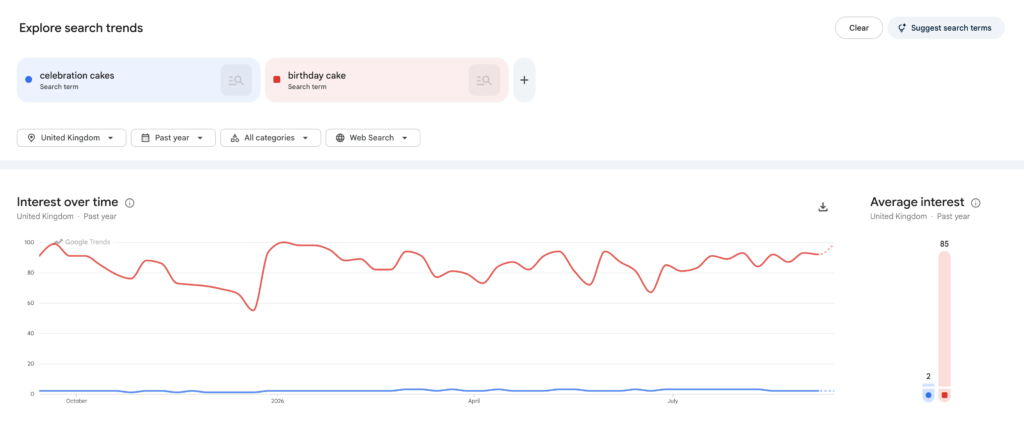
You can use AI to find out what industry terms are used regularly that your customers wouldn’t use. Then check your website for words that might confuse your customers.
Use this prompt in your AI app to find the terms your customers use.
I run a [TYPE OF BUSINESS] in [LOCATION].
Help me identify words and phrases that people in my industry commonly use but that an ordinary customer may not know, understand or search for.
For each one, give me:
- Industry term: The word or phrase someone working in my industry might use.
- Customer term: The simpler word or phrase a potential customer is more likely to use when searching on Google or asking ChatGPT.
- Example search: An example of how a customer might naturally phrase their question or search.
Focus on real customer language rather than technical terminology.
Where possible, distinguish between terms you know are commonly searched and terms that you are only suggesting based on natural language. Do not invent search-volume data.
Present the results in a simple table with the columns:
Industry term | Customer term | Example customer search
See what your customers actually search for by checking the Google Search Console
You can also check **Google Search Console** to see the real words and phrases people have used to find your website.
Go to **Performance → Search results → Queries**.
This shows you the searches where your website appeared in Google, including phrases you might never have thought of yourself. Compare these with the terminology you use on your website. You may spot opportunities to change industry jargon into the language your customers actually use.
Explain what you do clearly. Answer the questions your customers actually ask. Show your experience. Publish useful information that isn’t simply copied or rewritten from everybody else’s website. Keep your business information accurate. Make sure Google can understand and crawl your website.
And don’t forget the real world.
If people talk about your business, review it, link to it, recommend it and mention it elsewhere online, search engines and AI systems have more information available to understand who you are.
The technology behind search is changing enormously.
But the basic job hasn’t changed much, despite all those new acronyms.
Be the best answer to the questions your customers are asking.