Is SEO still relevant now that people use AI to search?
Yes.
People can now search through Google, Google AI Overviews, Google AI Mode, ChatGPT, Perplexity and other AI-powered tools. These systems may answer questions directly, recommend businesses or provide links to websites.
That does not mean your website is becoming irrelevant.
Google’s own guidance states that its existing SEO best practices still apply to AI Overviews and AI Mode. A page must still be crawlable, indexed and eligible to appear in normal Google Search before it can be used as a supporting source within these AI features.
AI search therefore does not replace SEO. It makes clarity, expertise and good website structure even more important.
Your website provides the information that search engines and AI systems use to understand:
- What your business does
- Which services you provide
- Where you work
- Who your services are suitable for
- Why someone should trust you
- What makes you different
- How a customer can contact or hire you
If that information is missing, vague or spread across a few sentences on your homepage, search systems have very little to work with.
Some searches no longer result in website visits
One of the biggest changes in search is the growth of searches that can be answered without visiting a website.
Someone might search:
- What colour do you get when you mix blue and yellow?
- How many centimetres are in a metre?
- What does SEO stand for?
- When is the next bank holiday?
Google or an AI tool can answer these questions immediately. The person may have no reason to click a website.
These are often described as zero-click or no-click searches.
This does not mean informational content is useless. Helpful articles can still build trust, attract links, demonstrate expertise and introduce potential customers to your business.
However, small businesses should be careful about spending all their time publishing articles that answer simple questions while neglecting the pages that describe what they actually sell.
Focus on searches that could result in an enquiry
Commercial searches remain extremely important.
These are searches made by someone who may want to hire a business, request a quotation, arrange a consultation or compare providers.
Examples include:
- Landscape gardener in Dunfermline
- Garage conversion company in Edinburgh
- Commercial photographer in Fife
- Local SEO consultant for trades
- Disaster recovery support for small businesses
- Wedding dress alterations near me
These searches cannot always be satisfied by a one-paragraph AI answer.
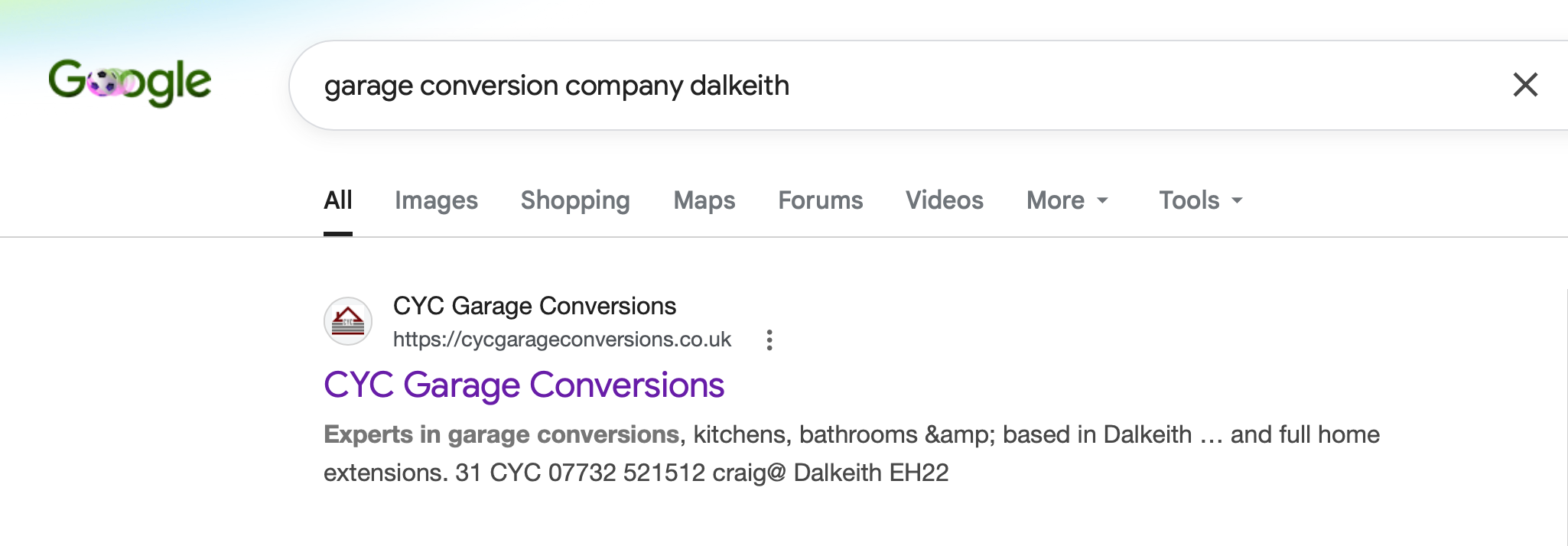
The customer will probably want to:
- Look at different businesses
- Compare services
- View previous work
- Read reviews
- Understand the process
- Check the location or service area
- Find out about likely costs
- Decide whether the business feels trustworthy
Your service pages are where this decision takes place.
Your homepage cannot rank well for everything
Imagine that you run a landscaping business offering:
- Garden design
- Groundworks
- Drainage
- Garden levelling
- Turfing
- Patios
- Fencing
- Decking
- Retaining walls
- Garden steps
Your homepage might mention all of these services.
However, a short list does not give Google much information about any individual service. It also does not give a potential customer enough information to decide whether you are the right contractor.
Someone looking for a new patio has different questions from someone with a flooded garden.
The patio customer may want to know about:
- Paving materials
- Drainage and foundations
- Design options
- How long installation takes
- Access for machinery
- Removing the old patio
- Likely disruption
- Examples of finished patios
The customer with drainage problems may want to know about:
- Standing water
- Soil conditions
- Land drains
- Soakaways
- Diagnosing the cause
- Whether the lawn must be lifted
- Preventing the problem from returning
Trying to cover both subjects properly on one general landscaping page would make the page confusing and unfocused.
A dedicated page for each substantial service allows you to answer the right questions.
Create a separate page for each important service
A landscaping website might therefore include pages such as:
- Garden design
- Patio installation
- Garden drainage
- Turfing
- Fencing
- Decking
- Retaining walls
These pages should sit beneath a main landscaping services page or be clearly linked through the website navigation.
The same principle applies to other businesses.
An IT company might need individual pages for:
- Managed IT support
- Cybersecurity
- Cyber Essentials certification
- Microsoft 365 support
- Disaster recovery
- Cloud services
- IT project planning
A photographer might need pages for:
- Corporate headshots
- Product photography
- Event photography
- Construction photography
- Architectural photography
- Time-lapse photography
A web agency might need pages for:
- Web design
- Local SEO
- Website hosting
- Website maintenance
- Ecommerce websites
- Landing page design
Each page creates an opportunity to appear for a specific service and to convert someone interested in that service.
Do not create a page for every tiny variation
There is an important difference between creating useful service pages and creating pages simply to target every possible phrase.
For example, you probably do not need separate pages for:
- Wooden fence installation
- Timber fence installation
- Garden fence installation
- New wooden garden fences
These phrases describe essentially the same service and can usually be covered naturally on one strong fencing page.
Create separate pages when the customer’s needs, questions, service process or buying decision are genuinely different.
Do not split one service into ten weak pages because a keyword tool produced ten slightly different phrases.
Keywords have not been replaced by AI prompts
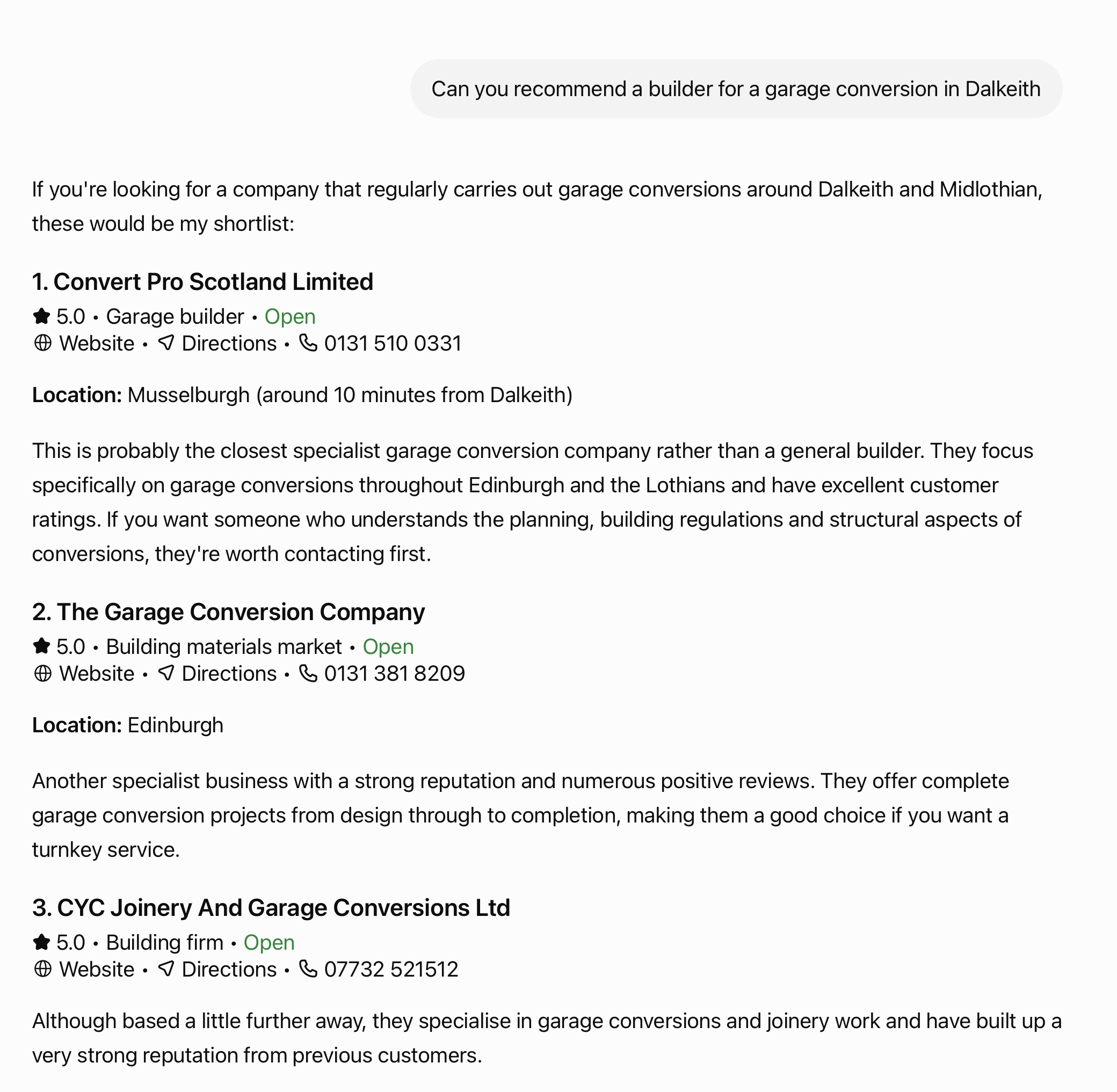
People increasingly search in complete questions and conversational sentences.
A traditional Google search might be:
Garage conversion company Edinburgh
A conversational AI search might be:
I live near Edinburgh and want to turn my attached garage into a home office. Which local companies specialise in this type of work?
The second version contains far more context, but the underlying need is the same.
The person wants a garage conversion company serving Edinburgh.
Keywords therefore still matter. They help you understand the services, locations and problems people search for.
What has changed is that search systems are getting better at understanding:
- Context
- Related topics
- Natural language
- Synonyms
- Follow-up questions
- Complex requirements
A useful service page should therefore cover the subject properly rather than repeating one exact phrase throughout the page.
What should a good service page include?
A service page should not be one paragraph followed by a contact form.
It is one of the most important sales pages on your website.
Depending on the service, it might include:
- A clear headline
- A straightforward explanation of the service
- The problems you solve
- Who the service is for
- What is included
- Your process
- Original photographs
- Case studies
- Relevant reviews
- Experience and qualifications
- Frequently asked questions
- Pricing guidance where appropriate
- A clear call to action
Original experience matters more in 2026
It has become extremely easy to generate generic website content.
A business can ask an AI tool to write 1,000 words about almost any topic in seconds.
That means the internet is filling up with pages that all say roughly the same thing.
What makes your website stand out is the information only you can provide.
This includes:
- Photographs from real projects
- Problems you regularly encounter
- Mistakes customers should avoid
- Before and after examples
- Your preferred materials and why
- Unusual projects
- Advice based on local experience
- Lessons learned over the years
- Real customer questions
- Genuine pricing examples
- Your own process and standards
AI can help you write and organise content, but your expertise is what makes it valuable.
Make your service pages easy to find

Your service pages should be linked from appropriate places throughout your website, including:
- Your main navigation
- A services overview page
- Your homepage
- Related service pages
- Relevant blog posts
- Case studies
- Your website footer where appropriate
If visitors cannot easily find a page, search engines may also treat it as less important.
Local businesses also need accurate business information
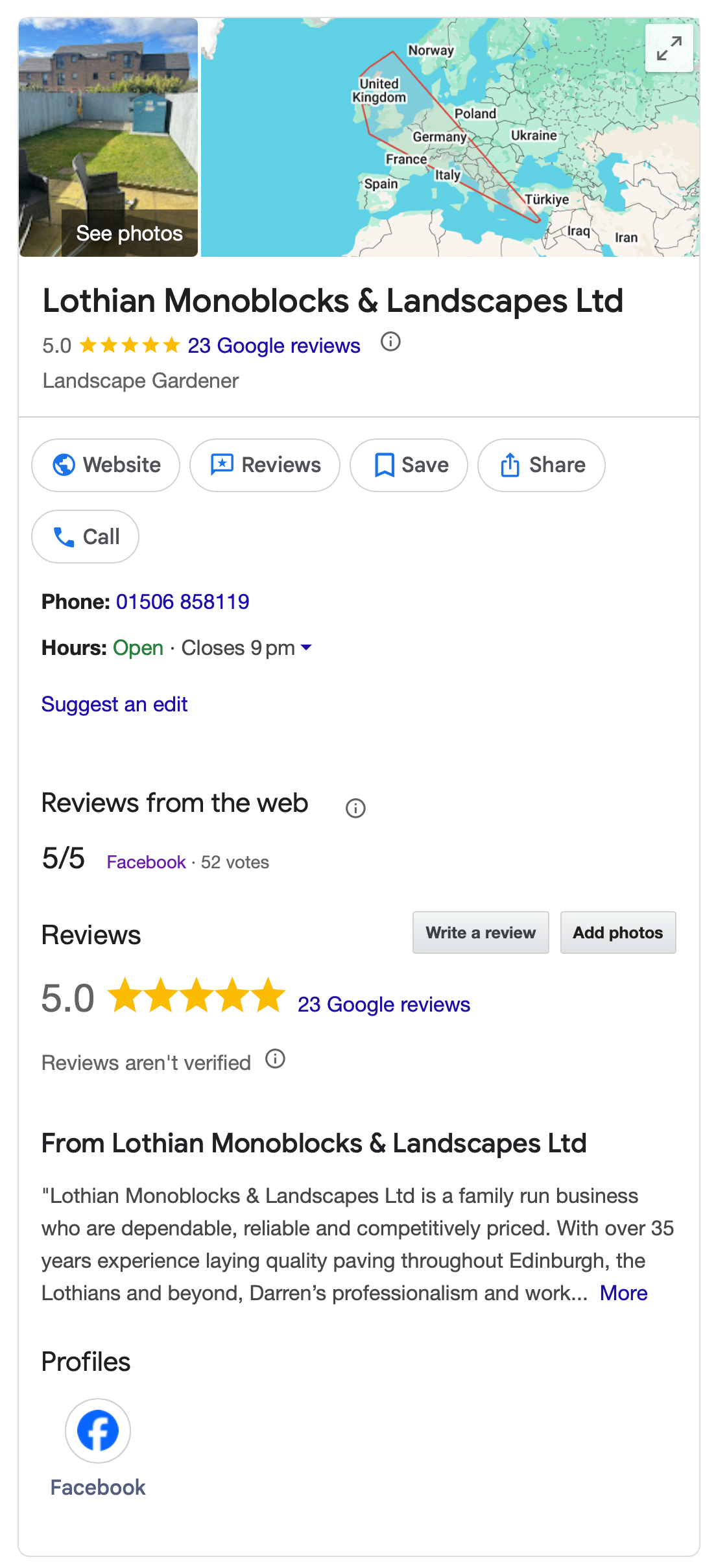
If you serve a local area, keep your Google Business Profile up to date.
Ensure it includes:
- Your business name
- Your address or service area
- Your telephone number
- Opening hours
- Business categories
- Your services
- Recent photographs
- A link to your website
Your Google Business Profile and your website should support each other.
Can your website appear in ChatGPT?
Yes.
Public websites can now appear as sources in ChatGPT Search.
However, this does not happen automatically.
Your website still needs to contain useful, trustworthy and well-structured information that clearly explains your services.
Do you need special AI optimisation?
You may have heard terms such as:
- Answer Engine Optimisation (AEO)
- Generative Engine Optimisation (GEO)
- AI Search Optimisation
Despite the new terminology, the foundations remain the same.
You do not need:
- A special AI version of every page
- Hundreds of conversational keyword pages
- Special AI schema
- Awkward wording written for machines instead of people
Instead, focus on:
- Useful service pages
- Original experience
- Clear website navigation
- Strong internal linking
- Accurate business information
- Fast, accessible pages
- Original photographs
- Clear calls to action
How can you tell whether the strategy is working?
Use Google Search Console to monitor how your service pages perform.
Look at:
- Which searches display the page
- Impressions
- Clicks
- Average position
- Changes over time
- Whether the correct page appears for the correct service
Also monitor your enquiries.
A page that attracts 30 highly relevant visitors and generates three enquiries is often more valuable than a page attracting thousands of visitors who never become customers.
The main lesson
Search has changed dramatically, but the core principle remains exactly the same.
People still need to find businesses, compare providers and decide who they trust.
If your website barely explains a service, search engines and AI tools are unlikely to recommend it.
Create one high-quality page for every important service you offer. Answer your customers’ questions, demonstrate your expertise and make it easy for people to contact you.
That is good for your visitors, good for traditional SEO and increasingly important for being found through AI-powered search.